




















Video
(Click Picture)
French Arrow (Kids)
Making Projectile Points
Survival Quickbow
Another Quickbow
Stone Age Bow 1
Stone Age Bow 2
Stone Age Bow 3
Stone Age Bow 4
Stone Age Bow 5
Stone Age Arrow
Found a good "Archery" link? Let Us Know!
Jump to Section on:
| Archery | Arrow Making | Bow Building | Bowstrings | Crossbows |
| Flint Knapping | History | Hunting | Targets | Tuning |
Archery
Equipment, Equipment Types & Selection | Shooting Styles & Technique | Tips & FAQs | Misc.
How to Select a Compound Bow that's right for YOU Like many products, compound
bows come in a variety of shapes, sizes, colors, and levels of
sophistication. If you’re new to the sport of archery, we’ll guide you
through all the jargon and technical hoopla and help you to make a
better-informed choice on your new bow. No advertising hype or sales pitches
here.
Basic Bow Types Basic facts on long, compound and recurve bows
Basic Recurve Equipment & Setup Common equipment and setup for recurve bows (includes
guidelines for FITA tournaments).
Recurve Bows, Care Of An FAQ on caring for a recurve bow, stringing and string selection.
Stabilizer Main Page To give some idea of how important I think stabilizers are, when advising
newcomers with a limited budget, I always suggest that they invest in a
simple longrod even before they think about sights. Sights can be
improvised, especially for indoor shooting - which is how most beginners
start in the UK - but a stabilizer can’t, and it will produce a bigger
improvement in score than any other ‘optional extra’. In fact, stabilizers
aren't ‘optional’ at all, for any modern bow.
Bow types Bow Selection Tutorial. One of the first considerations of the interested archer or bowhunter is the
proper selection of a bow, listed here are common bow types with short
descriptions.
Martin Cam Systems and Tech Info Click on any of the cam systems to get an overview of that system and what it
can do for you and your bow! To the left you can find spec charts from now into the past for your Martin
products. Just click on what you need to get started. If you cannot find
what you need, or need a little extra help, contact customer service or
visit the Martin Archery Tech Forums to look through previously answered
questions or post your own. See also:
Bow Manuals
Setting Up a Peep Sight A complete guide to installing a peep sight
on your compound bow.
Basic Compound Setup Basic equipment and requirements for Compound bows.
The Archer's Reference Guide (Recurve) A comprehensive guide to recurve archery, published by Balbardie Archers.
Archery Desktop Wallpaper These wallpapers can be downloaded in three different sizes, 640X480, 800X600 and
1024X768 pixels.
Setup a Peepsight &
Calibrate your Sight part of a how to faq
Basic Gear &
Basic Gear-2
Shooting Styles & Technique
Shooting Styles FAQ General tips from other archers on shooting
style and technique.
Target Shyness
Looking for some hints on how to overcome this
problem? - Look no further!
Bowfishing This is a section of the
FAQ for alt.archery.
Shooting a bow Fairly basic, but
interesting info.
Archers Reference A very complete guide to archery in
PDF. The author/editor is
Murray Elliot
Target Archery Overview Summary of the basic principles and
styles of target archery covering equipment and competitions.
UK Archery Rounds A guide to the most popular rounds shot in the UK
including printable charts covering distances and number of arrows at each.
Clout Shooting FAQ All you need to know about clout shooting
Solving Problems with Archery Equipment (Arrow Patterns).
Solving Problems with Shooting Form (Arrow Patterns).
Solving Problems with Shooting Form (Mental).
Tips & FAQs
Beginners Guide all the information you need when starting at archery.
Robert's Rules Of Archery Archery is a challenging sport and
Bob tells you what is important.
Frequently asked archery questions This link is dedicated to topics that
may be frequently asked in the field of archery… Why such a link? Well, one
always needs more than one source of information… And second, this link
tries to achieve a clear and non biased answer to the questions.
Tips and Tricks on Range Estimation
Range estimation can be one of the most frustrating aspects in archery. In
3-D Bowhunting tournaments, an archer who is a very good shot but a very
poor judge of distances, will most probably lose a lot of arrows. Here are a
couple of tips to improve your range-estimation accuracy.
Glossary of Archery Terms: Not all inclusive
Archery Frequently Asked Questions
All the Archery FAQs together. Yikes! Are there really this
many archery FAQ’s? Separated by category - Reference, Construction &
Maintenance, Form(s), Shooting, and Organizational FAQ’s. Check them out!
"The Ten Basic Steps of Archery" A
.GIF series on Stance, Finger Placement, Hand Placement, Bow Arm, Drawing,
Anchoring, Holding, Aiming, Release, and Follow-Through. Easy to follow,
basic primer.
Archery Fitness
Archery fitness consists of three main factors; flexibility, strength &
diet.
Misc. Articles
Primitive Archer Articles. They've gone subscription,
but you can still view their feature article selections here.
The
Art of Archerie By Gervase Markham (1568?-1637)
"The Steel Bow of India (269b.c.)"
Really fascinating article by D. Elmy of ancient steel bow, and even a steel
arrow, from ancient India.
"Observations of the Returning Arrow"
Wild article based on ancient Arab text describes the making and use of an
arrow that returns to the shooter (with deadly intent). The principle idea
was to either nail somebody standing next to you or to let him nail himself
by giving him the arrow to use. Article swears it works!
"The Sling & The Bow Hand" Interesting
article! Want to shoot more accurately? Read this article on the use of a
bow sling.
The Decline of the Longbow
An interesting historical article.
The Archery Tradition of China What can you recall about archery
among a great nation of two billion people with a written history spanning
four thousand years? If it is not a great deal, then don’t blame yourself. A
great tradition has existed in China, and it has died. But literature and
archaeology have left enough strands of DNA for the tradition to be brought
to life again. This is the project that I am engaged in present. © Stephen
Selby, 1997
Concerning the Archery of al-Islam Those familiar with the bows
of al-Islam will know that they bend one way unstrung and the opposite way
when they are strung. And when the bow is strung and held to be shot, the
belly of the bow is towards the archer, and that is horn; the back of the
bow is away from the archer, and that is sinew.
Defensive Archery Techniques The Assyrians along with having the
advantage of iron weapons over their bronze using opponents, made highly
effective use of archery in war. The bow was a primary weapon and of major
importance in their battles. Unlike the armies of Medieval Europe they
provided protection for their archers. This protection was in the form of
teams of shieldmen that were responsible for stopping incoming arrows.
The Mental Game This monograph was created for presentation to
archers engaged in competitive
SCA archery events. It therefore references archery terms, techniques
and equipment. This in no way invalidates the application of these basic
concepts to other forms of competition or training. Note also that I did not
say "target" competition. The basic techniques here are applicable to any
form of competition from archery to salesmanship. There are no champions who
do not take advantage of a variety of these techniques. Hopefully some of
these ideas will help you raise your level of competition as well.
HAFTING AND NATURAL GLUES By Charles
Spear (Bulletin of Primitive Technology, Spring 1994) The methods of hafting
used by 'primitive' man involved natural materials, which by their very
nature resist change contrary to many modern adhesives which deteriorate
over the long haul of time. To greatly overstate the case most natural glues
are the residues of deciduous and coniferous trees and the glues from animal
hide and bones. In the case of deciduous trees I have found black locust,
tulip, white ash, wild cherry, apple to secrete a gummy residue, which are
water-soluble glues. They are quite sticky and dry to a hard tenacious
binding when coupled with fiber wrappings. In addition, when dry they resist
water unless they are soaked.
Back To Top
Arrow Making
General | Modern | Primitive/Wood | Just Fletching | Just Nocking | Just Points | Tuning | Quivers | Misc.
Select your own Arrows part of a how to faq
Modern
Make up a set of Arrows part of a how to faq
Primitive/Wood
Arrow Straightening
by Dick Baugh: The use of heat for manipulating the shape of wood is a
fundamental Stone Age woodworking technique. Heat is and was used initially
to straighten spear and arrow shafts and also for periodic maintenance of
straightness...
Survival Arrows
by Longbow (Alton Safford) In an emergency situation, there are
two ways to make arrows. You can split them out of logs and whittle them
round—the White man’s way. Or you can use tree shoots or river reeds—the
Indian’s way. They both work.
How To Make Wooden Arrows - Alternative Tutorial A guide to making
your own arrows from the beginning.
Arrow making This section of the
archery newsgroup FAQ is a procedure by Rob McNeur for making your own
wooden arrows from scratch. The procedure has been left in the form of
replying to the original request for the information.
Arrow Making From Scratch
The English didn't tend to use Cedar for war arrow shafts as much as
things like oak etc, as they needed a very heavy and strong timber that
would stand the strains of being fired from 100+ lb warbows and impacting
steel plate without shattering. Of course, this wasn't a problem with
hunting bows/arrows, which could be made of lighter timbers.
Arrow Stiffness (Spine) Spine is one of those things that
everyone talks about, but few completely understand. I'll try to provide
some basic information and hopefully won't make too many mistakes.
Care & Maintenance of Wooden Arrows With the minimum of routine
care and maintenance, your wooden arrows should provide you with long and
faithful service. The few areas requiring your attention are all fairly
self-evident, but to remind you.......
Assembling a Wooden Arrow
by Larry Wise
ARROW WOODS and ARROWS Arrows have different work to do, and are,
therefore, made of different woods. Knock-about arrows, beginner's arrows,
roving, field and hunting arrows are made of birch. Better target arrows are
made of imported Norway Pine and Port Orford Cedar. Excellent hunting arrows
are also made of these woods.
Billets and arrows part 1 Wooden arrows crafted with care from
a single block of wood, spined, weighed and matched to the bow. Wooden
shafts, after being rounded and sanded smooth as silk, stained and crested
with your own mark, sealed against moisture and the elements, and finally,
fletched and properly tipped with a point intended for its crafted purpose.
The effort and time invested yields a final product that radiates the warmth
of not one, but a thousand campfires.
The Archery Centre Using the
short blade of the taper-tool, sharpen one end of all the shafts almost to a
point, just like sharpening a pencil, only not right to the end. Put a small
drop of fletching glue on the side of each sharpened point, and put a nock
on each one. Turn each nock round a few times to spread the glue, and then
give it a firm push on...
Arrow Making The art of
arrow making has been around for thousands and thousands of years, dating
back at least 25,000-30,000 years, and maybe even as far back as 100,000
years ago. Ancient Egyptians, Persians, Assyrians, Babylonians, Chinese,
Japanese, Greeks, and Romans all relied on the bow and arrow for hunting as
well as warfare. Soon the bow and arrow became the most important weapon
used across Europe, Eastern Asia, Africa, the Americans, and the Arctic
regions.
Footed Arrows Crafting wooden
arrows can be almost as challenging as making wooden bows. Wooden arrows
embrace mixed emotions of pride, accomplishment and self-reliance in archers
who prefer to make and use them to good effect. For those who are burning to
do so, why not try your hand at crafting a truly fine arrow: the footed
arrow.
a thought on how to straighten wooden arrows
Forum discussions
Just Fletching
Fletching Arrows If you are
shooting your bow all winter, like me, the fletching on your arrows are
probably in pretty tough shape. In this article, I will give you the
down-low on re-fletching arrows.
Arrow Fletching for Hunters
Fletching selection is crucial to accuracy with hunting broadheads. It is
one thing to shoot streamlined, non-veering field points or target points,
and quite another to use fixed- blade broadheads with air-catching flat
surfaces and a potential mind of their own.
Fletching By Hand
by Jon Jeffer: I started to make my own arrows just about the time I
finished my first primitive bows. This may conjure up an image of a guy with
a new bow, looking at it and scratching his head. That was about how that
happened. I had the weapon, but I was missing the ammo! It probably happened
just like that back in the Stone Age!
Fletching Jig
by Mike Richardson: I just came up with a wonderfully simple idea for
fletching arrows or atlatl darts. Now I'm no genius, and I'm sure some
ancestor in the past had to have thought of this, because it works so well,
but it seems to have been lost over time. Maybe there's one of these
fletching jigs in the "Mary Rose," but no one has identified it yet...
Stripping a Feather
by Klaus Appel Arrow fletchings can easily be made from feathers
that are stripped instead of split. The advantages are: (1) It takes only
seconds to strip a feather and much longer to split one. (2) The stripped
feather glues or ties down flush with the arrow shaft, leaving no sharp end
that can cut your knuckle as the arrow leaves the string and skids over the
hand (this assumes you shoot a bow without an arrow shelf).
The Nitty Gritty of Feathers The
most popular feather shape in the US is the Parabolic / Round Back. This
lower profile shape provides quiet, fast and accurate results. The Shield /
Shield Back provides a higher profile for increased stability, forgiveness
and "Traditional" looking appeal. The Magnum / Banana Cut is even more
feather for arrows tipped with larger / heavier broadheads. The Cut Section
/ Full Length feathers are made for Archers to design their own shapes and
sizes by using a feather burner or chopper.
Arrow Feathers - Feather Fletching Guide In general, for hunting
arrows tipped with broadheads, we have found three 5 inch feathers or four 4
inch feathers work well. Light weight carbon arrows have been successfully
fletched with three 4 inch feathers. Due to individual differences in
equipment and shooting style, larger feathers may be required. It is also
possible that good flight can be achieved with smaller feathers. Test
shooting is the best way to decide on any particular set up...
Arrow Fletching FAQ (extract from the
blackboard) For the target
archery disciplines that dominate Sagittarius, fletching pretty much means
Spin Wings. Beyond that, however, there has been endless debate, fueled in
part by the small and reclusive nature of the company that produces Spin
Wings. The issue of the characteristics of the different types and
especially colors of Spin Wings remains unsettled. There is also continued
debate about whether they should be straight or helical, and about how best,
mechanically, to align and attach them.
Arrow Fletching Options
Making your own arrows leads directly to better shooting. Doing it yourself
is the only way to control all the variables that are involved in tuning and
accuracy, and one of the primary variables to consider is fletching.
Dart/Arrow Fletching
As with the straightening process, a dart can be fletched just like an
arrow, and for the same purpose. The fletches help to stabilize the dart in
flight. Fletching can be as simple or as elaborate as you wish. It can be as
simple as tying two feathers on opposite sides of the dart, or three
fletches spaced evenly around the shaft, as with an arrow. It can also be
fletched in the Cherokee styles (two feathers are partially stripped and
bound on either side of the shaft). Turkey, chicken, crow or even grouse
feathers can be used. Do not use feathers from birds of prey, such as
eagles, hawks or owls as federal laws protect these.
Quick arrow and atlatl dart fletch with duct
tape At the 1998 Rabbit Stick
Rendezvous (September in Rexberg, ID) Scott Jones and I were engaged in a
learned dialog on the virtues of river cane, Arundo donax and Japanese arrow
bamboo as shaft material for arrows and atlatl darts and the importance of
tuning the oscillation period of the dart to match the thrower. One of us, I
don't remember who, casually suggested that it would be easy to make a
temporary fletch out of duct tape for a dart. It really works!
Arrow Fletching 101
Just Nocking
Nocking Height
The nocking height is the distance the bottom of the arrow nock above (or
very occasionally, below) the level of the arrow rest.
Michigan Hunting Safety Course - Nocking an Arrow
A nocked arrow should be positioned about a quarter inch above the arrow
rest on the bow handle. On most bows, a small brass band called a "nock
point" is crimped onto the bowstring to mark the correct position.
Just Points
Making Crane Beaks: - Markland-type heads that can be reused.
Making Markland Arrows A modified Markland arrowhead is one that
has a streamlining cone on the back of the head. They fly reasonably well
and usually make enough of a thump when they hit to be noticeable. Please
read this article all the way through before trying this procedure.
Buying Baldar Blunts
California Knapping The shaping
and sharpening of the edge of a struck flake normally involved the technique
of pressure flaking. Pope recorded that Ishi selected one of the pieces of
obsidian he had struck to pressure flake into an arrowhead. It would be
about 3 inches long, 1-1/2 inches wide, 1/2 inch thick and of appropriate
shape and grain. Larger pieces were desirable for a gift or war arrow, a
knife or spear; smaller and flatter for the oval heads he used for bear.
Arrowhead Types and Styles Information on the styles and
materials used to make arrowheads tips and broadheads throughout history.
The types of point to use for different applications are also included
South Carolina Hunting Safety Course - Types of Arrowheads
EFFECTS OF STONE PROJECTILE POINTS AS A
MASS WITHIN THE ATLATL-AND-DART ~ MECHANICAL SYSTEM AND ITS RELATIONSHIP TO
THE BOW-AND-ARROW by William R. Perkins: Very technical, but may be of
some use.
Tuning
Bare Shaft Tuning
An introduction to bare shaft tuning, with
details of how to carry out the process and advantages of it.
Precision Arrow Matching
Technical Tuning Tips Arrows
are usually given a spine rating on arrow spine charts by their
manufacturer. For example Easton produce a chart for all their arrows with
Easton Nocks on them. If you want to change the nock to say a Beiter or
Magnock then this does change the effective spine and tune of your arrow.
Tuning Arrows to Traditional Bows
In the years since I began shooting traditional bows I have sought to
achieve perfect arrow flight as a means of obtaining maximum accuracy. In
the early days, I would spend hours bare shaft tuning a particularly spined
shaft only to discover that after cresting and fletching, the finished arrow
simply did not produce the desired result. To say that I was frustrated was
an understatement.
Archery arrow tuning method and
apparatus - Patent 5902199
Quivers
Quiver Making Guide Make a quiver! Just follow these simple
instructions and you will get a quiver that makes all your friends go wild!
These instructions are for four arrows, but if you want a bigger quiver,
simply use larger measurements.
A 15th Century Italian Quiver In
making such a fine piece of equipment, one can learn many simple but
beautifully effective techniques of the medieval leatherworker. The assembly
is so simple, and modeling such an easily gained skill, that surely others
will find such a project of some merit.
Making A Cloth Quiver
Soon after the first Siloflex arrow was completed it became obvious that
some sort of quiver would be needed to hold and transport the arrows on the
battle field. There were plenty of designs on the internet for traditional
quivers for archery, but nothing was found which could effectively hold
combat archery arrows. Traditional designs were either too small, not strong
enough to hold the arrows, too expensive to make, or too hard to make. So,
this design was created.
Closed Quivers The horse
riding nomads of the Eurasian steppe lived in a harsh environment made more
difficult by their sometimes hostile relationships with their more
sophisticated neighbours to the South and West. Subject to the extremes of a
severe climate and the limitations of their technology, they had to develop
solutions to the special problems of maintaining and carrying their weapons.
When the Scythians burst onto the world stage in the eighth century BC, they
already had their characteristic quiver and bow case combination, the
gorytus, developed to overcome the particular problem posed by archery
equipment. This protected the arrows and the bow in a single case, with the
arrows on one side of a partition and the bows on the other.
Archery QUIVERS Big, sturdy, functional, good traditional looking back quiver.
Plains Style Quiver I used
what is known double-split leather. It has a suede finish on both sides. Not
only is this the cheapest type of leather you can buy, but the soft texture
on the inside surface holds your arrows securely, while the soft outer
surface quiets those unexpected brushes with tree limbs and such.
the_quiver I doubt there is
such a thing as the perfect quiver. But, if you use wooden arrows, two blade
broadheads and are comfortable with around a four arrow capacity, here’s one
that comes close. It’s cheap to make, quiet in the woods and protects your
arrow from broadheads to fletching.
Misc.
Arrow and Bolt Construction This is
intended to provide an introduction to arrow making. I'm sure I've forgotten
something and I also know that for every procedure I mention in here there
are thousands equally good used by others. The best way to learn to make
arrows is to find someone who knows how and ask them to teach you. Watch and
ask questions and you will be rewarded with knowledge and skill and more
information than I have been able to put in here.
Precision Arrow Matching If you have a set of properly matched
arrows you can greatly improve your archery scores. Most archers think that
if they buy a set of matched wood arrows from a supplier that they are fully
matched. However the arrows are only matched in weight (within five grains),
diameter (all five sixteenths or eleven thirty seconds, etc.) and spline
(within five pounds-twenty five to thirty or thirty to thirty five, etc). So
you see that they are not matched exactly.
"Turkish Flight Arrows" Article by
Fred Isles explains the mechanics of the famed Turk long-distance arrows
purported to fly accurate out to 950 feet! Detailed and interesting article
with text and graphics and tables. Enough to produce your own authentic Turk
Arrows.
Ballistic Properties in Ancient Egyptian Arrows A piece on arrow
spine by a non-engineer.
Whistling arrows
The history of the noise making arrow.
Back To Top
Bow Building
"Bows & Arrows - A Chapter In The Evolution Of Archery In America" 1963, by Paul E. Klopsteg. This article, as a first objective, is intended to acquaint the reader with the sports and other pastimes which have to do with the bow and arrow. Among the pastimes, perhaps surprisingly, are the serious theoretical and experimental studies of these ancient implements, which contributed in large measure to the unparalleled increase in their use in this country during the past 30 years. As a second objective, an account of the technological advance which resulted from the studies seems worth presenting, since the development is interesting in its own right and because it is probably unique in sports history.
Self-Longbow plans: according
to Rob McNeur's "General Bow Construction"
Cordage Backed Bow
by Dick Baugh: I had always been intrigued by the meticulous workmanship
that went into Inuit (Eskimo) cordage backed bows. These hunters of the
North put the same craftsmanship into their bows that went into all their
hunting weapons. It was part of their way of showing respect for the animals
which they killed for survival...
A Note on Indian Bow Making or the Secrets of Sinew Revealed by Dick
Baugh: Sinew, the shredded fibers of animal tendon, was used for cordage,
binding points on arrow shafts, and for backing material for bows. Why
sinew? What are its properties which make it so desirable for these uses?
Obviously it is tough and it shrinks when it dries, but how much? A fairly
extensive search of the Stanford library, asking professors of biomechanics,
mechanical engineering, and archeology yielded no useful information. It
looked like I would have to get my hands dirty and do some experiments on
the stuff but first, what did we already know about sinew?
Selfbow Secrets Kind of a Q&A series.
Dimensions of a Hunting Bow &
The Case for Intelligent Design A hunting self bow is a
special kind of bow. I've broken some laminated and backed bows these past
years while I've tried different glues, experimented with tempering bamboo,
played with limb design, worked with patches and tested the limits of wood
faults and stresses. Backed bows can be sexy and curvaceous, especially
these reflexed/deflexed bamboo/osage bows with which I like to play. Their
allure comes from the fast life they live. But they are temperamental and
demanding and you need to keep your wits about you playing with them. The
very fact of their complexity requires it.
Making a Wooden Longbow
Enjoy the photo essay on the basic process of making a wooden bow. From
stave to bow...roughing out the lines, tillering, shaving and shaping, to
finishing and handles. It takes a long time and a lot of bows to become a
master bowyer. And it's fun in the mean time...
Be a Back-to-Basics Bowyer
To craft bows of high quality, all you need is a small workspace, a few
common hand tools, four inexpensive C-clamps, and a woodstove or other
source of heat. Nature will provide the rest of your tools and — if you keep
your weapon strictly primitive — all of your materials.
Osage Kid's Bow I love to
make kid's bows. They are easy to make and make use of small or flawed
pieces of wood that won't make a full-size adult bow. Don't get me wrong,
you should be just as thoughful about making a nice bow for a kid as you
normally would but design can be seriously overbuilt since they often shoot
very light arrows at short ranges and kids aren't nearly as worried about
performance as adults are.
For the First Time Bowyer Part I by Steve Hulsey This article was
written for the first time bowyer; for those of you that want to reach back
in time and know the feeling of harvesting an animal with a bow that you
have made yourself. This article is straight forward and to the point. It
has been solely and specifically written for anyone who has never made a
bow, and deals with only the self-bow made from a single stave of wood. The
explanation and construction of this one specific type of bow will allow the
first-time bowyer to get his feet wet and end up with a lethal hunting bow.
Making an Asiatic Composite Bow
by Markus Klek: What is an Asiatic composite bow? It is the most
sophisticated and technologically advanced type of bow, being made entirely
of natural materials like wood, horn, sinew, and hide or fish glues. These
type of bows have been developed in multiple styles all over Asia and were
in use until slowly replaced by firearms. Several of these bows are still
being made by professionals today...
Making a Bow From a Sapling
Since this is a project that a lot of people are interested in periodically,
I have pulled my thoughts together on this. A bow from a sapling can be as
potent a weapon as you could hope for and will take big game, and can be
made successfully with a minimum of tools.
A Foolproof Method for Bow Tillering
by Dick Baugh (Dec. 28, 2003): The purpose of this article is to present a
simple, systematic method for checking the tiller (evenness of bending) and
draw weight of a wooden bow before you even string it. This is a
quantitative method of doing what an experienced bowyer does in a very
subjective, qualitative way...
Making a Survival Bow by Longbow A bow is not
difficult to make, relative to arrows and string, that is. Really! All you
need is a good knife. However, two knives are better: a machete-like Bowie
and a good pocketknife. Plus, you will need a knife sharpener.
General Bow Construction Answers to many questions that arise when
constructing your own bow, but is also a complete guide to building a
longbow or flat bow.
Manual for Building a 40 lbs. longbow Complete guide to building a
40lbs. longbow, includes easy to follow diagrams for beginners.
Bow Building - A Basic Introduction A straight-forward guide to bow
construction, and also contains a list of which types of wood and their
availability in different locations.
Basic Bow Construction Basic introduction to constructing your own
bow, complete with diagrams.
Bow Finishes A full tutorial to possible finishes to your newly
constructed bow.
General Bow Construction This is a section of the FAQ for
alt.archery. This is intended to give guidelines in the construction of your
own traditional longbow, mainly of the Self-bow style. For those interested
in traditional composite and/or recurved bows, I recommend the
Asiatic-Turkish section of the FAQ.
All Wood Composite: Bow Building 101 This article is for
bowyers who are looking for simplified instructions on building a durable
all wooden bow which is economical and when properly constructed, will out
perform all but the most meticulously crafted and best maintained self bows.
Hickory Backing--The Available Alternative After building self
bows for several years, I slowly became aware of several truths. Many pieces
of wood in my possession can never be self bows. Some are at best
questionable. The wood is too valuable to burn, yet not up to the standard
needed to sell. Consequently, these pieces of wood accumulate and tempt me
daily. In addition, I have made bows too light for anyone to shoot, flawed
due to my lack of patience and haste in trying to produce a shootable bow.
They also accumulate and multiply. How can we resolve this very common and
perplexing situation?
Building a Durable Hickory (White Wood) Bow, Quickly First
off, thank you for taking the time to read this article. I'd also like to
extend my thanks to Paul Comstock and Tim Baker for their patience with me.
You may already have your stave in hand and possibly are wondering where,
exactly, to begin. I hope these instructions are to the point and will be
helpful to you.
Red Mulberry, Its characteristics and application in Wood Bowyery
Now that I've got your attention, let me explain what I 'm talking
about. I am very much aware that Osage and Yew are the best known
traditional bow woods. Some of us however, simply don't have much access to
these historically and admittedly great bow woods.
Follow The Grain, Practical Advice for Working With Osage and Other Woods
Don't be put off or intimidated by the prospect of following the
grain. All you will accomplish by setting a stave in the corner and waiting
until later is waste time. After a bow or two the process of removing the
bark and sapwood, then following the grain the length of your stave, will
take less than 30 minutes in most cases. Go ahead, you can do it.
Primitive Archer | Bow Building & Usage
This is their free article page - updated monthly. For more, you'll have to
subscribe.
"N. American Sioux Indian Archery"
Fairly detailed article by Robert E. Kaiser explains the construction of
Sioux bows & arrows. Includes photos.
Some Speculations on the nature of Longbow strings What were old
strings made of?
Archery and Mathematical Modeling
Enough to keep you busy for a while! Covers the modeling of recurve bows.
On the Mechanics of some Replica Bows
A further investigation on the modeling of bows.
Glossary of archery terms. Less common archery terms explained.
Joe Tapley's Arrow Flight Simulator
This is a piece of software (free to download) with some documentation on
arrow flight simulation.
Ötzi's Bow by Dick Baugh, Vttorio Brizzi & Tim Baker (January 20,
2006): In 1991, the archaeological find of the century was made in the
Ötzaler Alps near the Austrian-Italian border. In addition to Ötzi's body
frozen in the snow there were clothing, tools of stone, copper, bone and
antler and archery equipment. This was a snapshot of the technology of 5,300
years ago. It is a challenge to derive as much information from the scanty
set of data that he left for us. Oh, for a time machine!
Chronology of the Longbow
The Decline of the Longbow Prior to the advent of firearms on the
medieval battlefield the longbow had been all-powerful. Bowmen were infantry
and artillery combined; indeed archers were designated "Artillarie" in Henry
VIII's reign when the Honourable Artillery Company was formed to encourage
the "science and feat of shooting long bowes, cross-bowes and handgonnes".
Unlike hand- gunners, bowmen needed no pikemen to protect them. See also:
The decline of the Longbow
(different)
The English Longbow - (on 'TheBeckoning') Perhaps the first order of
business is to define the longbow. There are many different styles and
materials used in making longbows, but there are a few constants. The
longbow must, of course, be long. It is generally regarded that the bow must
be as tall as the archer to be classified as true longbow, but any bow over
5.5-6 feet in length would also be called a longbow. The bow must also have
straight ends (not recurved). The English longbow has additional
requirements to be traditional. The bow must be wider at the arrow plate
than any other spot on the top limb. Arrow rests are not allowed (though
arrow plates are). The arrow is laid over the top of the forefinger for
shooting.
How to Make A Rattan Bow A rattan bow could easily be made to 30-40
pounds. How strong you get the bow depends very much on the quality of the
rattan and, of course, how thick the limbs are and how long the bow is. The
strongest rattan bow made in Uma was over 70 pounds from peeled rattan.
However, if you use a rattan stick with the skin still on you generally will
get a stronger and more endurable bow. Also available
HERE
Manual for Building a 40 lbs. Longbow More so than
is the case when building an American Flatbow,
the traditional English Longbow requires more skill, as it is much more
inclined to break. The elasticity of the backing and the compressibility of
the belly should be considerable, so that the wood one uses has to meet very
high standards. For thousands of years yew was used to build bows, as its
sapwood possesses a high degree of elasticity and its heartwood can be
compressed without much trouble.
The Medieval English Longbow From the thirteenth until the sixteenth
century, the national weapon of the English army was the longbow. It was
this weapon which conquered Wales and Scotland, gave the English their
victories in the Hundred Years War, and permitted England to replace France
as the foremost military power in Medieval Europe. The longbow was the
machine gun of the Middle Ages: accurate, deadly, possessed of a long-range
and rapid rate of fire, the flight of its missiles was liken to a storm.
Cheap and simple enough for the yeoman to own and master, it made him
superior to a knight on the field of battle. Yet, important as this weapon
was, most of our present day beliefs concerning it are based upon myth.
Oriental Hinged and Take-apart Bows Although the hinged bows one
sees are generally of Chinese origin, specimens from Tibet and Java have
come to light recently, indicating perhaps a distribution of the type by
Chinese traders and colonists.
Steel bows from India Throughout the ages experiments with steel as
a bow material have been made in various countries. The Indians were the
first people, I believe, to have overcome the problems presented by steel
and produced a weapon, which, while it may not have had the cast and range
of its predecessor, the composite bow, was nevertheless a decidedly workable
weapon.
Back To Top
Bowstrings
Making Cordage By Hand ~ Text
and Illustrations by Norm Kidder (Reprinted from the SPT Bulletin of
Primitive Technology, Fall, 1996): Cordage (rope and string) can be made
from many different fibers including (Bast) Dogbane, Milkweed, Nettles,
Hemp, Flax; (Leaves) Cattail, Yucca, Agave, Douglas Iris; (Bark) Willow,
Maple, Basswood, Cedar; (Root) Leather Root, Beach Lupine; (Whole stem)
Tule, straw, Juncus. Each material has specific requirements for extracting
and preparing the fibers, but there are only two basic ways for using the
fibers to make a cord: braiding (or plaiting) and twining. Braiding was
usually done with flat, split materials such as cattail or flattened straw.
The instructions in this article will deal only with twining, specifically
with two ply (S-twist, Z-ply, also called right-handed) cordage.
Cordage fiber shredder made from bone by Dick Baugh © 1996 Get Primitive.
File recovered from now defunct AboTech website and converted to Onsite PDF.
Cordage Materials ~ Sinew
Sinew is made from the ligaments and tendons of an animal's body. The
tendons would come from the animal's hind legs or from along both sides of
the spine beginning at the neck and running just past the ribs.
Grow Your Own Bowstring
by Dick Baugh (5/7/04): It's easy to grow your own flax for bowstrings,
sewing or anything else. Properly processed flax fibers are very strong and
have little stretch, the two most important characteristics for bowstrings.
There are different horticultural varieties of flax, one optimized for seed
production and another optimized for fiber production...
String Making Bow strings are
probably the easiest thing that can be manufactured or customized for a bow.
The most commonly used string is the continuous loop that most people are
using for recurve and compound bows. There are other types, one of which is
called "Flemish Twist" (usually used on traditional longbows, and for now
that's where we will leave it) We will only concentrate on the former.
Essentials of Archery The simplest kind of a bowstring is made of
linen or flax twine prepared especially for this purpose. All that is
required is to splice an "eye" in one end and fasten the string to the bow.
Making Natural Cordage Cordage — that is, thread, string, or
rope — is all but indispensable in a survival situation. It can be used for
(among other things) bowstrings, fishing lines, trap triggers, snares, and
lashings. Most people would likely despair if forced to make their own rope
or string. However, the materials needed to do so are plentiful in most
places (you'll find a list of possible options accompanying this article),
and the techniques required are actually quite simple to master.
A Note on Indian Bow Making or the Secrets of Sinew
Revealed Sinew, the shredded fibers of animal
tendon, was used for cordage, binding points on arrow shafts, and for
backing material for bows. Why sinew? What are its properties which make it
so desirable for these uses? Obviously it is tough and it shrinks when it
dries, but how much? A fairly extensive search of the Stanford library,
asking professors of biomechanics, mechanical engineering, and archeology
yielded no useful information. It looked like I would have to get my hands
dirty and do some experiments on the stuff but first, what did we already
know about sinew?
Making Bow Strings PDF/Adobe Acrobat File. To shoot a bow
you need a string, preferably one made of the new synthetic fibers. But
which type of material will make the best string for my application? How
many strands should I use? What length should I make my string? All of these
questions and more will be answered in this three-part series.
Building Bowstrings By Larry Wise . While most dealers buy ready
made strings from bow or string manufacturers, some make their own to
improve profits or to get the customer’s string replaced quickly when a
particular size isn’t in stock. Customer’s needs for special bowstrings may
demand that you learn to custom make the string that serves those needs. If
so, or if you are just one of those do-it-yourself types of dealers, this
article is for you.
Continuous Loop Bow Strings
PDF/Adobe Acrobat File. In primitive times, bowstrings were made from
raw animal and vegetable fibers, depending on what was available. Later,
linen came into use because it was strong and did not stretch as much as the
earlier fibers; two primary requirements for bowstring material. In fact,
several battles of medieval times may have been won or lost due to the
condition or dampness of the bowstrings. Modern materials in use that are
not as subject to stretch and dampness are standard Dacron B-50, or special
materials such as Fast-Flite string. Care should be used with materials
other than B-50 since many older bows will not hold up to the performance
characteristics of some of the newer materials.
How to Make Your Own Bowstring
The majority of the following is intended for the fabrication of an 'endless
string' style of bowstring, however a 'Flemish' type bowstring is more
appropriate and authentic for traditional bows (longbow and flatbows) and
details for this have been appended at the end.
MAKING A FLEMISH TWIST BOWSTRING by Ron Harris. The techniques I use to make a Flemish Twist
bowstring are not necessarily the only way to do it, but it works for me.
Making a Flemish Twist string is relatively simple. It's sort of like tying
your shoes--easy to do, but difficult to describe and a whole lot easier if
someone shows you how. Also available
HERE
The 'Flemish' bowstring The Flemish style does *not* need a string
jig at all. The Flemish style of bowstring was the style which tended to be
used most often in European bows. Asian and Arabic bowstrings used a
different style totally but will work quite happily with either the Flemish
or Endless strings. See also:
Crafting the Flemish String &
Crafting the "Compact Flemish Jig"
Making a Bow Stringer by THL
Brandon Smythe. A bow stringer is a basic accessory for the archer that can
be made using common materials in a very short time. See also:
Making a Bow Stringer [PDF] Better details.
Traditional Bowstring Making The majority of the following is
intended for the fabrication of an 'endless string' style of bowstring,
however a 'flemish' type bowstring is more appropriate and authentic for
traditional bows (longbow and flatbows) and details for this have been
appended at the end. See also:
Bowstring Making |
Ropemaking - Bowstrings
Make a Bowstring
Part of a how to faq
Native American Visions - Traditional Indian Art and Crafts
Stronger than any thread, sinew is used in both fine and heavy applications;
from sewing quills and beads, to making bows and rope. Genuine sinew used as
thread can be prepared wet or dry. This information sheet describes one
technique using water that will allow you to convert a sinew piece into
threads for future use.
Forest Knights - Sinew preparation from deer leg tendons
Sinews are fine thread-like fibers created from animal tendons. The animal
most commonly used to provide these sinews are members of the deer family
but any mammal could be used if necessary.
Cordage The following is a
partial listing of natural materials which yield good fiber for complete and
other cordage materials may await rediscovery. Information given on when to
harvest plants is intended only as a guideline. Species, climate,
environment, genetics and intended use may all effect when plants can or
should be harvested. Fibers may be cleaned and separated by many methods.
Back To Top
Crossbows
The Crossbow Defined - (on 'The Beckoning')
I am the first to admit that I am rather a novice in the ways of crossbows,
but I will do my best to help you understand the parts of the crossbow, and
help with some terminology surrounding the crossbow. I have also added a
number of terms for regular bows. Some terms apply to both, while others
only apply to one.
Crossbow FAQ: Everything You Need to Know
Crossbow Hunting &
Crossbow Fishing Very short
articles.
Howstuffworks "How Crossbows Work"
The crossbow, a weapon popular with Wookiees, vampire slayers and some
modern hunters, looks like a cross between a bow and a rifle. Like a bow, it
uses a fast-moving string to launch projectiles, but it also has a trigger
and a stock, like a rifle. Based on these similarities, some people may
think that the inventor of the crossbow took pieces from a rifle and
attached them to a bow.
MRNF - Hunting - Crossbows Over the last few years, the use of crossbows for hunting has developed
considerably. Crossbow hunters now have more opportunities to practice this
activity, and more people now have access to hunting, thanks to recent
developments in this field.
Crossbow Aiming and Hunting Techniques Literary and physical evidence
suggest that the crossbow originated in China during the 4th century BC,
though a type of crossbow called the gastraphetes may have been
independently invented in Greece at about the same period. It wasn't until
the 10th or 11th centuries AD that the crossbow became a significant
military weapon in Europe.
Hunting with Pioneer Weapons [PDF] Small pamphlet
Crossbow Regulations Regulations by State 2004-2005
Recurve Crossbows: Why Choose Recurve Crossbows?
Recurve crossbows have been around for literally thousands of years - they
date as far back as 341 BC, in fact. Since that time they've evolved
substantially in design, have become lighter in weight, and are dramatically
more accurate as well.
Crossbow Field Performance. What to expect from your new crossbow..... In
modern day, the crossbow has largely evolved into a weapon for sport and
recreation, but it's fearsome medieval heritage has unfortunately given rise
to some misconceptions. The most common misconception is that a crossbow has
long-range capabilities like a gun. IT DOESN'T!
Barnett Crossbows: Operating Manual - Crossbow Pistols
Ballistics of the Bullet-Shooting Crossbow
The arrow-shooting crossbow has been known since antiquity and was
extensively used in warfare and for hunting during the Middle Ages and
through the Renaissance. In the 16th Century, a two-stringed crossbow was
developed which shot smooth stones, or pellets of baked clay, and was widely
used for birds and small game. These "stone-bows" differed in construction
from regular crossbows in that the center portion of the stock was curved
downward so the stone, held in a pouch between the strings, could fly
freely. The early stone-bows usually had relatively thin metal bows which
were bent (cocked) by hand, as opposed to hunting crossbows which usually
required some mechanical means of cocking them.
Crossbow Connection Magazine - The Magazine for the
Crossbow ... Crossbow Connection
Magazine is the first and the fastest growing crossbow publication dedicated
to the crossbow enthusiast ever! Each issue is filled with many interesting
and informative articles on all phases of crossbow shooting, from hunting to
tournament shooting to crossbow maintenance and tips. We keep you up to date
regarding the latest on crossbow legislation.
Build a Wooden Crossbow Plans
These Popular Mechanics plans are for a wooden crossbow. This
repeating crossbow has all the handling characteristics of a fine
repeating rifle of the slide-action type. In the hands of an experienced
crossbowman it will deliver five shots in five seconds with near-rifle
accuracy over ranges up to 40 yards.
The Classic Crossbow: You Can Build Your Own!
An archer might consider it kin to a firearm ...a shooter, on the other
hand, most likely would think it a stock-mounted bow ...and you wouldn't
need a poll to know the general public's feeling: It looks sinister enough
to be a lethal weapon!
Crossbow FAQ - designing crossbows - maintained by Ausbow
Industries
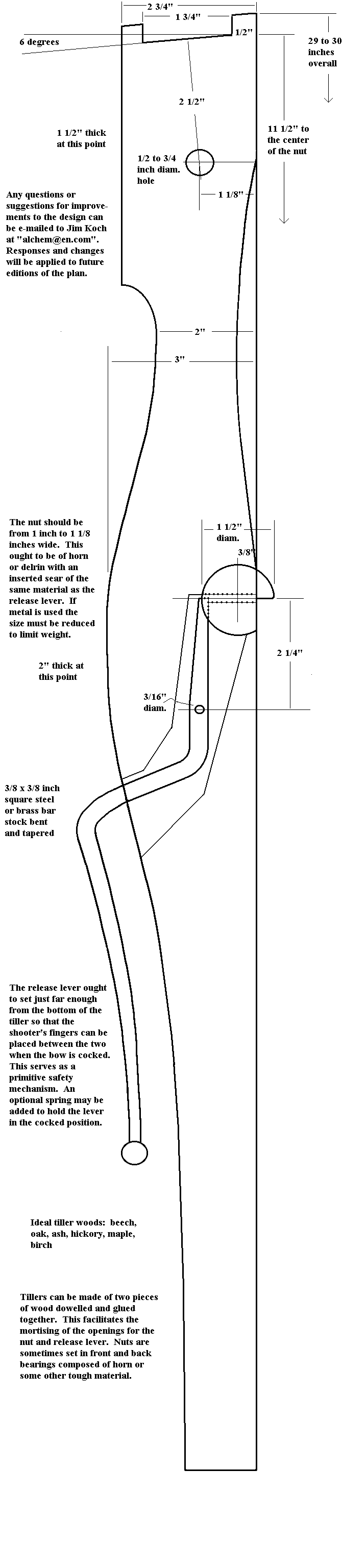
There is a
plan for a medieval crossbow stock and trigger
on Jim
Koch's web site. The .gif was too big for my puny 14" screen, but
printing it out shouldn’t pose any major problem. Or saving it with a
right-click and opening it off-line in a .gif viewer.
Inexpensive 2x4 Combat Crossbow Plans By Wulfric Alemaker.
These things won’t win any beauty contests, but they are an effective
munitions-grade weapon and a great way to get started. All the materials can
be purchased at hardware or farm supply stores, and damaged components are
easily replaced.
Crossbow FAQ Includes a glossary, brief history of the crossbow,
current manufacturers, a reading list of books & periodicals, crossbow
designs, and more. Maintained by Ausbow Industries.
Crossbow Prods Crossbow prods, as used in SCA target shooting, are
generally made from one of three materials. These are fiberglass, aluminum,
and steel. Each material has different characteristics. They are listed
below along with some comments on each...
"Fellwalker" ABD Crossbow Bolts and Arrows
"Fellwalker" anti-bounceback device crossbow bolts began active experimental
combat use in Caid in January of 1998 and were approved as a legal arrow for
SCA-wide use at the April 1999 BOD meeting after successful multikingdom use
at the Estrella War. They are currently used in Caid with heavy (1000 inch
pound maximum) crossbows in heavy rattan combat.
Stefan's Florilegium: Crossbows This file is a collection of various
messages having a common theme that I (Stan) have collected from my reading
of the various computer networks. Some messages date back to 1989, some may
be as recent as yesterday.
About the Stonebow There are a number of weapons similar in design
to the crossbow. A ballista for example, is basically a very heavy crossbow
used as a light siege engine. Of the portable off-shoots of the crossbow
though, the stonebow was debatably the most common. Depending on the source,
the stonebow was first mentioned in Europe in the 14th. century
(Paterson, p. 92), or it was developed circa 1500
(Payne-Gallwey, p. 158). Also available
HERE
Back To Top
Flint Knapping
California Knapping
[5 page article!] by Paul D. Campbell: Eleven thousand years ago Clovis
mammoth hunters ranged over North American and left a record of the
knapper's art in beautifully fluted spearheads, not two exactly the same.
What followed Clovis and the later bison hunting Folsom tradition was much
cruder, yet even these points were often well crafted and certainly
functional and a pleasure to view. After the passing of the big game and the
Paleo-Indian, distinctive regional cultures took form. In California it was
the San Dieguito...
What Tools are Needed and How to Make Them What are the basic tools?
The important tools to have are a billet, hammerstone, abrading stone and a
pressure flaker. That is it! Of course, it is highly recommended to include
a leather pad (one for your hand and one for your leg) and eyeglasses for
protection. You will however find that as your ability grows, so does your
toolbox.
FLINTKNAPPING
As a Lab Deliverable in Experimental Archaeology, for our SBSC 324sl,
Archaeology: From Map to Museum class, at
CSUMB,
we studied and participated in the production of stone tools. Our professor,
Ruben Mendoza, conducted the workshop, and here is a summary of what we
learned!
The Stokes Tool
a slab working tool! This innovative tool really helped me and with
Jim's permission, I want to let others know about it.
Tool Care and Maintenance
help your tools last a lifetime!
I live in Arizona where the climate is quite arid, even indoors. That has
forced me to come up with a standardized procedure to assure that my tools
will last! Here are some suggestions.
Flint Hints and Tips
Tonnes of advice courtesy of Bruce
Mensinger!
Tips for the Beginner
by Johnny Maduzia
Countering Shock
by Doug Land So you've spent the last thirty minutes completing that
nice sized biface using soft hammer percussion, only to strike it in the
middle to detach one last thinning flake and "whack", the biface breaks into
two parts. Frustrated, you lay down your tools and take a break - pondering
the mysteries of stone. Been there - done that?
My Flintknapping Kit My percussion tool
Kit is very basic. I use a combination of modern (copper), and ancient (antler).
Make your own
Copper Bopper Now that you have made a great billet for next to nothing, go get a
few nice spalls and BUST UP some rocks!!!!
Make your own
Pressure Flaker
The different types of
Stonethat I have worked with... and the results.
Tipsthat I have picked up that might help you out.
Cooking Rocks. A long time
ago, the Natives on this Continent learned a wonderful technique. They found
that many types of their favorite tool making stones were much easier to
work after being heated.
Fluting Those Paleo Wonders This series of pics are a composite
of work on 2 different preforms. After each of the flake removals in the
first few pics, remember to clean up the little overhangs just like you do
when making a biface.
Lap Knapping
This page is about one of the hottest and most exciting forms of
Flintknapping being done today. Lapknapping, or Lapidary Knapping, is the
process of first grinding a preform into shape, and then pressure flaking it
to achieve a finished point.
Making a Dalton Point arrowhead.
Back To Top
History
The Medieval English Longbow
Characteristics and origin. An article about the early longbows and how they
came to England.
Oriental Hinged and Take-apart Bows
And you thought the recurve take-down bow was modern?
A Brief History of Archery The discovery of the first stone
arrowheads in Africa tends to indicate that the bow and arrow were invented
there, maybe as early as 50,000 BC. It was probably developed in conjunction
with the invention of the spear thrower. A short bow would be a better
hunting weapon when used to stalk animals in wooded areas, rather than carry
around long spears. The shape of the earliest bows can only be guessed at,
as broken or worn out bows would probably end up on the cooking fire,
reshaped into different tools or just thrown away.
A short history of the English Longbow
The English Longbow, more than any other weapon of its time, was responsible
for vast changes in the nature of medieval warfare. In doing so, it made
England the foremost power in Europe during the 14th and 15th
centuries. England's armies became the most feared units in Europe, and with
good cause. Almost every battle fought was won by an intelligent utilization
of massed archers and men-at-arms. Upon many occasions, English troops were
sorely outnumbered, only to win the day.
A History of Archery Archery is one of the oldest arts of ancient
times which is still practiced today. From its first development until the
1500s, the bow was man's constant companion and has been the most widely
used of all weapons in recorded history. The bow allowed the prehistoric
human to become the most efficient hunter on earth, providing him safety,
food and raw materials such as bone, sinew and hide. From that time on,
archery has played an important role in many of the world's civilizations.
Archery History From 25,000 bc to the future.
Back To Top
Hunting
Bowhunting Tips These tips were extracted from a large collection of
archery and bowhunting magazines... I based my tips on articles that had a
reoccurring subject or theme. This is only intended to help a young
bowhunter not to be used as a set of rules that one must follow.
Bowfishing This is a section of the FAQ for alt.archery.
Hunting with the Bow and Arrow, by Saxton Pope
Reading the book online is fine, but to get the full effect you need to
download the .zip HTML file for access to the photos and illustrations. You
can also d/l the .zip file from our
archive if Gutenberg misplaced the link.
How Seasonal Changes Affect Fall Deer Movement There are several
factors that determine when and where deer move during the fall. An
understanding of these factors can explain the reduced sightings of bucks
during the hunting season.
Let's Talk Turkey My hunter and I quietly waited as the sky
became brighter. After several minutes I heard a gobble, followed
immediately by another gobble, and then two more. See also:
Wild Turkey Hunting &
Let's Talk Turkey by TR Michels - Turkey Hunting Articles and Stories
T.R.’s Tips: Elk Scents and Calls; Where, When And What Scents
are one of the most widely used methods of attracting deer species.
Manufacturers have responded to the demand by archery hunters who know
scents work on deer by providing hunters elk scents. Wildlife Research
Center first came out with elk urine at my prompting about ten years ago.
They now offer Bull Rage bull urine and Elk Fire cow estrus urine scents. I
have had excellent success with both products while elk hunting. Many
hunters use fox, coyote, mink, raccoon and skunk scents as either cover or
curiosity lures. Some hunters use unnatural or human scents to block game
from using escape trails. This vast array of scents can be confusing if you
don't know which ones to use and when to use them.
Post Season / Winter Whitetail Scouting After the deer season is
over and the hunting equipment is put away many deer hunters lose interest
in heading out to the wood. But, for the dedicated deer hunter the next
hunting season is just beginning.
Deer Calling Many folks rely on game calls strictly during the
rut, or possibly for a brief period prior to the peak breeding activity.
Truth be known, there are a variety of deer vocalizations that hunters can
employ. From the earliest days of bow season, to well into winter, game
calls can often tip the odds in the hunter’s favor. See also:
Deer Grunting - The Bowsite |
Rattling Whitetail Deer - The Bowsite |
Pre-Rut Deer Calling Strategies |
Moon Phase Hunting Guide |
Deer Calling |
Can You Hear the Deer Calling? |
Deer Calling Tips
Doe Activity During The Pre-Rut and Rut During the rut does move
shorter distances per day and concentrate their activities to a smaller
portion of their range. But there is lots more... See also:
Understanding the Turkey Rut: Using the Right Tactics at the
Right ...
Whitetail Security Factors During my seven year study of
white-tailed I discovered that deer are affected by several meteorological
conditions that I call Comfort Factors, that affect daily deer activity.
Many of these same factors also affect the health of the deer and can be
considered as Security Factors. See also:
Moon Phase Hunting Guide
Rut Phase Hunting Tactics As an outfitter, guide, and game
researcher I'm always trying to figure out how the activities of game
animals change throughout the hunting season; if and how different ages and
sexes of animals act; and the best hunting techniques to use during the
different activity periods of the animals. In the case of white-tailed deer
I wanted to know the best techniques to use on both dominant and subdominant
bucks during the different phases of the rut. Also available
HERE
Trophy Whitetail Areas If you are interested in a trophy whitetail
buck you should start by researching the record books of individual states,
and the Pope and Young and Boone and Crockett records. A few years ago I
checked the record books prior to 1988...
T.R's Tips: Whitetail Breeding Behavior Factors Deer are greatly
influenced by the drive to breed in the fall. In some instances, especially
with dominant breeding bucks, the breeding urge can override all other
factors. Breeding Factors are one of the most powerful influences on fall
deer movement and the change from summer to fall activity. Also available
HERE
Best Tactics For Rutting Bucks No matter which phase of the rut you
hunt, or what type of weapon you hunt with, the key to seeing bucks on a
regular basis is to know where they bed, where they feed, which doe home
ranges they visit, and how they get there. Also available
HERE
Late Season Deer Tactics In 1994 I began researching deer, using
a journal, and keeping a record of all my deer sightings, their location,
sex, size and activity; along with their direction of travel, the
temperature, wind-speed, wind-chill, humidity, dewpoint, cloud cover,
precipitation, barometric pressure, moon position and moonlight. Also
available
HERE
Do Carbon Suits Really Work? ABSOLUTELY! Sometimes an idea or an
invention comes along and radically changes things that have always been
considered unchangeable. Such was the case almost twelve years ago when a
somewhat frustrated bowhunter had the vision to create a hunting suit using
activated carbon to filter human odor. Since that time the idea has morphed
into an entire multi-million dollar industry that is dedicated to products
that big game hunters are successfully using around the world. Also
available
HERE
Bowhunting Basics Bowhunting is a sport rich in heritage and
tradition. However despite it's roots in American history, this challenging
sport continues to grow and evolve year after year. With a seemingly endless
supply of newer and better equipment available to archers often times the
basics of bowhunting can be overlooked. This article will hope both
beginners and seasoned veterans get back to the principles of bowhunting.
Dealing With Bowhunting’s Downtime Anyone with even a few years
worth of whitetail bowhunting experience can relate to the phenomenon. It’s
the second week of October. The big bucks you were seeing with regularity
during the early season period have literally fallen off the face of the
earth. And it isn’t only that you’re not seeing those deer either. You’re
also having a heck of a time finding any fresh rubs or scrapes. In fact,
you’re not finding any fresh buck sign at all. But to be quite honest, you
knew this was going to happen, because you’re smack dab in the middle of
bowhunting’s downtime.
Big Bear—Variety Is The Key to Success! The bear caught both of us
by surprise. I had just turned to whisper something to my son, Jake, when I
saw his eyes suddenly go wide. “There’s a bear right there, dad,” he said
excitedly. Jake was looking directly over my right shoulder. I turned and
immediately saw the bruin.
Tree Stand Secrets of the Experts Most bucks are taken from some
sort of elevated stand. This article is the result of conversations with
nationally recognized trophy whitetail hunters, as they shared how a tree
stand can help the hunter harvest a good buck.
Practice Makes Perfect Imagine a bowhunter sitting crouched in
his stand for hours. His complete concentration tuned into the woods. He
strains to catch a sound that will mean a whitetail buck draws near. He
intently watches forest for a glimpse of whitetail. He is near the climax of
his hunt. As the rack pops into view, his chest heaves and his heart starts
hammering. Adrenaline courses through his body. He nocks his arrow and draws
back his bowstring, saying a quick silent prayer that the arrow will hit its
mark.
Bowhunting Black Bears When I think of spring, my mind automatically
conjures up visions of big black bears easing silently through the scrubby
jack pines of Northern Canada. For almost a decade, an assortment of my most
unique friends and I have made the annual trip deep into Canada in pursuit
of big bruins with our bows.
Basic Equipment for Deer Take a close look at everything you
carry into the woods. If there's anything that can possibly let you down
during the moment of truth, get rid of it.
Texas Buffalo by Bob Baldwin Though we successfully circumvented the herd, as we worked up a little
ridge, the herd caught our scent, and began to move away through a little
valley. Apparently, the scattered remnants of the herd could hear the rumble
of the moving buffalo and began to follow.
Virtual Turkey and Buffalo Hunt by bowhuntingINFO staff
Wyoming Whitetails by Tom Nelson
Rouge Bull with Greg Abbas by Bob Baldwin
Texas Hogs with Greg Abbas by Bob Baldwin
The Making of a Champion - Linda Janecek
Kodiak Adventure with a Long Bow by Lenny Rock
Bear Essentials by Tom Nelson
WI-Massive Deer Kill Sought By MEG JONES of the Journal Sentinel staff
Locked Bucks battle to the death Courtesy, Mark Morgan
Namibia Safari By Tom Nelson, Host of American Archer on the Outdoor Channel
Virtual Bear Hunt bowhuntingINFO staff
Cronic Waste Disease By ROBERT IMRIE Associated Press Writer
Pronghorn Playground Tom Nelson bags a nice Pronghorn
Too Much Weight Are you drawing too much weight?
New Archer Where do I start?
Louie's Outpost & Timber Wolf Air featured outfitter
South Texas Whitetails by
Tom Nelson, host of the American Hunter
Pillow Talk - Turkey Style
Early morning turkey talk
Practice, 3-D or spot shooting? Which practice is better for
preparing for a hunt?
Communication - That's the Key Penny Hunter has done it again.
Please stop! My sides hurt from laughing!
10 Steps to a Successful Bowhunt by
Tom Nelson, bow hunter and host of the
American Archer
Moose Hunt Ala Buck Another article by Penny Hunter. No one could hunt Moose like this and Live!
Arrow Speed and Kinetic Energy Archery tips from our own Bob Baldwin
Deer Oh Dear You have got to see this funny article from a women's perspective. This won't be the the last article we
will see from Penny.
Safety Belts Follow our young hunter as he learns that safety belts may not work as well as a GOOD hand (and foot)
hold!
Measuring Success Turkey hunting may not always result in tagging your bird, but being
outdoors with your family is what it's all about.
Third Times a Charm This article shows that patients really does pay off in the long run. So
sit tight for some good readin'.
Panda's Bear You will enjoy this family bear hunt, while you read about Panda (Amanda)
and her father's first joint Bear Hunting experience.
PMI's Cover System A unique package of camouflage.
Bullseye Outfitting A Past featured Outfitter
L.J. Armstrong Big Game Outfitters A Past featured Outfitter.
Back To Top
Targets
Creating your own Archery Targets
Creating your own Archery Target can be a cost saving technique. It can also
be quite rewarding and save time due to back orders on some replaceable
cores.
Paper tuning tips The paper tuning
test is the most commonly used test by compound shooters to fine-tune the
arrows release. This test is only recommended for experienced shooters that
have gained enough experience to become consistent and shoot small groups.
Collection of targets to print and use in archery and
shooting To print the images save them to your
computer first, then you should be able to modify the size of the image to
print larger or smaller targets.
How to Make Archery Targets - eHow.com
There is a wide range of archery targets available for sale; buying one can
be expensive, while making one yourself can be quite simple.
Free Targets Printable Click
a free target to print. Targets must be printed in Adobe Acrobat for correct
measurements. Targets print on standard 8 1/2 x 11 paper.
Free Archery Targets
Everybody likes free archery targets that can be printed on a nearby color
printer. The novel thing about my free targets is that they contain an
overlay of grid lines spaced by 1moa. These targets can only be used
correctly at their rated distance, but provide a very powerful tool for the
analysis of groups of arrows.
Back To Top
Tuning
Ted Nugent Bow Tuning Tips
Bowtune, arrow tune, paper tune, timing adjustments, tiller, fiscmile, brace
height, knock point, rest clearance, cam rollover timing, cable guard, front
of the wall, back of the wall, peak valley, draw weight, arrow spine,
balance, forward of center percentage, arrow oscillation, perimeter weighted
cam, helical fletch, peep sight, anchor, feet per second, trajectory,
kinetic energy, archers paradox. I wonder if Geronimo worried about such
stuff with his circle of bowhunting friends.
Recurve Tuning FAQ's FAQ's including Walk back tuning and paper tuning.
THE FACTS ABOUT ARCHERY This page is about
archery and bowhunting. It presents accurate concise facts to help state and
local departments of wildlife and bowhunter organizations establish proper
bow hunting seasons and regulations. The information on this page was
collected from years of field experience, testing and evaluation by skilled
bowhunters and nationally ranked target archers.
Tuning Your Bow - Alternative Tutorial An alternative guide to
tuning your compound bow, also contains recommended books for tuning.
Paper Tuning Your Bow
A guide to paper tuning your bow, with the key things you should look out for, and a step by step guide.
Tuning Tips Equipment tuning tips for both recurve (Olympic) and compound archers.
Basic Tuning Bow tuning is
adjusting the bow to the archer's style of shooting to achieve the best
performance and achieve the best arrow flight. Tuning the bow and arrow
setup go hand in hand with the archer's shooting style. To get the most from
bow tuning the archer's shooting style must be consistent. See also:
Advanced Tuning
Tune your Bow part of a how to faq
Bow Tuning Properly tuning
your bow could spell the difference between shooting your next big buck and
shooting at it.
Bow Tuning 101 For most bow
hunters, tuning their bow means being able to hit what they are aiming at.
And for others they just hope their bow will become tuned by itself. But
they are wrong. Tuning your bow now might mean the difference between trophy
and tragedy.
Practical Bow Tuning A bow
should be tuned so you get good arrow flight and you hit where you are
aiming. Nothing else matters. You will hear some people say your sight pins
should be directly over your arrow or you should have a clean tear in paper.
While that may work for some, it won’t for everyone.
Walk-back Tuning FAQ Because the subject of tuning the bow is
still a bit controversial, I will give you my philosophy (which I also apply
on shooting style)
Tips On Recurve Bow Tuning
When it comes to tuning a recurve bow, many people learn the hard way. Too
many archers spend hours analyzing everything and fiddling with their
equipment, searching for those elusive few points that would push them up
the leader boards. It doesn't work, but it certainly provides a very neat
excuse.
Back To Top
Please Read The Website Disclaimer!
Copyright 1986-2012, The Survival & Self-Reliance Studies Institute (SSRsi), All
Rights Reserved
Site conceptualized, designed, created & maintained by MEG Raven
Snail Mail: SSRsi, PO Box 2572 Dillon, CO. 80435-2572