





















This article, as a first objective, is intended to acquaint the reader with the sports and other pastimes which have to
do with the bow and arrow. Among the pastimes, perhaps surprisingly, are the serious theoretical and experimental
studies of these ancient implements, which contributed in large measure to the unparalleled increase in their use in
this country during the past 30 years. As a second objective, an account of the technological advance which
resulted from the studies seems worth presenting, since the development is interesting in its own right and because
it is probably unique in sports history.
The sports mentioned are comprised of a variety of ways of using the bow, all of which depend on skillful handling.
Other diversions include the collecting of old books and prints, which not only give insight into the practice of
archery centuries ago, but also reveal something of the customs of those times. Then, too, there is the collecting of
bows, arrows, and associated gear from around the world, and of artifacts which were obviously or presumably
related to archery. For a person of my interests, the most interesting diversion, which attracted others of like tastes,
is the research and development aimed at understanding the mechanics of propulsion of the arrow and of its flight
characteristics.
It is not intended here to review the history of archery, for to do so would go far beyond the scope of this article.
For reasons already mentioned, the technical side of archery will be treated more fully than the others. It is the area
to which my attention and interest were initially attracted, and the area in which the rapid evolution of archery in the
United States took place.
My immersion in archery began in the late 1920's, when a dormant interest in the flight of a projectile was fanned to
activity by my undertaking, one summer, to do target practice with arrows. During World War I my work had been
largely in experimental ballistics. This may have stimulated a desire to know more about the manner of flight of the
arrow, about the way in which energy is stored in the bow, and about the mechanism of transfer of the stored
energy to the arrow in short, about the physics of bows and arrows. One of the chief attractions of archery is the
opportunity of applying the findings of science and engineering to the design and construction of bows and arrows.
Because of its venerable age and traditions, a voluminous literature has grown up in archery, especially in English.
Less well known in English-speaking countries is the wealth of written records concerning archery in Arabic,
Chinese, Persian, Turkish, and other oriental languages. By contrast, little of such writing has been produced in
German or French. The collecting of old books and prints and more ephemeral items as well is a possibility not
easily matched in any other sport. Its antiquity, its unique role in the history of nations, its science and technology,
and its appeal to craftsmanship the combination of all these is rarely found outside of archery.
Competent estimates indicate that 6 million or more persons in the United States are serious about some form of
archery. To discover reasons for such wide appeal, observe that the bow is one "of the first if not the first of
propellant devices invented by man. To what epoch in prehistory its genesis may be assigned is not clearly
established, but that game was hunted with the bow many millenniums ago is attested by the rock paintings in the
Cueva de los Caballos in eastern Spain. Among prehistoric tribes the bow was the steadfast companion of the
family provider, of the group defender,- perhaps even of the tribal aggressor. Without doubt it was the principal
implement used in the struggle for existence. To this day it plays the same indispensable role among primitive tribes
of Africa and South America.
The bow is thus an authentic antique. Its antiquity, along with the fact that the modern bow and arrow are in
principle unchanged from their prototypes, invests their use with fascination among sports which employ specialized
instruments. Appreciation of this and other attractive attributes helps in part to explain its growth and present large
number of followers. Archery has always been more a participant sport than a spectator's, which makes its
phenomenal expansion all the more noteworthy. Its number of followers will always remain small in comparison with
the crowds who are baseball and football enthusiasts.
Among the diversions which, comprise the "world of sports" one comparison is the relative market for the
implements used. By this test a participant sport ranks high, for nearly everyone interested in it is a potential buyer
for its equipment. Archery, so measured, has arrived as a major sport. Its manufacturers and suppliers are found
among the larger business enterprises. Manufacturers of firearms and fishing tackle have entered the primary
market. One other indicator which confirms its rank is the rapid expansion of its specialized magazines, the number
of recently published books, and the avid collection of old books and other material published in the field.
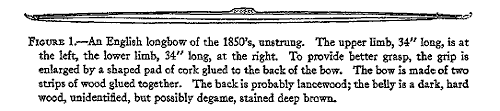
Today's number of archers contrasts sharply with that of only 30 years ago. During this period there has probably
been a doubling of numbers every 5 years, which would make the ratio more than 60/1, which seems plausible.
Prior to 1930, the number of archers in America was almost too small to be noticed. In the tables of data about
outdoor sports, its category was "miscellaneous" or "other." Seldom did the public press carry news about it. Among
the reasons for the prevailing popularity of the sport, a major one to be examined is the exceptional improvement of
its implements. This new excellence was the first in centuries, the centuries during which makers of bows and arrows
blindly and uncritically followed tradition.
Though unchanged in principle, the instruments of archery today differ profoundly in detail from their prehistoric
and historic prototypes. They differ radically even from the more recent ones being used during the first few
decades of this century. Changes in design, materials, and construction have contributed incomparably to precision
in performance, hence to greater accuracy in the hands of the skillful user. Even the fantastic skill attributed to
Robin Hood and his outlaws of Sherwood Forest does not surpass that of many of our present-day bowmen. The
new designs have undoubtedly served as a potent catalyst both in stirring the latent interest of many potential
archers, and in stimulating manufacture of the new bows which, unlike the old, lend themselves to systematic mass
production.
Shooting an arrow at a mark such as the bullseye or "gold" of a standard target has much resemblance to
measuring a physical constant with the purpose of determining its value to the utmost attainable accuracy. To
increase the accuracy in such a measurement, the first requisite is precision made possible by the use of
instruments of greater sophistication. In shooting, these instruments are the bow and arrow which in their present
design and construction are indeed sophisticated. To attain maximum precision with them requires:
	1. Minimum differences, in successive shots, in the energy stored in the bow at equal lengths of draw.
	2. Minimum effects of temperature and humidity on the materials of which the bow and the arrows are
	made.
	3. Minimum differences in dimensions, materials, and shapes of the arrows comprising the set.
	4. Arrows of proper spine in relation to the bow. (Spine is a characteristic of an arrow which depends
	on such factors as stiffness, resilience, mass, and distribution of mass along the shaft.)
	5. Exact replication by the archer of all the sequences of action in the process of shooting, i.e., of
	drawing the bow and "loosing" the arrow.
Requirement 5, which calls for near perfection in the archer's coordination and in the execution of the difficult,
interrelated steps in the shooting of an arrow, is to an extent dependent on the other specifications enumerated. His
confidence in his ability to perform all the necessary actions properly is increased if he can be sure that these
specifications are closely met.

In the United States the bow and arrow are used in five main categories of the overall sport. The oldest form, widely
practiced, derives from the kind of target shooting long practiced in England. It consists of competitive rounds,
variously named, such as York, American, National. Each round consists of certain numbers of "ends" of six arrows
each, at several known distances. The York Bound, for example, calls for 12 ends at 100 yards, 8 at 80 yards, and
4 at 60 yards for a total of 144 shots. The standard target on a thick straw mat is 4 feet in diameter. Its gold
bullseye is 0.8 foot in diameter. This is surrounded by four concentric rings each 0.4 foot in width, having colors
red, blue, black, and white going outward from the gold. A hit in the gold counts 9; and the rings, going outward,
have values of 7, 5, 3, and 1, respectively.
Clout and wand shooting are variations of the customary rounds. In the former, a target 12 times the diameter of
the standard, namely, 48 feet, is laid out on the turf, with its center 180 yards from the shooting line. The arrows are
loosed at a high initial angle and come down steeply to stick in the sod on which the target is described. In wand
shooting, a vertical lath 2 inches wide is set up at 100 yards, and hits are counted regardless of their elevation on
the wand.
A second category called flight shooting puts a premium on skill in shooting for maximum distance. The bows and
arrows are especially designed for the purpose. Another, field archery, requires a course of 14 targets, laid out
where possible up hill and down dale, with distances only approximately known, and with targets roughly
proportional in diameter to the distances from the shooting stands. Hilly woodland is preferred terrain, with natural
hazards, or with artificial ones built in.
Still another bow-and-arrow sport is archery golf, played on a golf course. Bows and arrows are substituted for
clubs and balls, and the cup is replaced by a circular disk of the same diameter as the cup, supported vertically.
Some historians of sport surmise that the "antient and honourable game" of golf is descended from the old archery
game of rovers. In this form of contest the participants, ambling about the countryside, selected a series of marks
as they strolled, and scored the total number of shots to hit the marks, low score winning. Archery golf may, in fact,
be "rovers reviv'd," in modified form.
The fifth major category, and the one growing most rapidly, is that of hunting wild game with bow and arrow. Most
States have long open seasons limited to bow hunting, usually preceding the rifle hunting season for deer. Deer
hunting is the most popular version. Hundreds of deer fall annually to the bow, but this is only a small fraction of
those still being taken each year with rifles. The word "still" is used by design, because many of today's bow hunters
are yesterday's riflemen. Other large game being hunted with the bow includes bobcats, mountain lions, javelina,
elk, and moose in this country, as well as black and brown bears. Babbits, squirrels, and upland birds are among
the small game. Carp and gar fishing with the bow and special arrows is becoming increasingly popular.
The requirements for precision shooting where the object is to hit a mark have already been enumerated. These
are closely approximated in most modern bows and arrows. Thus any appreciable scatter on a target of six matched
arrows may be attributed to the archer's technique, to the variations in his performance in the different shots.
Variable and gusty winds increase the scatter, whereas in a steady wind, the effect can be minimized by allowing for
drift. With all these factors considered, it seems reasonable to use the comparison of scores of today's champion
archers with the corresponding scores of 35 years ago as a measure of improvement in the equipment during the
intervening period. Before the improved bows and arrows were available, it was standard procedure for the archer
who was striving for highest score to shoot his matched arrows repeatedly with a given bow, to determine their
dispersion pattern, and to fix in his mind the deviation of each arrow, identified by number, from the intended point
of impact at various target distances. He also needed to know the effects of temperature and humidity on the
performance of his tackle, and make due allowances for them. With these precautions, experts could make fair
scores.
The story of how bows and arrows became the objects of study by scientists and engineers, and how the
transformation in design from the old to the new came about, begins in the 1920's, Among those who became the
pioneers in studies looking toward improvement, C. N. Hickman is one of the leaders. His training in physics to the
doctorate was at Clark University, where he worked with Robert H. Goddard, known as the father of modern
rocketry. Soon after the first World War, Hickman was employed at the National Bureau of Standards and soon
thereafter transferred to the Washington Navy Yard as research engineer. He seems to have inherited his interest
in archery. His grandfather learned it from the Indians, and his father was one of the relatively small number of
archers in the United States during the last decade of the 19th and the early decades of the 20th centuries.
Throughout his career Hickman has been a confirmed experimentalist in mechanics, with specific and practical
objectives, and with exceptional ingenuity in devising and constructing apparatus and systems needed for
specialized measurements and mechanical performance.
His exploration of the mechanics of the bow included the design and construction of a shooting machine with which
hand shooting could be more closely simulated than in earlier machines of this kind. In it he employed a nonjarring
pneumatic release, adapted from the pneumatic bellows used in a player piano. The device makes possible the
reduction to minimum of the inevitable small variations in the process of shooting by hand. The machine and his
modified form of the Aberdeen Chronograph, on the development of which I was engaged at Aberdeen Proving
Ground and in Philadelphia during World War I, made it feasible to measure accurately the short time intervals
involved in determining velocities and accelerations of arrows being discharged from bows. Data could thus be
obtained for better understanding of the "interior ballistics" of the bow and arrow combination, and of the velocities
and retardations involved in the "exterior ballistics" of the missile.
The beginning of my interest in these matters in the summer of 1929 came about through, the fact that part of the
family's vacation pastime was provided by a beginner's archery set and a homemade target.
First efforts sought to gain skill and improve scores. Practice was guided by an instruction sheet which came with
the set. We started with complete ignorance of the techniques, so that improvement began from the zero level. In
the course of my self-instruction in the art of "shooting in the bow" my familiarity with physics helped me to recognize
the mechanical principles and problems involved in the propulsion of an arrow by means of a bow.
To increase the success of our efforts I bought and read what few up-to-date books on archery could be procured,
and subscribed to the single archery magazine then being published, "yclept 'Ye Sylvan Archer' " the title of which
provided a flavor of romantic antiquity and old tradition for a struggling journal by and for amateurs.
The appearance of some of Hickman's articles in this magazine led to a renewal of our acquaintance. A lively
correspondence about the physics and engineering aspects of archery developed. My Aberdeen Chronograph and
shop equipment became the nucleus of an attic laboratory for which I built a shooting machine and other specialized
apparatus. The latter included high-speed flash equipment for obtaining instantaneous photographs of an arrow
being accelerated by the bow, and measurement of force-draw characteristics of a bow by photography. I was thus
launched, not to say propelled, into experimental studies which were all the more welcome for the diversion they
afforded from the serious economic problems following the great depression of 1929. In many respects, my
equipment was similar to Hickman's, so that we could easily compare and check measurements and keep our efforts
cooperative and complementary.
My publications reporting on these experiments began in 1931, first in "Ye Sylvan Archer," and later in a newly
established journal of small circulation, the "Archery Review." Reference to the bibliography shows that several
engineer-scientists other than Hickman and myself also published several papers, a few of which appeared in the
Journal of the Franklin Institute. Among the authors were English, Higgins, Nagler, and Rheingans.
The topics listed below give a picture of some of the interesting problems with which the research and development
efforts dealt; but many questions were only partially answered. There is still plenty of rewarding pastime left in them
for anyone who feels inclined to apply his skill to their solution.
	1. The effects of the shape, dimensions, relative settings, and angles of limbs on the static force-draw
	relation as the bow is drawn and the dynamic force-displacement relation as the arrow is accelerated.
	2. The static energy-draw relation as the bow is drawn.
	3. The velocity of departure of the arrow and its kinetic energy derived from the energy in the drawn
	bow.
	4. The mass-velocity relationship and corresponding mass-energy relationship for arrows of different
	masses shot from the same bow.
	5. Effect of the mass of the string on the initial velocity and energy of the arrow.
	6. The efficiency of a bow-arrow combination, i.e., the fraction of the stored energy in the bow which
	appears as kinetic energy in the arrow.
	7. The "virtual mass" of the bow.
	8. Factors which affect performance of arrows: their effects on accuracy, and consistency and distance
	in flight.
	9. The geometry and methods of aiming.
	10. Psychological factors in shooting.
The list above is representative of some of the questions in the mind of the observant, analytically minded archer
who has serious inclinations toward finding the answers. If he does, he has potential guides to improvement in
performance of both the archer and his implements, and the search for the answers will have provided pleasant
avocation for those who enjoy such pursuits. Our discussion of these matters will be illustrative rather than
exhaustive.
Known kinds of bows are numerous. They may have long limbs or short limbs, equal or unequal in length. Cross-
sectional shapes of the limbs are various. Materials may be wood, of a single kind, in "self" bows, or of different
kinds, glued together in layers. There are "composite" bows, with layers of several kinds of organic materials, or, in
modern form, of laminae of wood and synthetic plastics reinforced with fiberglass.
The two representative types of bow from which the kind now generally used has evolved are the longbow, with
which are associated centuries of history and tradition, and the oriental, specifically the Turkish, composite bow.
Prototypes of the latter are the bows used by the Saracens and by the conquering hordes of Genghis Khan. We
have authentic information, dating back to the 15th century, about the Turkish bow. Through the following centuries
its design apparently never changed. In the middle of the 19th century, interest in archery vanished with the end of
the reign of Sultan Mahmud II, and few if any bows were made in Turkey thereafter.
The English longbow had straight limbs when relaxed, i.e., not strung, except as the limbs might have taken a set
from having been repeatedly drawn. The limbs terminated in fitted tips of horn with grooves ("nocks") in which the
loops of the string were seated. Limbs tapered in both width and thickness from grip to tip. At any cross section, the
limb was rounded on the belly side, toward the string, and more or less flattened on the back, on the opposite side.
In the drawn bow the belly is under compression, the back under tension. Several shapes of cross section are
shown in figure 3. Such a limb is said to be stacked.
The grip occupied the region where the tapering limbs merged, and bending occurred throughout the length of the
bow. For this and perhaps other reasons, an unpleasant recoil might be felt in the bow hand when the arrow was
loosed. The stacked limb, characteristic of the longbow, was a violation of good mechanical principles and did not
properly exploit the possibilities of the wood from which the bow was fashioned. On the contrary, it subjected the
wood to needlessly high stresses. Indeed, such a bow had to be long to minimize stresses and prevent breakage;
hence longbow. That the margin of safety in the longbow was recognized as precarious is implied in the saying that
a bow fully drawn is nine-tenths broken. This is not true of the modern bow. Another feature of the longbow was that
its lower limb was about 2 inches shorter, and stiffer, than the upper. This seems to have been a concession to the
bowyer's desire to keep the overall length within tolerable limits and to have the arrow engage the string at the
midpoint of the latter. Both desires were satisfied by moving the handgrip in the direction of the lower limb by a
couple of inches.

During the known history of the longbow up to the early 1930's the only change in design seems to have been one
intended to reduce the aforementioned recoil in the bow hand. The change consisted of making the grip rigid and
nonbending by leaving more wood in the handle portion. The limbs then, instead of merging within the grip, made
juncture somewhat abruptly with the heavier midsection, where the latter was fashioned into dips which merged into
the limbs. The limbs thus became more clearly defined in length. In other respects the design remained frozen.
The original motive for Hickman's work and mine was the conviction, bred by recognition of the theoretical
shortcomings of the longbow and by the desire to improve its performance, that much better bows could be made.
The improvements that resulted from the work demonstrate the effectiveness of using science and engineering
principles as compared with the stagnation inevitable in adherence to tradition. In contrast with these improvements,
brought about within a few years, is the frozen design to which bowyers in England and America adhered through
the centuries, because they "knew" that it could not be improved. They must have felt certain that any attempts to
improve their product were predestined to failure. I have recollections of pre-1930 bowyers speaking with pride, if
not boastfully, of their ability in selecting yew wood for making bows par excellence. But no matter how singularly
excellent the quality of the wood they selected, or how well it was seasoned, even the best of their bows required a
high initial angle of trajectory for the arrow to hit the target at 100 yards. This did not contribute to high scores,
notwithstanding their derogation of the higher velocity and flatter trajectory of the new bows, not attainable with
theirs.
It may interest the reader to follow the major steps by which the improvements were achieved. Our point of
departure was the longbow, as used in this country prior to the early 1930's which was the English pattern modified
with the rigid grip.
Mechanics, that section of physics which deals with static and dynamic forces, with kinematics, and with the
properties of materials subjected to stresses, shows that when a elastic beam is bent, it is under tension which
causes stretching on the convex side and under compression, causing shortening on the concave side. Somewhere
between there is a geometric "layer" of zero thickness which neither stretches nor shortens as the beam is bent. At
this "neutral" layer the shearing force between the stretched and the compressed sections is a maximum, and this
diminishes to zero as we move outward, at right angles, to the surfaces of the beam.
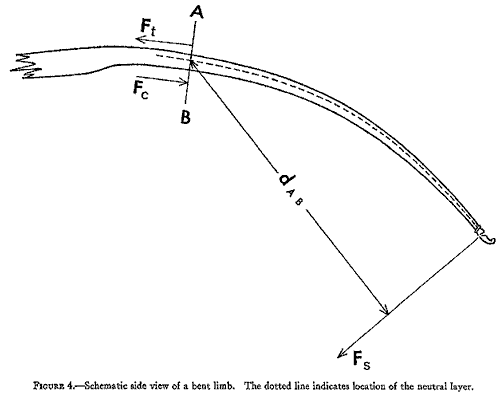
To illustrate this, consider the limb of a longbow (fig. 4). A force Fs applied to the tip through the string causes the
limb to bend in a curve which depends on the force, and on the shape, dimensions, and elastic properties of the
limb. At any section AB within some finite radius of curvature, the tensile force is Ft and the compressive force Fc.
These forces increase from zero to maximum values as we go outward from the neutral layer. The bending moment
at the section is the summation of the tensile and compressive forces over the elements of area on each side of the
neutral layer, giving a resultant tensile and compressive force, respectively; the sum of each of these resultant
force Fs, multiplied by the distance of its point of application from the neutral axis of the section, is the bending
moment at the section. This is equal to the moment represented by the force along the string multiplied by the
perpendicular distance of the section AB from the string: Fs x dAB.
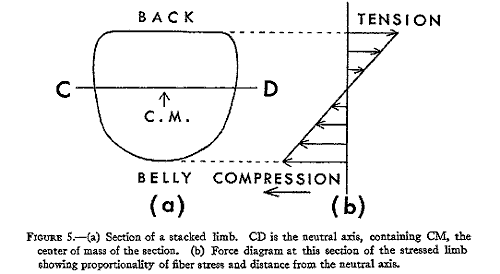
Figure 5 represents a section AB of the limb in figure 4, of a typical longbow. Line CD through the center of mass of
the section is the neutral axis. The neutral axes of all the sections define the neutral layer; conversely, the neutral
layer contains all the neutral axes of all possible sections. In the section shown, the distance from the neutral axis to
the outer surface of the back of the limb is less than the corresponding distance to the outer surface of the belly.
Since the maximum tension and compression occur at the outer surfaces, the back is subject to lower maximum
stress in tension than is the belly in compression. It is a general characteristic of wood, both from the standpoint of
intrinsic strength and of imperfections, that it can withstand greater tension than compression without failure. Thus,
in a stacked limb, forces to which the wood is subjected are not matched with the strength characteristics of the
wood. This confirms the previous statement that in the longbow the qualities of the wood are not properly exploited.
From mechanical considerations it would be better to reverse the shape of the limb, so as to make the stacked side
the back and the flat side the belly. It is now evident why the longbow must be long to withstand the stresses to
which it is subjected in use.
In a working bow, made of wood with suitable elastic properties, the energy in the bent limbs resides in the stresses
set up in them as the bow is drawn. When the arrow is loosed, the wood tends to spring back toward its unstressed
configuration. The best use of the wood or other resilient material is made when the maximum tensile and
compressive forces are constant throughout the length of the limbs, with constant bending moment per unit area at
any section. The condition can be approximated in a limb of uniform thickness, rectangular in section, bending in a
circular arc. In handbooks of engineering one finds that a cantilever beam of uniform thickness, tapering from finite
width at the point of support to zero width at its free end, with loading at the end, bends in a circular arc with light
loading and small deflection. Hickman pointed out this simple fact and suggested that a bow with limbs rectangular
in section, of uniform thickness and taper, would more effectively utilize the resilient qualities of the wood than does
the longbow. Experiments carried on by Hickman and myself some 30 years ago fully substantiated the point. When
the deflection is large, as in a fully drawn bow, the bending moment per unit area is no longer uniform along the
limbs. To restore uniformity, widths at different points along the limbs must be corrected so as to bring about the
desired result of keeping the bending moment per unit area constant.
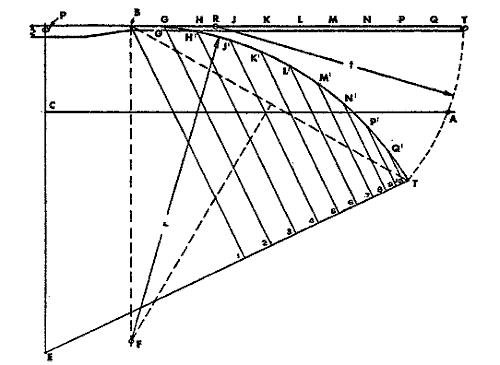
Figure 6 depicts a graphic method for determining the correct widths, along its length, for a limb of uniform
thickness, to achieve the stated objective. Accordingly, it becomes the basis for the design of a bow with limbs
rectangular in section, uniformly stressed.
Hickman showed that when a limb is bent in a circular arc, the path of its tip closely follows a circle having a radius
three-fourths the length of the limb, its center being on the limb. This simple construction enables one to draw a
circular arc representing the bent limb for any length of draw. The procedure for determining the relative widths, in
terms of the maximum width of the limb at its base, is described in the caption for figure 6.
It is of course impracticable to reduce the width of the limb to zero at the tip. This would have no place for seating
("nocking") the string, and because of the small width, the outermost several inches of the limb would be unstable
and tend to twist. Accordingly, in constructing the limb, sufficient width is left in the outermost 3 or 4 inches to
provide for a suitable nock and retain stability. To compensate for the extra stiffness due to the added width, the
thickness of the end of the limb is reduced so as to approximate bending in this section on the same radius with the
rest of the limb. The approximation cannot be close, because of the very small bending moment near the tip. The
corners of the limb are chamfered to reduce concentration of stresses.
The new design, shown in plate 3, which in effect loads the limbs uniformly and thus makes optimum use of their
elastic properties, made possible a reduction in their length by 10 to 15 percent, while reducing hazard of breakage.
A dividend was the possibility of making the limbs of equal length, instead of keeping the lower limb 2 inches shorter
than the upper, as in the longbow. This is accomplished by lengthening the rigid middle section sufficiently to
provide the same length of rigid section above the arrow as there is in the handle section below the arrow, thereby
keeping the bow symmetrical with respect to the axis of the arrow, with the arrow nocked at the midpoint of the
string. Both limbs are now alike in dimensions and stiffness. Such a limb has a period of vibration much shorter than
that of the equivalent limb of a longbow, the comparison between the two bows being based on their exerting the
same static force on the arrow at full draw. The new limbs therefore spring back faster, impart higher velocity to a
given arrow, and thus have greater efficiency in transferring their energy to the arrow.
Experiments with bows developed along these lines proved them to be far superior in efficiency to the longbow.
Whereas the latter at best transferred 40 percent of its stored energy to the arrow, the new bows, according to
measurement made both by Hickman and myself, had above 75 percent. With efficiency about double that of the
longbow, it can impart an initial velocity to a given arrow about 40 percent higher than that produced by a longbow.
It seems appropriate at this point to quote from a letter which I received from a distinguished scientist and friend in
Washington after I had sent him one of the new bows. He had been finding welcome relief from strenuous
responsibilities in military research and development by practicing archery occasionally with the Potomac Archers,
where he used a longbow. Upon receipt of the new bow, he tried it, then sent me the following comment:
	That is the doggondest bow I ever saw and apparently that the Potomac Archers ever saw. I took it down
	yesterday. The club was haying an informal shoot so I snuck off on the side, nocked an arrow, picked a
	point of aim somewhat nearer than with the older how, and let er go. I haven't seen that arrow since. I
	just hope it didn't plug someone. . . . When the gang started shooting at 100 yards, Mr. joined me and
	helped me try it out. ... He was drawing only 26 inches, so was losing a lot But his point of aim at 100
	was somewhere about the 40 yard line. He shot a couple, and it pretty well broke up the shoot because
	the gang gathered around as soon as they saw the flat trajectory. . . .
Publication in the early 1930's of a series of articles on the design and performance of the new bow met with some
skepticism by tradition-bound archers, but it also met with widely increasing acceptance. As more archers acquired
bows of the new design they were able to verify the published statements about performance. It took only a
relatively few years for the longbow virtually to disappear from tournament shooting lines.
In parallel with the acceptance of the bow of scientific design, another circumstance strongly influenced the
continuing improvement of bows. In the early 1930's I had begun to make a collection of books on archery, most of
which are of English origin, published from the 16th century onward. Among the items in the collection is a complete
run of an annual review volume called "The Archer's Register," beginning in 1864 and continuing through 1915.
Some of these contained seemingly authentic information as well as some conjecture about the practice of archery
in Turkey in the 15th and later centuries. One assertion was the almost incredible one that the Turks had shot
arrows a distance of a half mile incredible, certainly, to those who knew only the limited range of the longbow. My
technical interest stirred me to discover whether this might be true, and if so, how it had been accomplished.
In my exploration of Turkish archery, I was fortunate in being able to obtain a book by Mustafa Kani, printed in old
Turkish with Arabic-Persian calligraphy, published in Constantinople in 1847, and bearing the title, "Excerpts from
the Writings of the Archers." Among the things reported was the construction and methods of shooting the Turkish
bow.
Because of my inability to read Turkish, it was fortunate that I later discovered two other publications concerning
Turkish bows and arrows, both based almost wholly on the book by Kani. The first was a paper entitled "Concerning
Bows and Arrows: Their Use and Construction by the Arabs and Turks," by Dr. Freiherr Hammar-Purgstall,
presented before the Imperial Academy of Sciences of Austria-Hungary and published in the proceedings of the
Academy.
The second, "Bowyery and Archery among the Osmanli Turks," by Joachim Hein, was published serially in three
successive issues in 1921-22 of the German periodical "Der Islam." These two sources, both in German, which I
read easily, were of substantial help in giving me insight into Kani's book, which otherwise would have remained
obscure.
The result of the study of these two works led to my publishing a book in 1934, with the title "Turkish Archery and
the Composite Bow." In it I reported what I had learned from the two German sources, along with comments and
explanations deriving from both my practical experience in shooting, and from the research and development I had
done. The book, published in a limited edition, proved to be in greater demand than had been anticipated, with the
result that it became a collector's item on the day of its publication. A revised and enlarged edition was published in
1947, the centennial year of publication of the book by Mustafa Kani. The book deals exclusively with the Turkish
bow, arrows, shooting accessories, methods of practice and of shooting, distance records and other related and
pertinent information.
The Turkish composite bow differed profoundly from its English contemporary counterpart. Whereas the longbow
was made exclusively of wood, the Turkish bow was "composite," with limbs constructed of materials in layers, so
arranged that the compression, tension, and shear in the bent limbs occurred in those materials best adapted to
withstand these respective forces. The precise form and construction of the composite bow must have evolved
through experience in the use of the weapon, and from the trial-and-error method in construction employed by
many successive generations of cooperating bowyers and archers.
The studies of Turkish bows and arrows, and their use in distance shooting, reported in the book on Turkish
archery, left no doubt that their record distances were very much greater than any which had been achieved with
the longbow. The principal reasons for the superiority were probably:
	1. The greater energy storage per unit volume in the stressed limbs of the composite bow, made
	possible by the judicious use of suitable materials, and the geometry of the bow.
	2. The design characteristics of the Turkish bow, such as shorter limbs, strongly reflexed when
	relaxed; and the setback, or "ears" at the ends of the limbs.
	3. The design of the Turkish flight arrow, light yet strong and rigid to avoid buckling under high
	thrust; stabilizing vanes made as small as feasible, to minimize drag.
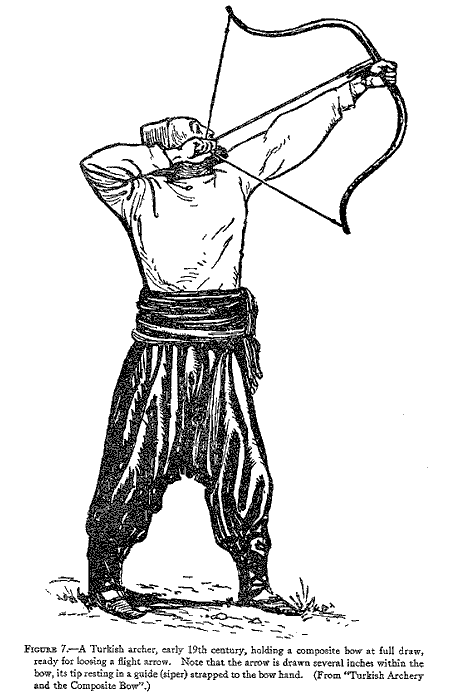
	4. The use of a relatively short arrow, also designed to reduce drag, drawn several inches within
	the bow, made possible by the use of a special guiding device worn on the bow hand.
	5. The thumb release, to minimize violent bending and deflection of the arrow during and
	immediately after release.
Many of the American archers interested in flight shooting who had access to the book on Turkish archery realized
the challenge which confronted them in the Turkish records, and proceeded to work at closing the wide gap
between those records and the much shorter distances attainable with the longbow, or straight self bow of wood.
Prior to publication of the book, some of them had already made changes in the longbow. They used limbs of
rectangular section, shortened them to the limit of safety, and provided them with ears. This was the beginning of
progress. The wood most frequently used in making flight bows was osage orange, a very strong, hard, resilient
North American wood, named bois d'arc by the French explorers because they found it being used by many Indian
tribes for bows.
Seasoned osage orange wood of good quality has mechanical properties approximating those of horn, making the
use of the latter as compression material unnecessary. Sinew fiber was, however, used for backing, to safeguard
the limbs against breakage from possible flaws in the wood, and to withstand the high tensile stress which develops
in a bend of short radius. They had learned from the book how the Turkish craftsman prepared the sinew and glue,
and how he applied the sinew fiber, in a glue matrix, to the bow. With such transitional models of bows, flight
distances increased through the 400's of yards into the low 500's.
Research and development during and since the war produced plastics with excellent characteristics for reliably
storing and releasing energy through stress loading and unloading. Mass production at low cost of glass fibers was
perfected, making long parallel fibers of glass readily available. Strong plastics with fiber glass reinforcement are
now in regular if not exclusive use in the construction of bows of all kinds. Except in certain kinds of specialized,
custom built bows, sinew fiber, horn, and osage orange wood have been displaced by the new materials. The bow
of the 1960's is composite in the Turkish tradition, though in modified pattern, influenced by the designs which
developed from the research studies of the longbow.
Plates 4 and 5 represent one commercial form of modern bow, relaxed, braced, and at full draw. Although
resemblance to the Turkish bow is manifest both in appearance and its composite structure, the straight-limbed bow
of rectangular limb section had a strong influence upon its development also, as an intermediate phase after the
longbow. The limbs are rectangular in section, with adequate width to insure stability against twisting as the bow is
drawn. Moreover, the design is aimed at employing the whole limb, including the backwardly curved ends, for
storing energy. The lesson learned from the bow with rectangular limb section, bending in circular arcs, is that each
limb is "working" throughout, with approximately the same stored energy in each unit of volume of the stressed limb.
In the Turkish bow only about one-half the length of each limb is under great stress when the bow is drawn. In the
modern bow, which is composite as is the Turkish, the tensile stress is taken by glass fibers in a matrix of strong
plastic, and the compressive stresses by the plastic, perhaps aided by the glass fibers embedded in and bonded to
it. The limb is built upon a thin strip of wood, usually hard maple, to both sides of which the plastic with embedded
glass fibers is bonded. The limb of the Turkish composite bow was constructed similarly, but, it will be recalled, with
horn to take the compression and sinew fibers to take the tension.
One of the outstanding gains of the new construction as compared with that of its precursor, the wood bow with
rectangular-section limbs, is the relative immunity to normal temperature and humidity variations. Moreover, the
modern composite has little or no tendency to follow the string, i.e., to take a permanent set from being braced and
drawn. It may be left braced over long periods, and when relaxed, will resume its original form. A significant test of
such a bow was to draw it full and let it snap 260,000 times. After this "abuse" the force at full draw was the same,
within a few ounces, as it was when new.
The modern bow has the long rigid midsection which has been mentioned before. It permits using short limbs of
equal length, and application of the drawing force to the bow along a line approximating the axis of the arrow as an
axis of symmetry. A new feature is the sculptured grip, as seen in plates 4 and 5, shaped not only to fit the contours
of the hand, but also to make certain that the force applied by the bow hand is always applied at the same location.
An arrow rest, and a marked nocking point on the string insure the proper positioning of every arrow and replication
in each shot of the impulse applied to the arrow. These features minimize variations which would introduce
inaccuracies in hits. Another important characteristic which makes a similar contribution to accuracy is the absence
of energy loss in the limbs from mechanical hysteresis, or internal friction in the materials of the limbs. This is
present in most self bows of wood. It is related to permanent set in the limbs, which has been previously discussed.
The modern arrow also makes its contribution to accuracy. For the most part, precision arrows are now made of
strong aluminum alloy tubing, precision drawn, with constant physical properties such as stiffness and mass per unit
length for each diameter and wall thickness. The wood arrows, which have been largely superseded, suffered from
the inevitable lack of homogeneity of wood. Notwithstanding close attention to manufacture, meticulous selection
and seasoning of wood, and other handling intended to increase uniformity, complete identity of specifications for
every arrow in a dozen could only be approximated. The final step in matching the arrows in a dozen was that of
selection, through measurements and tests, from a large number.
Another point of importance in accurate shooting at long distances, such as 100 yards in the York Bound, is that
the drag on the arrow must be alike for all. The principal cause of variation in drag has been in the vanes made of
turkey feathers, which are easily disarranged or damaged by mechanical impact, and changed in texture and
uniformity when wet. In the new designs, plastic vanes are used, with the result that greater uniformity is achieved
with smaller effort. Some experimenters and manufacturers have used four or six vanes in place of the usual three.
The only advantage is that for the same area of stabilizing surface, the larger number may be made somewhat
narrower, and this may have value in preventing contact of the vanes with the bow when the arrow is loosed.
The drastic changes made in bows and arrows during the three decades past have produced emotional reactions
among the older archers to whom the legend of Robin Hood was sacrosanct, and who were unable to tolerate
innovation. They lived in the old English tradition with the longbow and the arrows made of "old deal." They ridiculed
the research and development which pointed the way to better shooting and higher scores. Clearly they were
entitled to hold affectionately to the Robin Hood image of archery. However, their predictions about the decline of
archery, caused by the newfangled gear, failed of fulfillment. The number of archers has moved from the thousands
into the millions. In large part this has come about by leaving tradition behind. The new bows and arrows have
added immeasurably to the potential enjoyment of the sport.
A brief compilation of some of the technical considerations involved in the advancement of the art will, I hope,
interest many readers, for it helps in following the rationale of the research and development which have been
described.
The force-draw relation. The most obvious characteristic of any bow is the relation between the force and the
displacement of the nocking point of the arrow on the string. In graphic form, the relation is expressed as the force-
draw curve. It shows the force exerted by the bow on the arrow at any point of the path in which it experiences
acceleration.
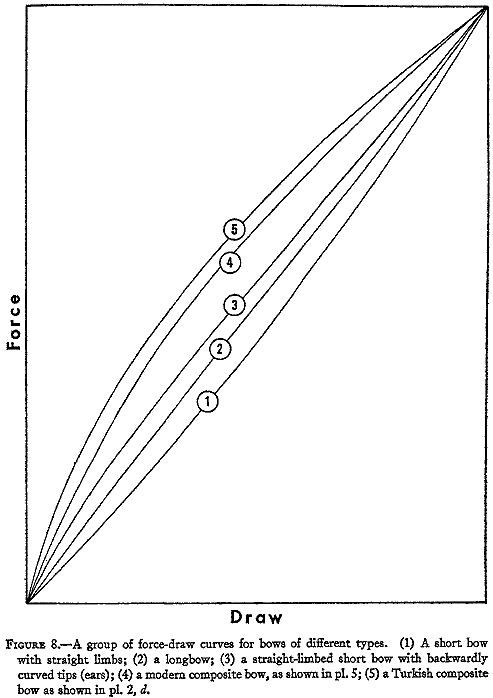
In figure 8 are shown force-draw curves of bows of the several kinds which are under discussion in this report.
These are adjusted to the same maximum force of draw at the same length of draw. The significance of the force-
draw curve in these studies is the fact that from it one obtains the energy in the drawn bow. The measure of the
energy is the area enclosed by the graph, the Z-axis at zero force and the ordinate at maximum force. The force-
draw curve for the longbow approximates a straight line. For a short, straight-limbed bow it curves slightly downward
from that for the longbow. Backwardly curved tips produce convexity upward, as do strongly reflexed limbs of the
kind employed in the Turkish bow, and some modern bows which employ modifications of such limbs. Hence the
energy at full draw is relatively lower in bows with straight limbs than in reflexed bows, or bows with backwardly
curving tips or ears. It would appear, therefore, that with substantially higher energy content for the same maximum
force, the bows which follow a modified Turkish design, or use backwardly curving tips, are to be preferred to bows
with straight limbs. This is indeed true if they are as effective in transferring energy to the arrow.
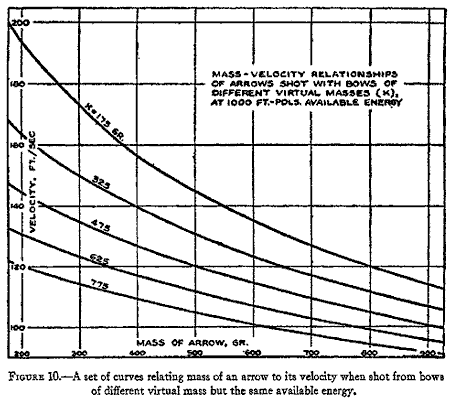
Velocity-mass relations in arrows shot from a given bow. An archer, as he gains experience with his bow, will notice
provided he shoots arrows of different weights--that the light arrow takes off with higher velocity than the heavier.
This raises questions. First, can one establish a systematic relation between the mass of an arrow and the velocity
imparted to it by a given bow? Second, can one find a relation between the mass of an arrow and the energy which
is transferred to it from the bow? These two questions, and the search for their answers, lead to some other
considerations of interest.
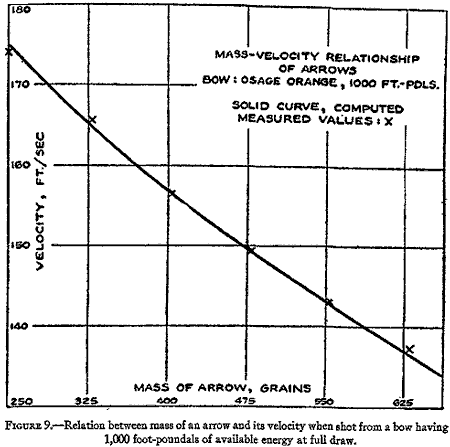
Figure 9 reproduces a mass-velocity curve obtained by plotting measured velocities of arrows of different masses
against the mass values, all shot from a bow with given energy at full draw. The solid line is plotted from computed
values of v and m, using the relation
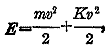
simplified to E=1/2(m+K)v2.
The equation says that the energy E in the drawn bow is accounted for by the kinetic energy in the arrow, 1/2 mv2,
and another energy term, 1/2 Kv2, which represents the part of E which failed to be transferred from the bow to the
arrow; it is that part of the energy which is left behind when the arrow leaves the string. This term employs the same
velocity V as that of the arrow, and a quantity K which has the dimensions of mass. This I have called the virtual
mass of the bow. A physical picture of virtual mass may be drawn as follows.
Imagine the bow and staring to have no mass, and imagine a mass K to ride "piggyback" on the arrow until the
instant the arrow leaves the string. The velocity v is that which corresponds to kinetic energy equal to the energy E,
transferred to a mass of m+K. The energy carried off by the arrow is 1/2 mv2, which means that the energy left
behind is 1/2 Kv2. The virtual mass K has been found by many experiments to be uniquely characteristic of the bow.
In bows of high efficiency, i.e., of high energy transfer, K is small, and vice versa. The virtual mass of a longbow is
large. It is much smaller in the "scientific" and the modern bows. This is the more readily understood when we
consider that the limbs of a bow must themselves be accelerated by the stored energy in order to impart
acceleration to the arrow. The long, heavy limbs of the longbow are sluggish as compared with the shorter and
lighter limbs of its successors. Were it possible to transfer all the energy in the bow to the arrow, the virtual mass of
the bow would be zero. Theoretically this might be achieved if a bow could be so designed that the limbs had zero
velocity in the normal braced position at the instant of disengagement of the arrow. This is an unattainable ideal,
but it has been approached to within 10 percent.
In closing this discussion, it is my hope that the purposes set forth at its beginning have been achieved. More
detailed exposition of the many technical considerations involved in the design, construction and use of bows and
arrows would far exceed its scope. The appended bibliography may serve as a guide for more thorough exploration
of such technical matters as hare been enumerated.
[Bibliography omitted]
Plate 1: An English longbow of the 1850's, like that of figures 1 and 2, at full draw. Reproduced from
Horace A. Ford's "Archery in Theory and Practice/' 1856. Ford was eleven times
archery champion of England.
Plate 2: a, Modified grip of an American-made longbow to show the change in midsection from that
of the English longbow. The midsection is made rigid, with "dips" where the limbs
merge with the grip, b-d, A Turkish type composite bow (b) relaxed, (c) braced, and
(d) at full draw. (From "Turkish Archery and the Composite Bow.")
Plate 3: A wood bow, of yew, made according to the design of figure 6, shown (a) relaxed, (b) braced,
and (c) at full draw. The limbs are straight, and, when drawn, bend in circular arcs.
Note how the slightly wavy grain in the wood has been followed by the bowyer, to avoid
cutting across the grain. Note also that the limbs are of equal length (28"); the long
(15") rigid midsection; and the symmetry of the bent limbs relative to the position of
the arrow.
Plate 4: A modern composite bow (bow of the 1960's) (a) relaxed, (b) braced, and pi. 5, at full draw.
Note the length (ca. 20") of the equal limbs, as compared with the 34" length of the
upper and 32" lower limb of the English longbow of figure 1, and the rigid midsection,
27" long, which is completely absent in the English longbow.
Plate 5: (See plate 4 for explanation.)
- End of Book.
Return to Self-Reliance>>Weapons>>Archery page.
Please Read The Website Disclaimer!
Copyright 1986-2012, The Survival & Self-Reliance Studies Institute (SSRsi), All
Rights Reserved
Site conceptualized, designed, created & maintained by MEG Raven
Snail Mail: SSRsi, PO Box 2572 Dillon, CO. 80435-2572