






















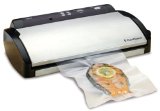

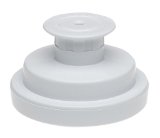
This is the model I have and use...
for more than just food.
An Invaluable tool!

Found a good "Canning, Preserving & Food Handling" link? Let Us Know!
| Jump to Section: | Canning | Preserving | Handling |
CANNING
Canning Basics - the What, Why & How of home canning. A
great resource for beginning or experienced canners who want the best
possible results.
High-Acid Foods - illustrated step-by-step guide to preserving
delicious jams, jellies, fruit, pickles, relish, chutney, and tomatoes.
Low-Acid Foods - illustrated step-by-step guide to safe home
canning of vegetables, meat, fish, seafood, poultry, game, soups, stews,
ragouts (combination recipes)
History of Canning from Del Monte Canning started in jars. The
process was invented in France in 1795 by Nicholas Appert, a chef who was
determined to win the prize of 12,000 francs offered by Napoleon for a way
to prevent military food supplies from spoiling. Appert canned meats and
vegetables in jars sealed with pitch and by 1804 opened his first
vacuum-packing plant. It was a French military secret that soon leaked
across the English Channel.
STUDY FINDINGS: COMPARISON OF SELECTED FRESH, CANNED AND FROZEN
FRUITS, VEGETABLES, LEGUMES AND PROTEIN FOODS
| North Dakota State University Extension Service: CANNING | ||
| Canning Equipment | Buying a Pressure Canner | Canning With a Pressure Canner |
| Testing Your Pressure Canner Dial Gauge | Canning Jars | Boiling Water Bath Canner |
| How to Can Vegetables | Canning Carrots | Canning Snap Beans |
| Canning Dried Beans | Preserving Winter Squash and Pumpkin | Canning Mixed Vegetables and Soup |
| Canning Tomatoes | Canning Tomato Products | Reasons Fruit Float in Jars |
| Canning Apples and Applesauce | Sugar-Free Canning | Canning With Sweeteners Other Than Sugar |
| Canning Meat and Poultry | Canning Fish | Canning Without Salt |
| Reasons Home-Canned Food Spoils | Guard Against Canned Food Spoilage | Unsafe Canning Methods |
| Botulism | Why Lids Do Not Seal | Reasons for Liquid Loss From Jars |
| How Long Are Canned Foods Safe | Discoloration in Canned Foods | Cloudiness in Liquid of Canned Foods |
Reasons Home-Canned Food Spoils Date: May 1989 (Revised April 1995)
Source: University of Minnesota Time, energy and money are lost when
food spoils. There are several reasons home-canned foods spoil. The most
common ones are: failure to heat process the filled jars, processing by an
incorrect method, processing for insufficient time, and failure of lids to
seal.
Equipment - With the exception of homecanning jars and two-piece
vacuum caps, few utensils are absolutely essential for home canning.
However, there are many unique utensils that are extremely useful to home
canners. This section illustrates them.
Recipes - Detailed step-by-step recipes take the guesswork out of
home canning. Click
Recipe Search to locate a recipe by category or fruit, vegetable type,
etc.
Food Preservation- Selection, Use and Care of Canning Equipment
Some helpful info for the beginning canner.
Home Canning- Selecting the Correct Processing Time
Excellent info.
PDF/Adobe Acrobat
The USDA Complete Guide to Home Canning The 1994 edition of
the Complete Guide to Home Canning and Preserving is the only approved
version of this document. If you have an earlier version, please replace it
with the 1994 edition. Information on ordering the paperback version of the
Guide can be obtained from this University of Georgia web site. The National
Center for Home Food Preservation (NCHFP) regularly reviews canning methods
contained within the USDA Guide and has developed many new preservation
recipes that are safe to use.
Identifying & Handling Spoiled Home-Canned Food This info could save
your life - or alot of pain.
High Altitude Food Preparation Guide
Jams and Jellies Extensive resource
Canning the Catch PDF/Adobe Acrobat File When you catch
fish, handle the fish with care to avoid bruising and exposure to sun or
heat. Bleed the fish immediately after catching to help increase storage
life. Remove viscera (internal organs). Rinse fish and keep iced,
refrigerated, or frozen.
Preparing and Canning - Meat Stock (Broth)
This document was extracted from the "Complete Guide to Home
Canning,", Agriculture Information Bulletin No. 539, USDA. Reviewed 1994.
Safe Home Canning of Meats, Poultry, Fish & Seafood
(Includes Rabbit & Squirrel!) This publication was extensively
revised by William Schafer, Extension Food Technologist, Department of Food
Science and Nutrition, University of Minnesota, from an original publication
by Isabel D. Wolf and Edmund A. Zottola.
Canning 101 — pickles, fruits, jams, jellies, etc. For
some reason, (definitely unknown to me) canning, as a method of very long
term food storage, fell into disuse. Maybe it’s the hurry/rush syndrome many
folks have become addicted to, necessitating “instant” foods, microwave
ovens, and mixes for everything from pancakes to casseroles. But for people
of a self-reliant inclination—raising a good portion of their own wholesome,
chemical-free food and establishing a storage method that is easy and
results in tasty food, even years down the road—home canning is the way to
go.
Potting Meat: Before
refrigeration changed everything in Southern Alberta, meat potting was a
more prevalent way of preserving meat than either salt curing or drying.
This is how we used to do it... By Gordon Schaufert (born 1942). Very
interesting text.
Salt Curing Meat in Brine. Curing meat by using a salt
brine was a widely used method of preserving meat before the
days of refrigeration. This is the way we cured pork in Southern Alberta,
however it would work for beef as well. Recipe by Verla Cress (born 1940)
HOME CANNING GUIDE. This publication contains many new
research-based recommendations for canning safer and better food at home..
It is an invaluable resource for persons who are canning for the first time.
Experienced canners will find updated information to help them improve their
canning practices. See also
NDSU: Canning
Back to Top
PRESERVING
FAO Preserving Tomatoes Three home-processing and preservation
techniques
Fruit Preservation Manual I &
Fruit Preservation Manual II UNDERSTANDING HOME-SCALE
PRESERVATIONS OF FRUITS AND VEGETABLES By Eric Rustin
NCSU Guide to Home Food Preservation Huge on-line text
Safe Storage of Herbs and Vegetables in Oil It's important
to keep food safety in mind when storing vegetables (such as garlic,
mushrooms, chili peppers) or herbs in oil. These low-acid foods can be a
source of Clostridium botulinum bacteria which are found in soil, water, and
air. Oil's oxygen-free environment is perfect for growth of the bacteria.
For this reason, herbs and vegetables in oil must be stored correctly to
prevent botulism food poisoning.
Preserving Squash and Pumpkin Squash and pumpkin can be
stored through the winter in a cool (but not freezing), dark place which is
slightly humid, but not damp. If you store them in a basement, they should
be laid out in a single layer on clean paper or wood pallets so the bottoms
do not collect condensation and start to mold. Check them from time to time
and discard any that become soft or moldy. Original document now only
available as
PDF File See also
Selecting, Storing and Serving Ohio Squash And Pumpkin,
HYG-5530
Spiced and Pickled Seafood Pickling with vinegar and
spices is an ancient and easy method of preserving seafood. Commercial
processors pickle only a few seafood species, but you can pickle almost any
seafood at home. Store pickled seafood in the refrigerator at 32-38°F. Use
pickled seafoods within 4-6 weeks for best flavor. Refrigerate seafood
during all stages of the pickling process.
Rec.Food.Preserving FAQ in
Text form, best for saving to disk or printing.
Michigan Venison - How to Field Dress,
Butcher, Prepare/Cook/Preserve
Preserving Food Safely Database To use this data base, click on a
letter to bring up a list of keywords that begin with that letter. Related
topics will be listed under each keyword. Try
HERE also
University of Georgia's So Easy to Preserve Guide to Drying
Huge on-line text
Wild Side of the Menu - No. 3 Preservation of Game Meats
Wild game provides wholesome, nourishing food, but should be
preserved carefully to retain quality. Like domestic meat, wild meat is
perishable, so care is needed to maintain its quality. Freezing meat is the
most accepted way to maintain top quality. Other methods for preserving game
meats include curing and smoking, drying, corning, canning and sausage
making. Covers curing & smoking, corning, and canning.
| Syrups | Apricots -- Halved or Sliced | Grapefruit & Orange Sections | Festive Mincemeat Pie Filling |
| Apple Juice | Berries -- Whole | Mixed Fruit Cocktail | Green Tomato Pie Filling |
| Apple Butter | Berry Syrup | Nectarines -- Halved or Sliced | Peach Pie Filling |
| Apples - Sliced | Cherries -- Whole | Peaches -- Halved or Sliced | Pineapple |
| Applesauce | Figs | Pears -- Halved | Plums-Halved or Whole |
| Spiced Apple Rings | Fruit Purees | Pie Fillings | Rhubarb -- Stewed |
| Spiced Crab Apples | Grape Juice | Blueberry Pie Filling | Zucchini-Pineapple |
| Apple Pie Filling | Grapes -- Whole | Cherry Pie Filling |
Dial Gauge and Weighted Gauge Charts
Back to Top
Handling
Aging Big Game Many practical considerations must ultimately
determine whether to age or not to age game meat. Among these are the
temperature at the time of kill, the chilling rate, the internal temperature
of the muscle after chilling, the youthfulness of the animal, the relative
humidity, the amount of weight loss the hunter is willing to sacrifice, the
processing procedure and the cooler space and labor available if the game is
to be processed commercially. Under ideal conditions, age antelope 3 days,
deer, sheep, goat, cow elk and cow moose 7 days and bull elk and bull moose
14 days after the kill at 34ºF. If the temperature is higher, the aging
period should be shorter. Game which is killed when the temperature is 65ºF
or above and held at this temperature over 1 day should be cut immediately.
Game that is to be ground or chopped does not need to be aged.
Aging Big Game by Ray A. Field and C. Colin Kaltenback. Hunters
seldom agree as to the length of time a big game carcass should be aged.
What is involved in the aging process? When is it beneficial to age game
meat? Under what conditions is it inadvisable to age game? This pamphlet is
concerned with answers to these questions. See Also:
B-513R - Aging Big Game
Field Care of Big Game &
Cutting Up a Big Game Carcass
Nebraska Hunting Guide Big Game Guide to Field Care & Home Processing
Properly field-dressing game is the most important part of a successful
hunting trip. Deer and antelope make fine table fare if the animal is well
cared for. The flavor of the meat depends on how quickly and carefully the
meat is field dressed. Far too many animals are wasted or provide
poor-quality eating because fail to follow simple, common-sense rules of
good meat handling.
Canuck2's Gutting Guide - A very good pictorial guide.
Aging Game Meat AGING MEAT does not mean hanging the carcass up to
see how many days it takes to spoil. A neighbor of mine and his wife shot
four antelope, and they decided to age the meat. The daytime temperature was
in the 70s and even higher, yet they hung the meat in their garage. "I like
it when it's about to fall off the bone," the man told me. My suggestion was
to cut the carcasses down immediately, butcher them, package the meat and
hope for the best. But hang longer, they did.
A Pocket Guide to Care and Handling of Deer & Elk from Field to Table
See also:
A Pocket Guide to Care and Handling of Deer from Field to Table
by Julie Garden-Robinson, Martin Marchello, and Pat Beck, and
Deer from Field to Table
A Pocket Guide to Care and Handling of FISH from Stream to Table
Fish are fun to catch and nutritious to eat. They
are high in protein, rich in vitamins and minerals, and low in saturated
fat. Fish oils are high in polyunsaturated fats that may function in
lowering blood cholesterol. Proper handling of fish from the time you catch
them until you get them to the table will help maintain optimum eating
quality. Keep the following fish handling tips in mind.
Food Safety for Deer Hunters A powerpoint presentation
Freezing Meat, Poultry and Game The flavor and texture of the final
product depends upon the manner in which the meat is handled following
slaughter. If you slaughter your own meat, contact your local Extension
office for complete information on slaughtering. Use only meat from healthy,
disease-free animals. The meat should be chilled without delay to 40 degrees
F or lower to prevent spoilage. Rinse poultry thoroughly in cold water and
drain. Handle meat rapidly and keep everything that touches the meat clean.
Trim off all gristle, bruised spots and excess fat before freezing. After 24
hours of chilling, pork, veal or lamb is ready to be cut, wrapped and
frozen. Beef may be left at 32 to 36 degrees F for five to seven days to age
the meat, making it more tender and flavorful. See also:
Quality for Keeps — Freezing Meat, Poultry, Fish, Eggs and Dairy Products
Nutritional value meat from wild animals A number of studies on the
nutritional value of wild animal meat indicate that bushmeat is comparable
if not better than domestic meat. The general trend is that the meat of most
wild animal species tends to be low in fat, while equal or better than beef,
mutton, chicken or pork in protein content and much higher in vitamin
content (Tables 2.7 and 2.8). Apart from the large game species, nutritional
studies on wild animals have been carried out for "non-conventional" species
such as rodents, insects and snails. Nutritional studies of rodents used as
food in the Zambezian woodland gave average protein content of 24% (fresh
weight); fat content of 2.816.8% and ash consent of % for twelve species
(Malaise and Parent 1982, see Table 2.7). Based on these results, the
authors concluded that the nutritive value of rodents places them on the
same level as beef and chicken.
Food Shelf-Life Recommendations A table with some common items.
Dr. Gary North's Food and Food Storage Forum Archive 4 July 97-2 Feb
98. Whoa! This sucker is 93 pages of info-packed
dynamite. Definitely a first stop on the food-storage information train!
Presented by the fine folks at Walton Feeds. Thanks, Guys!
Back to Top
Please Read The Website Disclaimer!
Copyright 1986-2012, The Survival & Self-Reliance Studies Institute (SSRsi), All
Rights Reserved
Site conceptualized, designed, created & maintained by MEG Raven
Snail Mail: SSRsi, PO Box 2572 Dillon, CO. 80435-2572
