





















Add to this topic area by submitting your own article/ideas!
Beneath the Occupied City Scenario: You've been tasked by your resistance leader to reconnoiter the underbelly of the city in preparation for the establishment of underground safe rooms, secure routes of egress, and communication with other groups within the city. If possible, you are to devise methods of receiving and transporting goods and personnel into and out of the city. The sewers, subways, sub-basements and utility corridors are your new domain... how do you complete your assignment? An analysis of utility tunnel viability in urban areas Looking for a copy of this title: "An analysis of utility tunnel viability in urban areas" ABSTRACT: Urban utilities are overcrowding underground space. Therefore, future sustainable underground strategies will consist of the ability to reduce the use of traditional trenching. During the last century, there was an increasing interest in utility tunnels for urban areas as a problem-solving technique to avoid congestion of the street subsurface. Utility tunnels or utilidors are joint-use underground facilities that may contain multiple utilities such as water, sewerage, gas, electrical power, telephone, and central heating in various combinations or in some cases all together. The key advantage of utilidors is the substantially lower environmental impact when compared with trenching alternatives. Their construction presents no new problems of an engineering nature. However, implementing these subsurface tunnels is retarded most by first-cost, compatibility, and liability problems. These underground facilities are highly complex and difficult to manage because of synergistic effects. Utility tunnels, as a major capital investment in urban development, should be considered in the broad context of the urban planning strategy. This research work has focused on utility tunnel feasibility and its practical application in urban areas. Establishing sustainable strategies in urban underground engineering Looking for a copy of this title, too: "Establishing sustainable strategies in urban underground engineering" ABSTRACT: Growth of urban areas, the corresponding increased demand for utility services and the possibility of new types of utility systems are overcrowding near surface underground space with urban utilities. Available subsurface space will continue to diminish to the point where utilidors (utility tunnels) may become inevitable. Establishing future sustainable strategies in urban underground engineering consists of the ability to lessen the use of traditional trenching. There is an increasing interest in utility tunnels for urban areas as a sustainable technique to avoid congestion of the subsurface. One of the principal advantages of utility tunnels is the substantially lower environmental impact compared with common trenches. Implementing these underground facilities is retarded most by the initial cost and management procedures. The habitual procedure is to meet problems as they arise in current practice. The moral imperative of sustainable strategies fails to confront the economic and political conflicts of interest. Municipal engineers should act as a key enabler in urban underground sustainable development. Underground Infrastructure of Urban Areas This enticing manual is available for VIEWING on ScribD at: http://www.scribd.com/doc/24712381/Underground-Infrastructure-of-Urban-Aeras (I know, they spelled it wrong) It IS available for printing - if you have FLASH 10.1 or greater. I tried to upgrade my Flash, but couldn't find any free upgrades over 10.45. I tried to print it to .pdf anyway, using PDF995, but it only captured the first 14 pages of frontal material (which included only one paragraph of the first chapter). Analyzing utility tunnels and highway networks coordination dilemma Here is another very interesting and helpful title which I have already downloaded and will be uploading to the files section for the group shortly. Alternatively, you can view it online or download it yourself at: http://docs.google.com/viewer?... (Truncated as it was @ a mile long) Cincinnati's Abandoned Subway Over in America, there are decaying underground spaces on a huge scale, as well. This Cincinnati Transit site documents all the structures and stations of this unfinished subway transit system, built from 1920 to 1925. Fully seven miles of tunnels, bridges and stations were abandoned in the end, no track was ever put in, and no passengers ever rode the trains.Three underground stations still exist, but the above-ground structures were demolished, leaving only a few barely-visible access points into the vast underground territory. One such entry point:
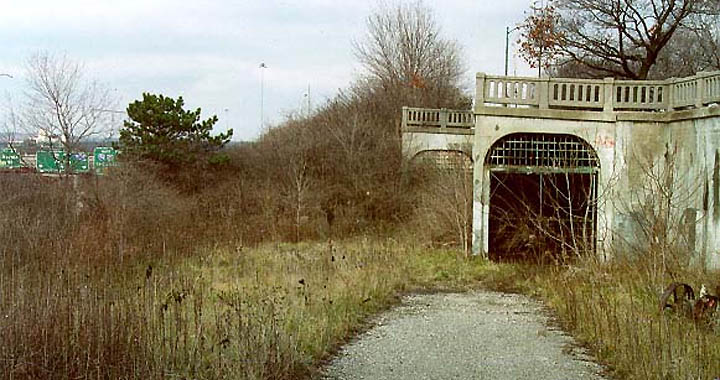
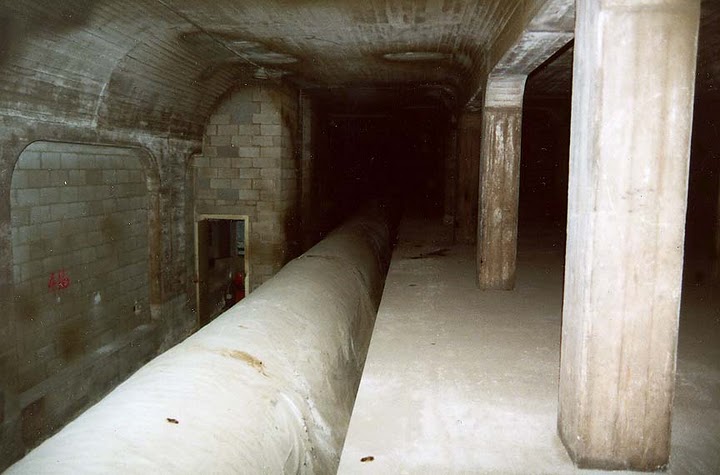
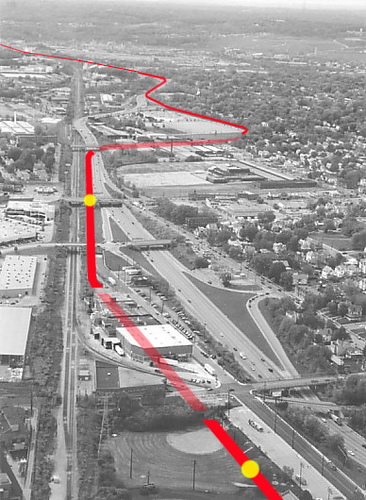
Map of a hidden subway line (one of many):
A similar tunnel system (but build in the 70s) runs underneath downtown core in the city of Calgary, Canada. The
LRT (Light Transit System) line was meant to run underground, but the plans were shelved for the financial
reasons. There are a few doors in Calgary leading to this explorer's playground, to tunnels wide enough for rush
hour traffic.
Urban Archeology
See the entire article with some great pics at: http://milkshakechocolate.net/subwayNYCsduncan.htm
Going underground is not only taking the subway to go somewhere in the city.
The cities have developed another whole world hidden in its interior. The cities grow with their inhabitants and so
spaces before essential now are just mere appendices of the city abandoned and covered with layers of soil,
streets, pipes or subway tracks.
There are people that find these abandoned places something to take care of because they tell our story better
than anything else. These people study old geographic books and city plans to find those places that were
indispensable in our cities not that long ago.
The classic example if this fact are the ghost stations in the subway tracks. Hundreds of websites and blogs try to
explain the best spots from where you can see some of these ghost stations. But those are only little examples of
what we can find if we dig a little in our cities.
I had the pleasure to meet Steve Duncan, one of these urban archaeologists that travel underground our cities to
find out a little more about our history. He gently answered some questions for Milkshake Chocolate and provide
amazing pictures from his own web site.
by Patricia Yague
Urban Archaeology:
Steve Duncan for Milkshake Chocolate
How and why did you start to explore the hidden parts of the cities?
"I started pretty much as soon as I came to New York.
I came to NYC for school, and fell in love with the city right away. For the first few months here, I kept on
"discovering" things that everyone knows about-- I was really excited to find out i could walk across the Brooklyn
Bridge; I biked around the city and wandered around the abandoned piers on the west side of Manhattan; and
sometimes when I was around industrial parts of the city I'd go into random buildings and see if I could get onto
the rooftops, just to be able to see the city laid out and see how the blocks connected.
And I was in college, at Columbia University, which is a century-old campus which was actually built on the site of a
former insane asylum (the Bloomingdale Insane asylum was there in the 19th century). Like most universities, all
the buildings on campus are connected to each other with a series of utility tunnels that carry steam, water, and
phone and data lines. But because it's a fairly old university built in New York, the tunnels range greatly in age,
and there are even one or two tunnels that incorporate old stone foundations from the insane asylum that used to
be there. So I became fascinated when i realized that you could literally see the past by going underground. Also
at the time it was a huge adventure to try to find ways into the closed-off sections of the tunnels... The challenge
was really exciting, and it was also exciting to realize that there were these relatively unknown and hidden spaces
that were closed off to most people, just hidden away behind locked doors and the walls of ignorance that most
people have about the world around them."
Mole People:
	http://www.undercity.org/ {Truly awesome photography - something you've got to see!}
            My fascination with New York's underground began when I heard of "mole people," homeless people who
lived in tunnels and built their homes in these underground spaces. Over time I became familiar with many of the
tunnels in the city. Though there are many underground spaces in New York, very few are accessible and large
enough to provide shelter; however, some do exist in particular a series of old train tunnels provides shelter from
the wind and rain under Manhattan's west side.
            A fairly large community existed in this area in the 1980s and early 1990s, though its residents were
expelled and the structures inside the tunnel razed as Amtrak purchased the track rights to run its trains from
Penn Station. This was concurrent with efforts by the Giuliani administration to remove homeless and transients
from any established tent cities or squatter communities. A few of the more hidden people remained, however—
the oldest residents that remain have been there nearly two decades—and in the intervening years other
shorter-term residents have also come to call these tunnels home.
            I've worked with documentary filmmakers or reporters who try to see in the tunnel-dwellers a metaphor for
the social stratification in New York, as these people quite literally live underground beneath the "respectable" city,
and in some cases even directly below condos and apartment buildings where much richer people live in a luxury
that seems worlds apart. I don't see this metaphor as an accurate description, however. Documentarians who
come with this idea as a pre-determined paradigm always seek to interpret lives lived underground as particularly
miserable, oppressed, or pathetic. This does a great disservice to the people who are described this way. What is
more accurate is that these people, just like any others, are real and complex individuals living in a difficult
environment. Some have made relatively comfortable homes for themselves; some suffer from problems and
personal difficulties; all have their own stories and, in their own ways, try to live the best life they can.
            In photographing and interviewing these "mole people, there are two things in particular that I seek to show.
The first is the incredible, constant ingenuity that people have in building homes and lives in all parts of the urban
environment—the harsh environment of tunnels makes this all the more apparent. The second is that their very
existence, and the fact that they can live out their lives in these hidden, unknown niches, hints at how much there
really is in this city—especially underground—that's beyond the quotidian city we all know and see.
Response

Seattle Underground:
	http://www.undergroundtour.com/about/history.html
 In 1889, a cabinetmaker accidentally overturned and ignited a glue pot. An attempt to extinguish it with water
spread the burning grease-based glue. The fire chief was out of town, and although the volunteer fire department
responded they made the mistake of trying to use too many hoses at once. They never recovered from the
subsequent drop in water pressure, and the Great Seattle Fire destroyed 25 city blocks.
 Instead of rebuilding the city as it was before, they made two strategic decisions: that all new buildings must be of
stone or brick, insurance against a similar disaster in the future; and to regrade  the streets one to two stories
higher than the original street grade. Pioneer Square had originally been built mostly on filled-in tidelands  and,
as a consequence, it often flooded. The new street level also assisted in ensuring that gravity-assisted flush
toilets that funneled into Elliott Bay did not back up at high tide.
Dallas Underground:
I used to love going underground in downtown Dallas, TX ~30 yrs. ago!  There were lots of shops and places to
eat. The downtown Dallas Underground dates back to the 1970s and was developed and expanded as new
skyscrapers were completed. Thousands of employees could eat and shop in the Dallas Underground every
weekday without venturing out into the summer heat (aka "the furnace") or winter cold.
At least one person did not enjoy exploring this area:
	http://www.johnnyamerica.net/archives/2005/09/01/11.35.58/
Cheers!
Abandoned Man-Made Military Island
	http://weburbanist.com/2008/01/06/7-more-abandoned...institutions/
		(Truncated as it was @ a mile long)


	Baltimore, Maryland has a number of interesting abandonments, but none
	so sizable and prominent as Fort Carroll. Over a century old, this for was
	constructed in the middle of the 19th century though it never saw war. In
	WWII it was briefly used as a firing range for the Army and a checkpoint for
	ships, but has been abandoned ever since. Developers have failed to find
	uses for it and it has since become a habitat for numerous animals and the
	site of occasional urban explorations.
Response:
Hi, MEG, I found your page on underground city spaces to be fascinating. Great starting point! But when exploring an
underground space, one should have a minimum of tools so as to come out alive: light source, defense tools, and ways
to mark things.
Light source can be anything that works for you; if a flame, it should be protected from drafts, & think twice about going
where combustible fumes are or might be. Carry spare batteries for a flashlight if you can, but try to keep them away from
coins (like pennies) in your pockets!!
Defense tools are anything to keep you safe from anything else. Plastic bags, one wrapped around each foot, can keep
you from tracking sewage into your (hopefully clean) hiding spot. Of course weapons count as defense tools, also. A
ladder, placed where you can easily remove it to prevent someone following you, is a means of access or defense. Also
handy is a trip wire or other alarms, like empty plastic bottles than will roll & rattle loudly when someone unfamiliar with
your area comes in.
Lastly, you need a way to keep track of your paths & locations & goods. IMHO, ideally a mark should be easy for you to
understand but also easy to remove or alter if you need to.  It can be as simple as a message scrawled on the wall by the
entrance, or as not-so-simple as a song softly sung while counting out the proper number of steps in the dark.  You can
carve identifying lines into the ceiling, or string some rope along the wall or ceiling, attach bottle caps at intervals, etc; use
chalk/paint lines, like the different-colored lines of paint that indicate the different "lines" of the Boston "T" system. Just be
sure you consider how easily an enemy can alter these & thus confuse you.  Another good idea would be a way to indicate
if, for example, a room is occupied, and if it's okay to go in. A bendable twig on the doorknob might indicate okay to go in,
a piece of steel would indicate no; a smallish round rock by the door might mean "empty room", a triangle may mean
"hazards inside!"  etc.
Reply:
	Thanks, Kris. Good suggestions. I don't relish the idea of having to exist in these spaces, but if I had to, these
	are very practical suggestions to consider.
Please Read The Website Disclaimer!
Copyright 1986-2012, The Survival & Self-Reliance Studies Institute (SSRsi), All
Rights Reserved
Site conceptualized, designed, created & maintained by MEG Raven
Snail Mail: SSRsi, PO Box 2572 Dillon, CO. 80435-2572