





















Add to this topic area by submitting your own article/ideas!
LDS Surviving in the City

Introduction
While we all want to do our best to prepare for a coming crisis, and many of us realize the city is perhaps the worst
place to live, very few people are really prepared to pack up the old Winnebago and head for the hills. Most
Americans, whether they're aware or not, are going to stay in the cities.
This is not a hasty decision for most people. Most of us depend on the city for our livelihood, and we can be better
prepared by continuing to live in the city, earn a good income, and make preparations for exiting the city at the
appropriate time or by staying in the city and living off existing supplies.
This special report explains some of the most critical dangers of living in a city and presents some solutions to
surviving them. If you are one of the people who has decided to stay in the city, you'll benefit greatly from this
information.
Cities are artificial
Every city is an artificial construct. Cities formed as people came together to conduct business, participate in social
interaction, and benefit from efficiencies in public services (such as schools, sewers, water, etc.) and a common
defense. Yet cities cannot survive alone. They need resources from the country; most notably, food, water and
electricity. While electricity and water can sometimes be created or found within city limits, the acreage
requirements of food dictate that no city could possibly feed its own people.
Read that last phrase carefully: No city can feed its own people. Not one. Cities are, by their very nature,
dependent on the importation of food. The advent of just-in-time delivery systems to our grocery stores means that
most cities would run out of food within a week if supplies were for some reason disrupted.
Remember, cities are not self-sufficient. Although they may seem to be in 2005, they have for a long time been
entirely dependent on the American farmer for their support, something almost all Americans take for granted
(except the farmer, of course.)
Risks in the City
The city presents some serious risks during a crisis. The four most serious ones are:
	1. the collapse of social order (riots),
	2. the failure of the water treatment and delivery systems,
	3. the depletion of food supplies and
	4. the failure of the power grid.
While not every situation will appear in every city, every situation will most certainly appear in some cities. Will that
include yours? We'll tackle these one at a time:
1. The Collapse of Social Order
"Social order" is a delicate thing, and it exists as a psychological barrier that could easily collapse under the right
conditions. We all saw this during the L. A. Riots following the Rodney King trial verdict as citizens of L. A. set fire
to their own town, yanked people from vehicles and beat them literally to death, and even fired guns at firemen
attempting to save their buildings! More recently we were all witness to the looting, violence and total breakdown
of society following Hurricane Katrina in New Orleans.
What allowed this to happen? Simple: the simultaneous melting away of the psychological barrier of "order." Once
people realized 911 couldn't handle the load, or was offline, that the local police were helpless or had simply
abandoned their posts, "Law and Order" ceased to exist in their minds. They then conducted their lives in the way
they always wanted to, but couldn't because of the police. That is, they ran out to the local stores and just took
whatever they wanted (looting). They took our their racial frustration on innocent victims who happened to be
driving through the area, and they let loose on a path of destruction that only stopped when men with rifles (the
National Guard) were called in to settle things down. In other words, only the threat of immediate death stopped
the looting and violence. Rifles work wonders.
Imagine store owners lying prone on the roofs of their stores with AK-47's, firing at anyone who approached. This
is exactly what happened in Los Angeles. But worse, imagine the lawless horde firing at the rescue copters trying
to bring in supplies to the desperate masses.
The National Guard eventually got things under control. This event was isolated, however, to one city. Imagine a
hundred cities experiencing the same thing. Will the National Guard be able to handle the load? Not likely. What
about local police? They aren't fools; if things look bad enough, they'll grab their families and head for the hills,
just like they did in New Orleans. No pension is worth getting killed for. A few U. S. cities could be transformed into
literal war zones overnight. It would require all-out martial law and military force to have any chance whatsoever of
bringing order to these streets. And the reality is that there are not enough military in the USA to secure all of the
cities if this happens.
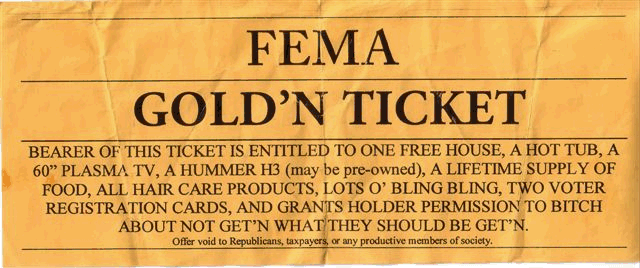
This collapse of social order is perhaps the greatest risk of staying in the city during a crisis. What, exactly, would
cause this collapse of social order? Lack of three things: food, water, and money. When people run out of
food, some will begin ransacking their neighborhood, searching for something to eat. (Remember that in a city, a
"neighbor" does not mean the same thing as a "neighbor" in the country. They are not necessarily your friends.) It
won't take long, then, for violence to take over in some cities. While certain regions will certainly manage to keep
things under control and people will form lines at the local (depleted) Red Cross shelter, other cities will see an
explosion of violence. Imagine the gang-infested regions of L. A., Chicago, New York, St. Louis & New Orleans. Do
you think those people are going to stand in line and wait? They already have guns; now they finally get to use
them. Pent-up racial tensions & hostilities will simply serve as justification for shooting people of the same or other
color in order to get their food.
Even if the food somehow gets into the cities, lack of money (due to the government not sending out checks) could
cause the same thing. Eventually, lack of money results in looting and mass theft. As the stealing balloons, it also
results in a collapse of social order. Water; the same thing (but faster). The collapse of social order is also very
dangerous because it doesn't require any "actual" collapse of the power grid, telecommunications, transportation
or banking. Social order is a psychological artifact. It is a frame of mind, and any global panic can quickly remove
the mental barrier that right now keeps people basically "lawful."
2. The Failure of Water Treatment and Delivery Systems
Will the water treatment facilities fail during a crisis? Many will. Some won't. The problem lies in figuring out whether
yours will. Certainly, they depend on electricity, and testing conducted on some plants has already revealed
weaknesses in the system.
In one such test, the water treatment plant released a fatal dose of fluoride into the water system when tested. The
computers thought they were 99 years behind in releasing minute doses of fluoride, so they made up the
difference. If you happened to be downstream, drinking that water, you were dead. Fluoride, no matter what
misinformed dentists tell you, is actually a fatal poison. A major crisis likely to demonstrate this fact in more than
one city.
The most important question here, though, is about what will happen when the water stops flowing (or if it is flowing,
but it's not drinkable). As you are probably aware, while people can live without food for long periods of time (2-3
weeks), water is needed on a daily basis. You can go 2-3 days without it, at most, but beyond that, you'll quickly
turn to dust.  [See www.EndTimesReport.com/water.html]
That means people will do anything to get water, because to not have it means death. And guess where it's going
to be the most difficult to actually get water? You guessed it: in the cities. During the first day of the water crisis,
many people still won't figure out what's going on. They'll figure it's a temporary breakage of a water main and the
government will get it fixed within hours. As those hours stretch into the next day, these people will get very worried.
By the second day, more and more people will realize the water isn't coming. At that point, you could easily see a
breakdown of social order, as described in the previous section (as you can see, these things all tend to cause
each other.). People will begin their "search for water," and the first place they're likely to go is where they always
go for liquids: the grocery store, the local Wal-Mart, the 7-11. The shelves will be cleaned out rather quickly.
Beyond that (because those liquids aren't going to last long), you're going to see people engaged in a
mass-exodus from the cities. They'll take the gas they have left in their tanks and they'll leave the city in search of
water. Some will go to "Grandma's house" out in the country where they might at least find a pond or stream to
drink from. Others will simply go on an expanded looting mission, stopping at any house they see and asking the
residents (with a gun in their face, likely) if they have any water to "donate."
As a result of all this, if water stops flowing, here are the events you can expect to see in some of the worse-off
cities:
	•    Looting of all the grocery stores by the second or third day (remember New Orleans?)
	•    Minor outbreaks of violence during the looting. Shop owners, for example, may attempt
	     to defend their shops with firearms (ala L. A. Riots)
	•    Mass exodus of residents from the city in search of water
	•    Ransacking of any houses or farms within a gas-tank radius of the city, presumably by
	     desperate people with guns
	•    Mass traffic jams on the outbound highways as people run out of gas and abandon their
	     vehicles (if bad enough, this could actually block the highways and trap people in the
	     cities) (Remember Hurricane Rita?)
	•    Mass outbreak of water-borne diseases as people use streams and rivers as both a
	     water fountain and a bathroom. People crapping upstream are going to infect the
	     people drinking downstream. Very few have any kind of water filtration device. That last
	     point is really critical. Once the water flow stops, disease is going to strike.
3. The Depletion of Food Supplies
The food supplies will likely dwindle quickly as we approach a possible crisis due to people stocking up just in case.
Once the crisis actually hits, expect to see breakdowns in the transportation sector that will result in major delays in
food delivery. This means food may arrive in sporadic fashion in some cities (if at all).
Once this happens, food suddenly becomes really valuable to people (even though they take it for granted today).
And that means any small shipment of food that arrives will be quickly grabbed and eaten or stored. It only takes
one week without food to remind people how much they actually need it, so expect the atmosphere to be that of a
"near panic" if food is delayed by as little as three days. The level of panic will vary from city to city. Some cities or
towns may experience very little difficulty receiving food. Others may face near-starvation circumstances.
Remember, the cities depend entirely on food shipped in from the farms and food processing companies. Also,
note that if there's a water problem as mentioned in the previous section, and the mass exodus begins, the
highways may be jammed up at critical locations, causing gridlock for the trucking industry. If we're lucky, some
trucks will continue to roll. If we're not, assume that nothing gets through.
[See www.EndTimesReport.com/food.html]
A shortage of food ultimately results in the same behavior as a shortage of water. First, people eat what's in the
pantry, then they loot the grocery stores. After that, with all local supplies depleted and no hope on the horizon,
they leave the city and start ransacking nearby homes. Some will hunt in nearby forests, but most city-dwellers
don't know how to hunt. In any case, anyone with the means to leave the city will likely do so soon after their food
shortage begins.
4. The Failure of the Power Grid
Nothing is as suddenly obvious nor has such a gigantic psychological impact as the failure of the power grid. When
the electricity stops, almost everybody knows it at the same instant (unless it happens at night).
Naturally, during the first few hours of the power failure, if it occurs, people will assume it's a temporary situation.
Maybe a tree fell on some power lines, or perhaps a transformer blew up somewhere nearby. They'll sit tight and
wait for the power to come back on.
What if it doesn't? Then the city faces a severe problem. Without power, obviously, everything shuts down. Within
hours, the looting begins in the more crime-ridden cities (we saw this in New York a few decades ago.). The longer
the power stays off, the worse the social disorder.
The loss of power will bring the entire city to a halt. While vehicles may get around for a few more days (using
whatever fuel they have left), businesses obviously won't be operating. Houses that depend on electricity for heat
will quickly reach Winter temperatures, freezing many occupants to death.
[See www.EndTimesReport.com/kerosene.html]
While those that depend on electricity for Air Conditioning will just as quickly reach Summer temperatures, resulting
in death from heat stroke. Hospitals and police stations may have generators on hand, with a few days worth of
fuel, but in short order, that will be depleted, too.
But the water treatment plant will almost certainly be off-line without power, causing all the events mentioned in the
water section, above. Let's face it, the power is the worst thing to be without in the city. If you have power, you can
survive a food shortage, perhaps even a short water shortage. But without power, all bets are off. If you have a
"bug-out" vehicle stocked and ready to go (see below), this might be the time to bail.
Solutions in the City
Okay, so you're stuck in the city. You've made the decision to stay. You've read the problems above, you believe
they make sense, and you're intelligently frightened. What now? You really have two strategies. You can:
	•    Stay and defend your house
	•    Bug out (leave the city and head for the hills)
Important! This is not an either/or situation. You can begin by staying in your house and assessing the situation.
You'll want to have a "bug-out" vehicle stocked and ready, just in case, if you can afford one, but you may never
actually choose to bug out. You'll have to be the ultimate judge of this. Just remember that when you bug out, you
face major risks and disadvantages. Among these:
	1. You're severely limited in how much you can carry -
	2. You have limited range due to fuel -
	3. You expose yourself to social chaos, roadblocks, random violence, etc. -
	4. Your house will certainly be looted while you're gone -
	5. You run the risk of mechanical breakdowns of your vehicle -
	6. You must have a place to go that you know is in better shape than where you currently are.
In general, unless you have a specific, known safe place as your final destination, I don't advise people to bug out.
Just "heading for the hills" is a very poor plan. You might not make it. But heading for Grandma's house or some
known, safe place could be a very good plan indeed, depending on whether Grandma is ready, willing and able to
accept you! [This subject is covered in depth in my booklet, "Evacuation and Relocation." ]
For these reasons (and more), staying and defending your house is sometimes the only reasonable course of
action, even if it seems dangerous. For the most part, looters and people looking for food are going to have plenty
of easy victims, so if you show a little willingness to use force to defend your property, you'll likely send people on
to the next house.  [See www.EndTimesReport.com/homedefense.html]
That is, until the next house is already empty and you appear to be the last house on the block with any food and
water left. If you're in a bad enough area, your neighbors may "gang up" on you and demand your supplies or your
life. This is truly a worst-case scenario, and unless you literally have a house full of battle rifles and people trained
to use them (and the willingness to shoot your neighbors), you're sunk. This is why the best situation by far is to
keep your neighbors informed and help them get prepared. Then you (both your member and non-member
neighbors) can act as a group, defending your neighborhood and sharing the supplies you have with anyone
willing to help defend you.
When you have this kind of situation going, your neighbors realize you are their lifeline. You supply them with food
and water, and they will help support you because they are, in effect, supporting their own lives. The best situation
is when your neighbors and other ward members have their own food and water supplies. That way, they aren't
depleting yours, and they have a strong motivation for getting together with you defend your neighborhood. (More
on this below.)
Storing (and Hiding) Your Food
Storing food is just as important in the city as in the country, but hiding it is far more important. That's because in
the worst areas, marauders will be going from house to house, demanding your food or your life. If you're dumb
enough to put everything you own in the obvious places, you might as well not buy it in the first place. They will find
it. To count on having any amount of food left over after the marauders break in, you'll need to hide your food.
One alternative is to plan on defending your home with force. If you have enough gun-wise people in the house,
and enough firearms and ammo, you can probably pull this off. But most of us aren't nearly as experience with
firearms as the gang members. A better alternative might be to plan on bringing you supplies to your ward/stake
building where all of the Saints can both pool and defend their resources. This of course will depend greatly on
your local Bishop and Stake President.
Back to hiding: the best way to hide your food is to bury it. You'll need airtight containers, long-term food that won't
rot and you'll need to plan ahead. Bury your food at night so nobody will notice, and make sure you don't leave the
map on the refrigerator door! (Better to memorize it!) Try to get the ground to look normal after you're all finished.
You'll want to bury your food as early as possible because it gives the grass time to regroup over the spot. If you're
in an area that snows, you'll have a great concealment blanket! Most food marauders won't go to the trouble to dig
up food, especially if you insist you don't have any.
Best plan: Have some smaller amount of food stashed around the house, letting them find something. Better to
give them something and send them on their way. The art of hiding your food is an ancient one. You've got to get
creative. Use the walls, the floors, and the structure of the house.
If hiding your food is simply not an available alternative, then try not to advertise it. Keep it put away in your house
or garage in as discreet a manner as possible. Don't make a point of telling people that you have a years supply
(or more). Word gets around fast that Bro. Jones has a ton of food in his garage. Boxes of food fit nicely under
beds, behind furniture, in the attic, etc.. Be Creative!!
To sum up the food storage, you really have three strategies here:
	•    Store it all in your house and plan on defending it by force.
	•    Bury it in your yard in case you get overrun by looters.
	•    Store part of it in your house, and hide the bulk of it.
	•    Relocate all of it as soon as you recognize a major disaster is in progress
One of the best ways to store food for burying, although it will only last 2-3 years in high-humidity areas, is to
purchase 55-gallon good-grade steel drums. You can get them from: Memphis Drum Service, 3299 Tulane,
Memphis, Tennessee 38116 (901) 396-6484; (800) 960-3786) The drums are only $16.50, but shipping them is
around $30 each. Once you obtain the drums, dump in your grains or other food items. If you purchase bags of
food from Walton Feed, this is the perfect way to store it. Don't leave it in the bags unless you're actively eating it.
[Note: Plastic barrels do not rust.]
Then sprinkle some {food grade} diatomaceous earth into the drum. You'll need about two cups to treat a 55-gallon
drum, and it must be mixed in well. Diatomaceous earth is made from ground up sea shells, and it kills bugs by
getting into their joints. You can get some from: Perma-Guard, Inc. 115 Rio Bravo S. E. Albuquerque, New Mexico
87105 (505) 873-3061
This diatomaceous earth is food grade, and on the bag it says, "Fossil Shell Flour." Their prices are one pound,
$4.90; 2 lb., $8.05; 5 lb., 14.70, 10 lb., $18.00; 50 lb., $24.95.
Once you get these drums filled and sealed, you can then bury them in your yard. This is actually a HUGE
UNDERTAKING and is a LOT more difficult than it sounds, since you'll need to dig to a depth of around 5 or 6 feet
in order to sufficiently bury these drums. You're likely to attract a lot of attention unless you do it at night, and you'll
definitely be removing a lot of dirt that you'll need to find some use for. Because the drums are steel, they will also
deteriorate unless you line the outside with plastic (a good idea) and treat the drums with some kind of protectant
or oil. (Don't use WD-40.) Even Vaseline would work well, although you would definitely need a lot to coat a
55-gallon drum.
When you're all done, you should have your protected grains in 55-gallon drums, buried in your yard and protected
against the humidity of the surrounding earth. It's a big effort, but then again, the food inside may save your life.
You'll find it much more efficient to bury several barrels at once; side by side.
In reality it would be faster and easier to simply build a false wall in your garage and seal up your food behind the
false wall. Sure, you might loose 2-3 feet of useable space in your garage, but the tradeoff is knowing everything is
safe and sound.
Storing Extra Water
Water can be stored in exactly the same way, although you might want to bury the barrel before you actually fill it
with water. Make sure you treat your storage water, rotate it or have filters on hand when you get ready to use it.
If you don't have a yard, or it's not practical to bury your water, you'll have to store water inside your house. This
can get very tricky because water takes up a lot of space and it's very difficult to conceal. It's best to get containers
made for long-term storage, but in a pinch, you can use almost any container: soda bottles, milk jugs (although it's
very difficult to rinse the milk out), and even rinsed bleach bottles (in that case, you won't need to add bleach). But
a lot of these containers will deteriorate quickly, and they may break easily. Also, consider what happens if your
water may be subjected to freezing. Will your containers survive? Be sure to leave enough air space to handle the
expansion.  [See www.EndTimesReport.com/water.html]
In order to prepare yourself for the water shortage, assuming you're going to stay in the city, stock at least six
months of water at a minimum two gallons a day per person. That's nearly 400 gallons of water if you have two
people.
Of course, even with the best in-house preparations, you may find yourself depleted of water supplies. In this
situation, one of your best defenses is to have a really good water filter (like the Katadyn filter) that can remove
parasites and bacteria from the water. You can also treat your water in other ways (iodine, distillation, silver
solution, bleach, etc.). Armed with these items, you can safely use stream or river water (or even pond water) for
drinking.
WATER WELLS
By far, the best solution for obtaining long-term water supplies is to drill a well. Buy the best-quality hand-pump
available (cast-iron pumps available from Lehman's) and a good cylinder. They will last a lifetime if installed
properly. With this setup, you'll have a near-unlimited supply of water.
The total cost of doing this, depending on where you live, ranges from about $4000 - $6000. Is it worth it? If you've
got the money, I think so. However, many cities simply don't allow the drilling of wells, so you may not be able to get
one drilled even if you want to.
The deeper your well, the more expensive it gets. Most well drilling companies charge by the foot. When water is
deeper, you also need a bigger pump and a more powerful cylinder, so the costs tend to really grow the deeper
you go. If you can find water at 20', you're very lucky and it might not cost you even $2000. If you have to go down
to 200', it might cost you $7500, and you're at the depth limit of hand-powered pumps anyway.
Defending Your Life and Property
Let's talk about force. No doubt, there are plenty of nice people in this country, and I think that in small towns and
rural areas, people are going to find ways to cooperate and get along. I also think, however, that some cities will
suffer complete social breakdown and violence will rule. If you happen to be stuck in one of these cities, you're
going to need to use force to defend your house. The section that follows discusses what I consider to be extreme
responses to violence in the most dire situations. Hopefully, you won't find yourself in these circumstances, but if
you do, the information below may be valuable.
Important: Do not use your lights at night. If you are stocking propane-powered lanterns, solar-powered flashlights,
or other unusual supplies, using them at night will announce to everyone within line of sight that you have more
than the "usual" supplies. Expect them to come knocking in your door.
[See www.EndTimesReport.com/lighting.html]
At most, let a fire burn in the fireplace, but in general, avoid drawing attention to your house.
Defending your house is a crucial element on your stay-in-the-city plan. Make your house your fortress, and hold
drills to help other family members practice some of the more common activities such as hiding, defending,
evacuating, etc. Some useful items for home defense include:
	•    A guard dog
	•    Pepper spray
	•    Firearms
	•    Smoke bombs (military-grade)
	•    Trip wires
Let's go over these:
The guard dog is certainly a welcome addition to any family trying to defend their house. Although he probably
eats a lot of food, the investment is worth if. Dogs also tend to sleep light, so let them sleep right next to the food
storage areas, and make sure you sleep within earshot. If the dog barks, don't consider it an annoyance, consider
it an INTRUSION.
Pepper spray is a great alternative to the firearm. It will incapacitate people and certainly give them a painful
experience to remember. On the downside (potentially), it might just remind them that next time they come back for
food, they better kill you first. So understand the limitations of pepper spray.
Firearms are useful for obvious reasons. In the worst-case scenario, when looting is rampant, you may have to
actually shoot someone to protect yourself or your family. If you're squeamish about pulling the trigger under these
circumstances, don't plan to stay in the city. Use the "bug out" plan instead.
Smoke bombs can be useful for covering a planned escape from your house. You can purchase high-volume
smoke bombs that will quickly fill up any house with an unbreathable cloud of military-grade white smoke.
Trip wires are great perimeter defenses. You can buy them from Cheaper Than Dirt (they run a few hundred
dollars). They will give you early warning if someone is approaching. You can connect the tripwires to flares,
shotgun shells, light sticks or other warning devices. This way, you can have an audible or visible alert, your
choice.
In addition to these devices, you can make significant fortification-style improvements to your home. While none of
these are very affordable, they certainly help defend your home:
	•    Replace glass windows with non-breakable Plexiglas
	•    Add steel bars to the windows
	•    Replace all outside door locks with heavy-duty deadbolts
	•    Replace all outside doors with steel doors, preferably without windows
	•    Remove bushes and other shrubs where people might hide
	•    Black out the windows entirely to avoid light escaping at night (similar to
	     what residents of London did during the WWII bombing raids)
	•    Build secret hiding places for food, coins, or even people
	•    Create escape hatches or passageways
	•    Rig pepper-spray booby traps
These aren't as absurd as they might at first sound. Many people living in rough cities already have steel bars
covering their windows, and removing extra bushes and shrubs is a well-known tactic for making your home a safer
place.
LIGHT
To light your home when there's no electricity, try the following:
	•    Use LED flashlights and rechargeable solar-charged batteries. You can buy
	     all these items from the Real Goods catalog
	•    Use propane-powered lanterns. You can find these in the camping section of
	     your local Wal-Mart. Be sure to purchase extra mantles and store lots of propane.
	•    Purchase quality oil lamps from Lehman's and stock up on oil. You can also
	     purchase cheap kerosene lamps from the Sportsman's Guide or Wal-Mart, then
	     simply purchase and store extra kerosene.
	•    Buy extra candles.
	•    Purchase lots of olive oil. Not only can you cook with it (and besides, it's a lot
	     healthier than corn or vegetable oil), olive oil also burns as a clean candle fuel.
	     You can float a wick in a jar half-full of olive oil and light the wick. Viola, a
	     home-made candle. Olive oil is a fantastic item for your storage anyway because
	     even if you purchase all the grains in the world, you'll still need cooking oil, and
	     you obviously can't buy powdered cooking oil. Well-stored olive oil can last for
	     thousands of years.
STAYING WARM
Did you know that people won't steal giant logs? Although they may easily steal wood you've already chopped,
most people won't have any way of stealing logs. They're too heavy, and the vehicles won't have any gas left. For
this reason, your best bet in regards to stocking fuel for your house is to stock up on UNCUT wood logs.
It takes a lot of extra research to find out how to get them (took me a few weeks of asking around), but you can find
a source if you look hard enough. Or you can usually get a permit to go out and cut your own. The effort is worth it,
because this will give you a ready-to-go source of heat and fuel that cannot be easily stolen.
The catch, of course, is that you'll need equipment to cut and chop the wood. A chainsaw is REALLY nice in this
way, but it requires fuel. Fortunately, chain saws don't use much fuel, so if you have a way to store as little as 50
gallons or so, you've got enough to power your chainsaw for a few years (at least!). You'll need fuel stabilizers, too,
which you can buy at your local Wal-Mart. (Be sure to buy extra chains for your chainsaw, too.)
You'll also need splitting hardware. You can buy log splitters or just buy an axe, a wedge, and a sledgehammer.
[This is too simplistic: See www.EndTimesReport.com/woodcutting.html]   Better yet, buy all four so you have a
choice of what to use. And remember, wood splits much better when it's frozen, too, so you might just wait until the
cold hits in Winter to start splitting your wood. Only split a little at a time, because you don't want to end up with a
big pile of nicely-split wood sitting out in your yard. It will invite theft from people who don't have any. If you already
have trees on your property, you're all set. Cut down about 4-5 cords right now, so they can start drying out, then
chop them as you need them.
A "cord" of wood, by the way, is a volume measurement. It's 8' x 4' x 4', or 128 cubic feet of wood (stacked). Some
people that sell wood will try to rip you off, so make sure you know what you're buying. If you purchase logs, it's
better to get a price per linear foot, based on the diameter of the log. For example, you might ask for logs that are
an average of 10" in diameter, and you'll ask how much the charge per linear foot would be. Something in the
range of $1 - $2 would be great.  [See www.EndTimesReport.com/storing_firewood.html]
Relations With Neighbors
I've already mentioned the importance of getting along with your neighbors. It really is crucial to your city-based
survival plan. The best situation to be in, as mentioned before, is to have neighbors & other church members who
are aware of the issue and who are getting ready for it by stocking their own food, water, and other supplies. Every
neighbor & member that becomes self-reliant is one less neighbor or member you'll have to support.
The range of neighbor situations, from best to worst, is as follows:
	•    Best case: your neighbor is current Recommend holder, is aware of and both temporally
	     & Spiritually prepared for an emergency with their own supplies and training.
	•    Good case: your neighbor is aware of a potential crisis, and even though they don't have
	     their own supplies, they're willing to help defend yours as long as you share
	•    Bad case: your neighbor is a non-member that didn't prepare for it, figuring they would
	     just steal from you if things got bad. They are aware of YOUR supplies but don't have
	     their own.
	•    Worst case: your neighbor isn't aware of anything, he is anti-Mormon and he's a violent,
	     angry neighbor just released from prison. He is going to be caught off guard by the
	     ensuing events and will likely attempt to use violence to get what he needs or wants.
Your decision on whether to stay in the city may depend greatly on the quality and quantity of your neighbors. If
you do live in a bad neighborhood, do what you can to relocate. If you live in a good neighborhood, do the best
you can to educate and inform your neighbors. This might well be the most important missionary work you ever do
for your own temporal salvation!
Gun Control in the Cities
No matter how you felt or thought about gun control in the past, it's time to face disaster-induced reality. The
gun-control politicians (and the people who supported them) have placed Americans in a situation where not only
can the police not protect us in a timely manner, but we cannot lawfully defend ourselves. Criminals unlawfully have
firearms; citizens lawfully don't. Intentionally or otherwise, gun-control supporters have created a situation where an
unfortunate number of innocent men, women and children are going to be in danger during a crisis simply because
they could not obtain the tools of self-defense.
It also happens that the cities where the rioting will likely be the worst are precisely the cities where firearms are
most likely to be banned from lawful ownership (and where criminals may wield near-absolute power for a while.).
Perhaps when society recovers from it, we can review the fallacy in the cause / effect logic that keeps people
voting for gun-control laws, but in the mean time, millions of people are going to have to resort to breaking the law
in order to protect their families. And yes, you too will have to resort to breaking the law if you are to acquire a
firearm in an area where guns are entirely banned from private citizens (like New York, Los Angeles, etc.).
After the disaster hits, if the rioting gets really bad, we're going to see local police begging law-abiding citizens for
help. Your firearm will be a welcome addition to the force of law and order, believe me. No local cop is going to
mind you having a handgun if you're manning a roadblock protecting a neighborhood of families with children. Act
responsibly, tell them what you're doing, and they'll probably give you a big thanks. But if you're carrying a gun
while you smash a window of the Wal-Mart and walk off with a stereo; well that's a different story. Be prepare to get
shot.
See, cops don't mind private ownership nearly as much as we've all been led to believe. I know, I work with law
enforcement officers in a small town, and I ask them about topics like this. When the crisis hits, they'll be more than
happy to have your cooperation. We're all going to need as many law-abiding gun-toting citizens as possible in
order to fend off the criminals and establish some degree of order.
One More Reason To Move Out
If you really feel you need a firearm to protect yourself and your family, your best bet may be to move to a city or
state where people are a lot more accepting of firearms. You'd be surprised what a difference the locale makes.
Check the gun laws in any state you're considering moving to. Obviously, "cowboy" states like Arizona, Texas and
Wyoming will have fewer restrictions on firearms (and, interestingly, they have less of a problem with gun violence).
States where the population is more dense (like California & New York) tend to have much greater restrictions on
private ownership of firearms.
Bugging Out
Suppose it's July 14, 2006, and you've changed your mind about this city thing. You happened to be right smack in
the middle of one of the worst-hit cities in the country. The looting is getting worse, the power has been out for two
weeks, and your water supplies are running low. You still have enough gas in your truck to make it out of town if
you can get past the gangs, that is. You've decided to BUG OUT!
Some basic pointers:
	•    Don't try to bug out in a Chevy Geo. You will likely need a big heavy 4x4 truck in order
	     to go off-road and around stalled vehicles
	•    Get something that can carry at least 1000 pounds of supplies. A big 4x4 pickup will do
	     nicely! Yes, it requires more fuel, but you can carry the fuel as cargo.
	•    Don't bug out unless you can have someone ride shotgun, literally. You will need an
	     armed passenger in case you run into not-so-nice people
WHAT TO TAKE   [Overly simplistic. See my booklet Evacuation and Relocation.]
Ahh, the bug-out supply list. All this will fit in your truck. Here's what you should take if you're preparing to bug out
with two people:
	•    Your 96 hour kits for each person in the vehicle
	•    20 gallons of water
	•    40 gallons of extra fuel or more (and a full gas tank)
WHERE TO GO
As mentioned earlier, if you have a designated place of refuge (Grandma's house, a cabin in the woods, etc.),
head straight for it. If not, you're basically driving anywhere you can go, so try to head for an area that forested
and near a creek or river where you can get some water.
Conclusion
Choosing to remain in the city is a rational choice for many people in many situations. However, as you have seen
from the dangers described here, the further away you can get from the population centers in general, the better
your chances of surviving.
Most people, perhaps yourself included, have a difficult time actually accepting that a major disaster is going to be
as bad as described in this report. And after all, if you leave the city, sell out, quit your job, move to the country,
and then nothing bad happens? You will have disrupted your life, and you may find yourself broke, jobless, and
homeless. You COULD assume it will be a mild event, which I suppose is also a credible possibility. In that case,
surviving in the city will be quite feasible, especially if you have neighbors that can support your efforts and you
don¹t live in a dangerous city with high racial tensions. However, the very nature of a major disaster means that if
only one or two major infrastructure components goes down, the ripple effect will quickly create a much worse
scenario. It seems there is very little room for "mild" effects unless they are miniscule. The most likely scenario at
this point clearly points to massive disruptions, severe shortages in food and water, loss of power in some areas,
and a breakdown of social order in certain areas where the population density is high.
But you can survive anything with good planning, an open mind, and plenty of practice. Why not start now?
~~~~~~~~~~~~~~~~~~~~ ~~~~~~~~~~~~~~~~~~~~ ~~~~~~~~~~~~~~~~~~~~ ~~~~~~~~~~~~~~~~~~~~ ~~~~~~~~~
Christopher M. Parrett's LDS Preparedness site.
Here you will find a few items of special interest to LDS (Church of Jesus Christ of Latter Day Saints) Members.
A copy of my LDS Preparedness Manual, V5.02 (Nov 1st, 2008)
http://www.ldsavow.com/preparedness/Preparedness.pdf
If you would like to purchase a Hard Bound printed copy at cost, rather than download and print 220+ pages, follow
this link. LDS Preparedness Manual - Printed Version
A copy of "Behold I Come Quickly". A short pamphlet on why the Saints should get prepared Right Now.
http://www.ldsavow.com/preparedness/beholdicomequickly.pdf
ROGER K. YOUNG FILES.
Roger K. Young's Article, "Preparing for a repeat of Haun's Mill".
http://www.ldsavow.com/preparedness/repeatofhaunsmill.pdf
Roger K. Young's article, "Why Tent Cities"
http://www.ldsavow.com/preparedness/whytentcities.pdf
Audio File of "Roger K. Young's November Presentation" (Large 113MB)
http://www.ldsavow.com/preparedness/RogerYoung Nov9-05.mp3
If you area member of the Church of Jesus Christ of Latter Day Saints (The Mormons) or are just seriously
interested in learning more about Preparedness, I invite you to come and take a look at my online LDS
Preparedness Forums.
LDS AVOW is a gospel-based online LDS community for Saints who are passionate about their Spiritual and
Temporal Preparedness. Join with others just like yourself who are excited about following the Prophet's counsel to
become better prepared & more self-reliant through Provident Living. Come and see what over 11,000 other Saints
have already discovered. "If Ye Are Prepared, Ye Shall Not Fear!"
Another Voice of Warning
Thanks
Brother Christopher M. Parrett
E-Mail Chris
Please Read The Website Disclaimer!
Copyright 1986-2012, The Survival & Self-Reliance Studies Institute (SSRsi), All
Rights Reserved
Site conceptualized, designed, created & maintained by MEG Raven
Snail Mail: SSRsi, PO Box 2572 Dillon, CO. 80435-2572