





















Found a good "Mechanical Power From Water" link? Let Us Know!
Hydroelectric Energy
page.
The Burden water-wheel: The Burden water wheel, built in 1852, was the most powerful
water wheel in the world. It most likely inspired George Washington Ferris to build the Ferris Wheel.
Burwell's chain water wheel: United States Patent 4498294: A
buoyancy prime mover that converts the potential energy of a gas buoyant within
a liquid into rotating mechanical energy comprises a plurality of rigid or
collapsible buckets joined by one or more chains with rotatable sprockets and
shafts to form a continuous loop within an enclosure and means for controlling
the pressure within the enclosure whereby the buoyant gas is trapped within the
buckets, the buckets rise through the liquid and rotate the chain and sprockets
to generate power.
McConnel's improved water wheel: In 1852, Daniel Kennedy's first gristmill
on Slippery Rock Creek was destroyed by fire so he rebuilt it in 1868. Thomas
McConnell bought the mill in 1875, and improved it by replacing the waterwheel
with water turbines and the grinding stones with rolling mills. One of the first
rolling mills in the country, it processed corn, oats, wheat and buckwheat for
local customers. Sagging profits and antiquated equipment closed the mill in
1928, but if you are in the area (west central Pennsylvania), you can visit the
mill and maybe figure out how to DIY. See also:
McConnell's Mill Pictures
Early Water Power
Water has been used to power mills for a variety of tasks since colonial
times. Almost any river or stream of any size in New England had at least
one mill. The first settlement in Woonsocket occurred in the in the late
1660's when Richard Arnold, Sr., an associate of Roger Williams, built a
sawmill powered by the Blackstone River below the Woonsocket Falls in the
area now known as Market Square. The recreated snuff mill at the Gilbert
Stuart Birthplace is typical of this early water power technology. see also
Waterpower on this site.
Water Wheel Engineering, by Ron Shannon (Australia), Chapter Eight -
Technology Stream, a submitted paper, from Conference Proceedings and the
Permaculture Association of Western Australia Inc.
Against the Current and Against the Odds: Noria Technology in México,
by William E. Doolittle, Department of Geography, University of Texas at
Austin. Getting water to lands that would otherwise be too dry for
agriculture is a problem that has confronted farmers since the beginnings of
agriculture itself. One method of raising water from either rivers or wells
to field surfaces is by means of a noria, a vertically-oriented wheel
with buckets attached. As the wheel turns, the buckets dip into the water
source at the wheel's bottom and empty into a trough near the wheel's top.
Water then flows from the trough into a pipe or a canal to fields nearby.
Norias were introduced to México in Spanish colonial times and used in
some parts of the country for centuries. In recent decades, however, almost
all have been abandoned for reasons that remain unclear. One group of
farmers in Veracruz, México, however, is contradicting the trend and is
reverting back to using the traditional technology of the noria. This
paper describes the fruit of their endeavors, and discusses its
implications.
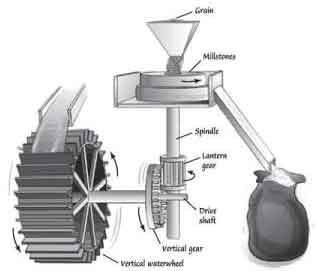
Technological Aspects of Water Wheels. The invention of machines set
in motion by a hydraulic system has ancient origins. The water wheel, both
the horizontal and the vertical one, were already present in the first
century B.C. The most ancient water mill employed for grinding was that with
the wheel placed horizontally, paddle wheel or "swallow-tailed" wheel where
the drive of the motion through the vertical shaft was directed from the
wheel to the millstone
Waterpower for personal use The creak
of an old, wooden moss-covered wheel lazily driving a gristmill in a long
lost past is how most people think of a small scale water power. Of course
water power is old. Historical records put it at around 4000 years old.
While that makes it an ancient technology, that doesn't make it an antique
technology. If you have ever considered windmills, think of a water wheel as
a windmill that uses a fluid 824 times as dense. In other words, 824 times
as powerful. On the negative side, you need access to a good stream, while
the wind is everywhere. I am making this comparison to show that water power
isn't any more complicated than wind power to understand.
How the Roller Mills Changed the Milling Industry by Theodore R.
Hazen. Milling was founded on sound information and tradition passed on from
one generation to another. This is the way it was both in England and when
it came to this country. The millstone was the miller's symbol of his art
and his industry, and they were reluctant to accept roller mills in place of
the millstone.
The Automation of Flour Milling in America Part 1 by Theodore R.
Hazen. Before the Industrial Revolution, mills traditionally derived their
power from wind, tidal and water (stream) power. The wind, sea and streams
supplied the energy that turned wind wheels and water wheels. Inside the
mill, the rotating main shaft turned the wooden gears which provided power
to operate the grinding machinery of the millstones.
The Automation of Flour Milling in America, Part 2. The
Evans mill on Red Clay Creek with most of the improvements was in full
running order in 1785. A pair of Brandywine millers came to inspect the
mill, they found the mill operating but without the benifit of its operator.
They found Oliver Evans working in a nearby field because it was haying
time. The millers had found the mill clean and in perfect working order, and
for the most part were greatly impressed. However, the strange sounding
machinery to them sounded like "a set of rattle traps."
The Young Mill-Wright and Miller's Guide, by Oliver Evans, 1795.
A Cross Section of a Typical Oliver Evans Mill Text and Drawing by
Theodore R. Hazen. This drawing shows a cut-away section of a mill equipped
with the Oliver Evans system of machinery, revealing some of the internal
workings of the mill. The mill is shown with three pairs of millstones,
however, at one time the mill may have had four pairs of millstones. The
machinery shown was installed in a restoration. For simplification, not all
of the machinery is shown. With the Oliver Evans machinery installed in a
mill, such a mill with three pairs of millstones can produce flour to supply
seven bolters (sifters) with ground flour. The millstones, on the first
floor of the mill, are the primary machinery and use 60% of the total
available power. The secondary machinery, the elevators, conveyors (augers),
hopper-boy, bolters, etc., uses the remaining 40% of the power generated by
the water wheel.
The Same Typical Oliver Evans Mill Shown in Side Cross Section
Schematic Layout of a Typical Oliver Evans Mill
How it all works by T.R. Hazen. This is a must see article with fascinating
drawings and great text. Highly informative.
The Hopper-boy of Oliver Evans by Theodore R. Hazen. The
hopper-boy, or cooler, was invented in the late 1700's by America's best
known milling engineer and inventor, Oliver Evans. This mechanical device,
once commonly found in the upper floor of mills, is no longer in use. It
faded out of popularity less than 100 years after its invention. Designed to
cool hot flour coming off the buhr stones, the hopper-boy was automated and
more sanitary than the traditional method it replaced. This was one of the
five inventions that were to make Oliver Evans famous to this day.
Millstone Dressing Tools
by Theodore R. Hazen. Very
interesting & informative article with a host of secondary links showing
actual use of the tools in a restoration project.
Millstone Dressing- Part 1 : Millstone Dressing By Theodore R.
Hazen. Oliver Evans greatly improved the milling business through his
inventions and did a lot to better the life of the miller. However, he did
nothing to improve things for the millstone dresser. Evans advocated
sharpening the millstones twice a week, instead of the usual once a month.
but perhaps because of his inventions, he provided them with more
opportunities to work thus requiring more frequent dressing.
Millstone Dressing - Part 2 :
The Art of the Millstones, How They Work. Excellent article with
great graphics.
Millstone Dressing, An Interpretive Program.
Interior Views of Mills Circa 1850-70 &
New Process Milling of 1850-70 &
More Interior Views of Mills Circa 1850-70
The Fitz Water Wheel Company's Restoration of Peirce Mill,
Part 1. &
Part 2
Mill-Speak: "Sayings" from the Mill.
Mill Stories and Fairy Tales: The Miller's Daughter to
Puss-in-Boots.
So You want a to be a Miller?
Period Appropriate Historic Miller's Clothing.
A Short Course in How to be an Historic
Miller-Mill Operator.
Flour & Meal Products from Historic Mills.
Recommended Health Practices for the Operation
of Historic Grist Mills.
Rodent Control: Value of a Good Mill Cat.
Historically: How to Site a Mill. &
Reference Works for Mill Dams and Water Power.
A History of the Water Wheel.
Types of Vertical Water Wheels.
Efficiency of Different Water Wheels Types.
The Parts of Traditional Wooden Water
Wheel.
A Glossary of Water Wheel Terms.
Sizing up a Water Wheel.
Example of a Materials List for the
Construction of a Wooden Sluice and Water Wheel.
The Construction of a Wooden Water Wheel.
The Operation and Maintenance of a Traditional Wooden Water Wheel.
The Water Wheel Album:
Water Powered Technology
Below is a list of "hit terms" that came up when I was searching for information
on putting water to mechanical use. It is in no way exhaustive, but should serve
to illuminate how water has been and may be put to use.
water-powered air pump
water-powered alternators
water-powered bellows
water-powered bloomsmithies
water-powered blowing-engines
water powered compressors
water-powered cotton spinning mills
water-powered dock
water-powered factory
water-powered flour mills
water-powered flywheels
water-powered forges
water-powered fulling mills
water-powered funicular
water-powered generators
water-powered grinding wheels
water-powered gristmill
water-powered looms
water-powered machine gun
water-powered machinery
water-powered machines
water-powered mills
water-powered paper-mills
water-powered pestles
water-powered rollers
water-powered saw
water-powered sawmills
water-powered spinning machines
water-powered textile factory
water-powered trip-hammers
Please Read The Website Disclaimer!
Copyright 1986-2012, The Survival & Self-Reliance Studies Institute (SSRsi), All
Rights Reserved
Site conceptualized, designed, created & maintained by MEG Raven
Snail Mail: SSRsi, PO Box 2572 Dillon, CO. 80435-2572