




















Found a good "Stirling Technology" link?
Let Us Know!
Thanks to Chris, a viewer, for suggesting this page!
Start
Here:
Stirling Engines for Beginners "Today we have ecology
problems and energy problems. The world needs a clean and environmental
power source. Stirling engines are able to use many kinds of fuel and
achieve a high theoretical efficiency." THEN GO
TO: Keveynet animation illustrates the process with
Two-stroke animation or alpha configured and
Single-stroke animation or beta configuration.
UNDERSTANDING STIRLING ENGINES By William Beale. This paper
describes the basic Stirling engine, as well as some of the most promising
modern varieties. The intent here is to familiarize people in developing
countries with the engine's operation and range of applications.
Stirling Engine for Cars
Students of the University of Melbourne created this page back in the 90's. Lost
on the internet in 1996, we've rescued this article for our Stirling fans. "Our overall objective in investigating the use of the Stirling engine focused on
its use in the automotive industry. To the uninitiated the name of the engine,
Stirling, suggests an engine named after one of the all-time great racing
drivers, Stirling Moss. Thus our initial thought was to investigate the engine's
potential for use in a high-performance, racing-car application. However as
research continued it became evident that these engines were not race engines.
Rather, to achieve the aims of reduced pollution and increased efficiency, they
must be used in large-scale, mass-produced numbers. "
A Compendium of Solar Dish/Stirling Technology This technology
compendium, which is international in scope, presents the results of a
survey on the technology status, system specifications, performance, and
operation of parabolic dish solar collectors that use Stirling engines to
generate electrical power. Technical information on the engines used or to
be used in dish/Stirling systems is also presented. This study uses
consistent terminology to document the design characteristics of dish
concentrators, receivers, and Stirling engines for electric generating
applications, thereby enabling comparison of dish/Stirling technologies at
both a system and component level. Development status and operating
experience for each system and an overview of dish/Stirling technology are
also presented.
Stirling Engines: How They Work (Non Technical Terms) The Stirling
Engine was named by Dr. Rolf. J. Meijer who at that time was a project
manager with Philips of Holland. Philips was struggling with creating a new
name to call the 'Air' engine when there was no air inside the engine. This
is because in an Air engine, the air inside the engine is called the
'working gas'. If you change the 'working gas' to a gas like Helium or
Hydrogen, then it can no longer be called an 'Air' engine. The name Stirling
Engine was chosen in honor of the inventor of the regenerator (economizer)
and the engine that demonstrated its use...
Schmidt Theory for Stirling Engines This is a famous thermodynamic
theory for Stirling engines. The Schmidt theory is one of the isothermal
calculation methods for Stirling engines. It is the most simple method and
very useful during Stirling engine development.
This theory is based on the isothermal expansion and compression of an ideal
gas. See also:
Simple Performance Prediction Method for
Stirling Engine [Java script] Offers
a simple method which predicts a output power and engine speed of the
Stirling engine. You can calculate on this page.
David Haywood University of Canterbury NZ-
"Introduction to Stirling-Cycle Analysis" (PDF)
University of Ohio
Course Text: 'Stirling Cycle Engine Analysis', I Urieli, D M Berchowitz.
(1984) This book is out of print, however some copies are available in Alden
Library. Much of the material that is in the book has been updated and
placed on this web site, so that you will not need to refer to the text for
this course.
Can Stirling Engine
Build your own science project. You can't use it for much, but it is a good
way to generate interest and learn a thing or two... See also:
Let's build a Can Stirling Engine :
A Can Stirling Engine , GIF format data, English version
with a text and html file for a local computer, 122 kB If you had
downloaded an old version of this file (no text file), please download this
file,
cantxte.zip (4 kB). |
A Can Stirling Engine , EPS format data, English version, 99 kB
How Stuff Works: Stirling-engine
The Stirling engine is a heat engine that is vastly different from the
internal-combustion engine in your car. Invented by Robert Stirling in 1816,
the Stirling engine has the potential to be much more efficient than a
gasoline or diesel engine. But today, Stirling engines are used only in some
very specialized applications, like in submarines or auxiliary power
generators for yachts, where quiet operation is important. Although there
hasn't been a successful mass-market application for the Stirling engine,
some very high-power inventors are working on it.
SFA Stirling Engine Project
This project is part of an Engineering 112 team project at Stephen F. Austin
State University. This work was inspired by
TheRecentPast. Here are a few movies of engines in motion. Right click
and "Save Target as..." for best results.
Let's build a Model Stirling Engine 'LSE-01'
This engine is a two piston type Stirling engine with a cap type heater made
of stainless steel and it does not have a regenerator. Its cooling system is
a natural convection cooling by air. The pistons and cylinders use medical
syringes made of glass, so the engine has few leakage of the working gas and
small friction. To minimize the friction loss, at most of drive parts are
used ball bearings. This engine has high speed performance. It can rotate
about 3000 rpm.
Section of LSE-01 |
Assembly Drawing of LSE-01 (1) |
Assembly Drawing of LSE-01 (2) |
Suggestions to Assemble LSE-01 |
A Model Stirling Engine "LSE-01" , GIF format data, English version, 117 kB
[ZIP]
Let's build a Model Stirling Engine 'TSE-03'
You can make a model Stirling engine TSE-03 in a short time, because TSE-03
has a few parts. If you can use machine tools very well, you can make this
engine about 1 hour.
Section of TSE-03 |
Assembly Drawing of TSE-03 |
Suggestions to Assemble TSE-03 |
A Model Stirling Engine "TSE-03" , GIF format data, English version, 87 kB
[ZIP]
Plans for a Rotary Displacer Type Stirling
Engine This rotary displacer type
Stirling engine has very unique feature. I introduce the plans of the
prototype engine in this site. There is more information about this engine
in
"View of model Stirling engines" site.
Let's build a Model Stirling Engine 'ESE-10'
This engine is a two piston type Stirling engine with a cap type heater made
of stainless steel and it does not have a regenerator. Its cooling system is
a natural convection cooling by air. The pistons and cylinders use medical
syringes made of glass, so the engine has few leakage of the working gas and
small friction. To minimize the friction loss, at all of drive parts are
used ball bearings. This engine has high speed performance. It can rotate
about 4000 rpm.
Section of ESE-10
How to cut a glass syringe
&
How to get a glass syringe (Used as a component for the above
models)
Piglet - A Robinson look-a-like. Piglet was built from a set of
commercial aluminium castings but bears little resemblance to the original
design. The most obvious alteration is the greatly increased length of the
air chamber and displacer to both reduce heat leakage loss and to give
increased surface areas for regeneration...
Phoelix -
A Stirling dyno/lighting set.
The engine had logged a total of nearly 7000 hours,
sometimes running for several weeks non-stop. All bearings were completely
worn out (the big end had been adjusted several times) but the piston seal
was still 100% and, apart from the dreadful racket, it ran (and still runs)
as well as ever...
Whippet -
A 5cc Gamma type Competition engine.
Whippet was built for the new Class B introduced in the 1980 Hot Air Engine
Competition , to be judged on power to weight ratio, and weight was
eventually reduced to 11ozs - the massive looking bed is actually a very
light tinplate shell...
Whigmaleerie
- A yoke drive, alpha type engine.
Although I had seen several Ross Yoke type engines running they had all been
enclosed designs and gave no idea of the nearly straight line motions that
the yoke gives to the piston rods. This engine was built to show the
ingenious mechanism in operation...
Simple Stirling Engines:
TEST TUBE STIRLING: Our first Stirling was our redesign of the
now-common test-tube version. The parts are a Pyrex test tube, cloth tape,
two jumbo paper clips, two #2 single-hole stoppers, glass or copper tubing,
a piece of metal strap, a corner brace, two bolts with wing nuts, three
marbles, the end off of a balloon, a base of any sort, copper-wire ball,
balance-weight "washer" and an alcohol burner. AND: SIMPLE SIMON:
Simple Simon uses a displacer disk made of 5/16" foam 4" in dia. and a
balloon-and-cork piston. The displacer cylinder is a piece of plexiglas tube
4 & 1/2" dia., 5/8" high with 3/16" wall. The piston and displacer have a
1/4" stroke, so the crank offsets are 1/8". They are 90 degrees apart, so
when the power piston is neutral, for instance, the displacer is all the way
up (or down). This offset determines the direction of rotation. AND:
SIMPLER SIMON: SimpleR Simon uses a flat rubber membrane instead of the
balloon end inside a plastic cap, but is otherwise the same as Simple Simon.
This design requires less temperature differential. The balloon-rubber power
piston and steel washers are rubber-cemented (not caulked) to the aluminum
base. The cork piston is rubber-cemented to the balloon membrane.
The Idaho Stirling Engine Homepage, USA
Dr. Don Elger, organized three groups of ME430 students with the goal of
designing, instrumenting, and modeling a Stirling engine that could be used
as a teaching aid in his classes. The goal was to design the teaching aid to
be “cool and observable” rather than to design for maximum efficiency. The
engine ran continuously at approximately 250 revolutions per minute. The
engine will be very useful as a teaching aid in the classroom. However,
there is always room for future improvements. The next design iteration
should focus on improving the engine’s efficiency and the ease of which it
can be mathematically modeled...
How The Engine Works
This page illustrates two basic designs of sterling engines, the first is
the simplest form, it is a basic displacement engine the second works on the
same principles but it is a little more intricate and is known as a two
cylinder engine... See also:
History of the Sterling Engine
|
Ideal Engines
|
Commonly Used Equations
on this site.
animation This animation was developed to illustrate how the Stirling Solar
Dish converts solar energy into electricity. This animation was
developed for the Oak ...
(Good information to builders:) Why Aviation Needs the Stirling Engine by
Darryl Phillips,
main address (http://www.qrmc.com/),
mirror Quote: "...This 4-part series appeared in the March 1993 through
March 1994 issues of Stirling Machine World...Common four cylinder engines
such as Lycoming and Continental show torque that varies from a negative
100% to a positive 350% of the nominal torque...A Stirling with the same
number of cylinders and identical power has a torque variation of +/-
5%!..."
Stirling fly motor animation Animations:
[1] ,
[2] ,
[3]
Israel Urieli: Stirling Engine Simple Analysis,
main address,
Alpha Stirlings,
Beta Stirlings,
Gamma Stirlings Once we have done an Ideal Adiabatic analysis on a
specific Stirling engine, we would like to evaluate the heat transfer and
flow-friction effects of the three heat exchangers on the performance of the
engine. This will enable us to do a parametric sensitivity analysis as
required for design optimization.... Pretty technical.
Peter Fette: Stirling Engine Research and Computer (simulation) Programm
Development,
animation,
prozess,
mirror (Site is in German)
Quote: "...One possibility of equalizing the regenerators loss in double
acting engines is to design it as a counterflow heat exchanger as described
in [1 ..."] This is where you go if you want to see/do the math...
Quote: "...This Stirling Engine with 8 cylinders is twice double acting.
Its special highlight is the facility for the heat transfer from a liquid [eg.
water] to the working fluid [eg. air] which results in extremely low
temperature losses....Because of the nearly isothermalized heat transfer the
efficiency is near carnot's ..." Another math-heavy site, but the text is
fairly easy to follow.
Amitabha Mukerjee: Stirling Engine,
usage,
How does it work? Quote: "...As a final note a solar powered stirling
engine coupled with a generator achieved a record solar-to-electric
efficiency of 30%!..." I like this link better:
Sterling Engine
Stirling Energy Systems Inc. - What is a Stirling Engine? Today,
Stirling engines are used in some very specialized applications, like in
submarines or auxiliary power generators, where quiet operation is
important. Stirling engines are unique heat engines because their
theoretical efficiency is nearly equal to their theoretical maximum
efficiency, known as the Carnot Cycle efficiency... See also:
Stirling Energy Systems Inc. - Frequently Asked Questions
Stirling Solar Dish Animation [Flash] This animation was
constructed for an interactive presentation. Click on the animation to start
stage one. Click on the animation again after the first stage is complete
and stage two of the animation will begin. Click on the animation one more
time to see the the third and final stage.
The Energy Blog- Another Major Stirling Solar
Dish Facility Stirling Energy
Systems (SES) announced that it has signed a contract to build a 300-900 MW
dish solar facility for San Diego Gas & Electric (SDG&E). The power company
has agreed to a contract to buy all the power produced by the 300 MW first
phase of the project.
Dishing Out Real Power - Popular Science
The way Robert Liden sees it, his company is simply
building an odd-looking car. It’s made mostly of steel and glass, after all,
and it has an engine with a radiator and a water pump. It just doesn’t have
wheels, seats or a Blaupunkt...
Treehugger- Stirling Engines (Could) Rule
Here’s the deal: Stirling engines make solar power far, far more efficiently
than photovoltaic solar cells can. A Stirling solar dish--which behaves like
a sunflower, following the sun all day and returning to a face-down position
at night--directly converts solar heat into mechanical energy, which in turn
turns an AC electrical generator. So, large farms of Stirling solar dishes
(we’re talkin’ like 20k-dish farms here) could actually deliver cheap solar
electricity—maybe even as cheap as we pay for electricity today...
EETimes.com - Sun catchers tuned to crank out
the juice The last leg of a
two-decades-long effort by the U.S. Energy Deaprtment to unleash
superefficient solar power by 2011 is homing in on the so-called Stirling
engine, which is being used to drive solar generators. DOE test site
measurements suggest the setup could bring the cost of solar power on a par
with traditional fossil fuels and hydroelectric sources — assuming the
project engineers can balance the separate power feeds from farms of
thousands of simultaneously online 25-kilowatt Stirling solar dishes... see
also:
The Mysteries Archives
RenewableEnergyAccess.com | 300-900 MW Solar
Project Planned for ... Stirling
Energy Systems' (SES) has announced a 300-900 MW solar power facility for
San Diego Gas & Electric (SDG&E) in southern California. This is the second
major solar project for SES in as many months, and when complete the project
will provide 30 times more solar power than all the current solar capacity
in the entire San Diego region...
World's largest solar installation to use
Stirling engine technology -
20-year purchase agreement between Southern California Edison and Stirling
Energy Systems, Inc. will result in 20,000+ dish array covering 4,500 acres
capable of generating 500 MW, more than all other U.S. solar projects
combined. (PESN; Aug. 11, 2005)
Stirling Energy Systems
- Developing equipment for utility-scale renewable energy power plants and
distributed electrical generating systems. Their most remarkable achievement
is the recent contract with Southern California Edison to install a
4,600-acre solar system that will generate 500 megawatts. (PESWiki;
Aug. 11)
Sunpower Unveils 2007 Micro Co-Generation
Technology - Device uses Stirling
engine to efficiently use natural gas to generate heat and 1 kW of
electricity. Designed for kitchen installation in Europe. Brings distributed
energy concept home. (PESN; Mar. 3, 2006)
Stirling engines, invented nearly 200 years ago,
are being built by North County man
- Features Van Ardsell of
SterlingEngine.com whose passion is to promote Stirling engine technology
via educational kits. (San Diego Union-Tribune; June 1, 2004)
Could a 200-year-old engine solve today's petrol
crisis? - a leading expert on the
Stirling engine has claimed it could reduce petrol and diesel consumption in
motor vehicles by more than half. "The problem was that it would cost a pile
of money to re-tool up to build Stirling engines." (The Scottsman;
June 5, 2004)
US DOE homing in on Stirling engines to boost solar efficiency -
Stirling solar dish directly converts solar heat into mechanical energy,
which turns an ac electrical generator. (EE Times, NY, Nov. 20, 2004)
Stirling Engine -- Simplified Plans - Collection of proof of concept
designs that you can build for as little as $99. "This small-scale model
situated on one boiling cup of boiling water and cooled by a cube of ice,
can turn for 35 minutes." English translation of photologie.net French site,
by Pure Energy Systems.
Around the World by Stirling Engine by Brent H. Van
Arsdell: Probably the best general book on Stirling engines. Explains
how Stirling engines work. Covers all the current power producing uses of
Stirling engines along with how to contact the people who build them. Covers
everything from Stirling engines in military submarines, to a Stirling
engine that powers the rotisserie for an Oklahoma mechanic's barbecue.
The Kockums Stirling air independent propulsion system - Swedish
submarines use Stirling engines for propulsion. In the late 1980s
Kockums fitted a Stirling engine in the Royal Swedish Navy submarine Näcken.
The submarine was placed in dry-dock and cut in two. A fully outfitted
eight-meter AIP section was then inserted. The years of practical sea-trials
that followed were extremely satisfactory and resulted in the installation
of Stirling AIP systems in the new Gotland Class submarines.
STM Power
- Product in the market.
Download STM Clean Energy Brochure
Hubert Stierhof's Seesaw Stirling Engine - new 10/01/99: A few weeks
ago, Hubert posted a message on the Stirling Engine society - USA (SESUSA)
mailing list as follows: I am developing designs of that kind myself and
lately I found an design (using liquid pistons) with only ONE MOVING PART
and SELF STARTING in the sunlight. Based on that design I have a modified
do-it-yourself-instruction I can offer to everybody interested in (for
free). It can be build in half an afternoon and even if you deletantically
build it - it works...
Update #2
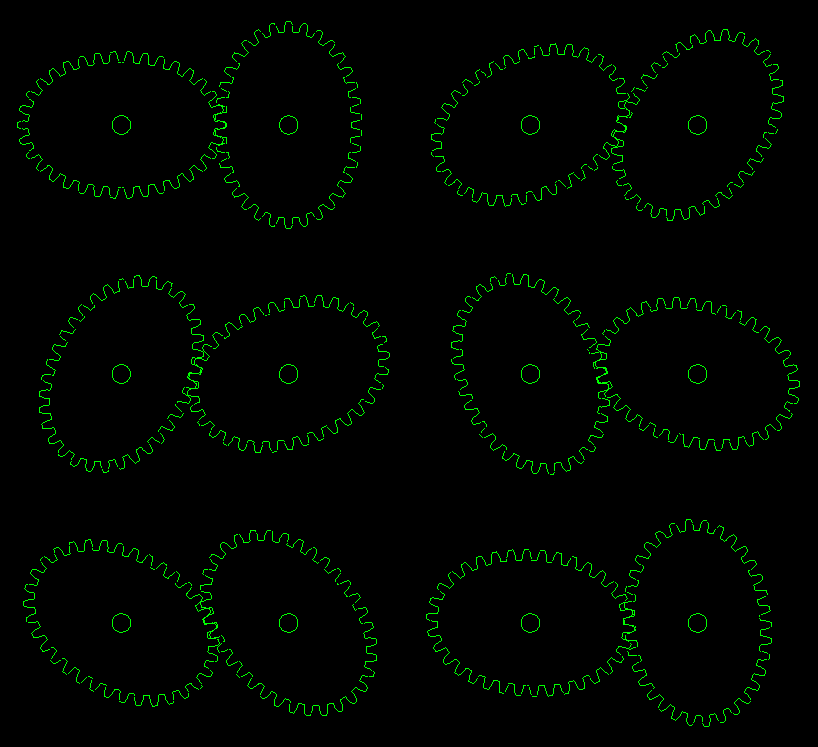
6/19/00 Our research has led us to elliptical gears.
Elliptical gears exhibit characteristics that seem quite well suited to
Stirling cycle engines. If one gear is rotated at a constant speed (RPM) the
other speeds up and slows down twice per revolution. An animation has been
prepared to help demonstrate this. Once it has started, hold your hand or a
piece of paper over the gear on the left. You will see the gear on the right
is rotating at a constant rpm. Now block the gear on the right and look at
the gear on the left. It will be seen to speed up and slow down.
Click here to start the animation.
Build an A S A P* new 10/21/99, Revised 1/3/2000: The drawing files
for this engine are quite large (approximately 1 meg each) to preserve
legibility, so I have chosen not to show them on this page. The plans should
print on a standard A4 or 8.5x11 sheet. They are in GIF format (our thanks
to Harry Siebert for converting them from some very large jpg files), so
copy them to your hard drive, then print via a draw program or viewer. *The
"ASAP" the "As Simple as Possible" Stirling engine.
SE-8575 VISIBLE STERLING ENGINE This is the PDF Product manual for a
commercially available coffee cup model. There are alot of cool experiment
apparatus
available at this site - many with free manuals or accompanying material
for download.
Solar Thermal Engine
Solar thermal power plants use the same kind of superheated steam as
conventional oil, coal, or nuclear power plants. Unfortunately it's almost
impossible to build and install a practical high temperature power plant for
a single residential house. How about the low temperatures available from
flat plate collectors? Can they supply enough heat to drive a solar thermal
engine?
The Carnot Cycle and the Efficiency of
Engines WebPhysics Server @
Mississippi State University This is kind of cool...
Global Cooling B.V.
Stirling cycle coolers: The future of refrigeration.
Global Cooling Manufacturing
A subsidiary of Global Cooling.
The home page of Dennis Chesters. A Goddard Space Flight Center
Scientist. This site will lead you to more places than you could ever have
time for!
Rider Ericsson Hot Air Pumping Engine - Stirling Cycle Engine Rider Ericsson Hot
Air Pumping Engine - Stirling Cycle Engine Rider Ericsson Hot Air Pumping
Engine Powering engines by the changing volume of air as it changed
temperature was first envisioned by Henry Wood in his patent of 1759. His
idea was to pump heated air into a large cylinder, cool the air, and let the
atmosphere do the work on the inward stroke of the piston.
Antique Stationary Engines - Gasoline, Kerosene,
Stirling Cycle, Tractors, Steam
Antique Stationary Engines - Gasoline, Kerosene, Stirling Cycle, Tractors,
Steam For SALE -- History of the Gas Engine 6 h.p. Richard Hornsby -
Vaporizing Oil Engine 25 h.p. Commercial - Built in Los Angeles Lorenz -
Czechoslovakian Engine 14-28 Rumely Oilpull
Aquatap - REVISED 10/02/02: A Water Cooled Ringbom Stirling
Engine Patterned after Dr. James Senft's "Tapper", an air cooled engine.
Ringbom Stirling engines differ from the usual kinematic Stirlings in that
there is no physical linkage between the power piston and the displacer
piston. Instead, the displacer rod is of a sufficiently large diameter that
changes in pressure inside the engine cause the displacer to be moved
between the top and bottom of the cylinder at the appropriate times...
"Blazer" revised 9/10/98: Blazer is a flame licker engine built from
plans by Philip Duclos in "Projects in Metal" magazine for June, 1992. these
engines have been variously called Atmospheric Engines, Vacuum Engines and
Flame Suckers in addition to our title above. The engine is made mostly of
aluminum, except for the piston, which is brass, and the valve mechanism,
which is steel. No oil is used on the piston, because the additional
friction would prevent the engine from running. Instead, graphite is used to
lubricate the piston/cylinder interface...
Straight Arrow - A newly designed Flame Licker. Page revised
8/10/98: "Straight Arrow" was so named because the piston rod moves in a
straight line, rather than the usual crank motion. Photo 1 "Aladdin's view"
was so named because of the "magic lamp" that fires the engine. those of you
with a strong home improvement bent may recognize the modified doorknob!
The "Test Tube Rhombic", is a Beta type Stirling engine whose hot
end is a Pyrex test tube, and whose displacer is a cigar tube. The
combination of aluminum cigar tube displacer and the clear test tube allows
observers to view the internal workings of the engine, while the rhombic
drive is fully exposed on top of the assembly. It was fun to make, run and
watch! For the mathematically inclined, I have included 3 pages on the
design of the TTR. Click
here to take a look.
Breezy, A Stirling Fan - New 3/15/99: Well, actually it is three
fans. I decided on triplets because we needed a demonstration Stirling for
DeKalb Tech's Machine Tools Club, I wanted one for myself, and I wanted to
make one for my son, who loves things mechanical as much as I do. The basic
design is from Jim Senft - his "Moriya", plans of which are available from
him. I modified his design somewhat. The base is similar to one made by Tim
Johnson (see the Prime Report), and the blade guard is reminiscent of those
used on fans from the '20's and '30's. I fire them with a miniature Bunsen
Burner (that's a story for a future page) or an alcohol burner made from a
doorknob.
Lil' Bit, a Half Scale LTD Stirling - New 3/15/98: Last year I built
3 Low Temperature Differential engines from Jim Senft's book of the same
name. Richard had made up a few sets of the main plates in a beautiful blue
anodized aluminum, and had the Plexiglas rings and piston assemblies, so I
had only the miscellaneous parts to fabricate. As in the fans, one copy went
to the Machine Tool Club at DeKalb Tech, another to my son and the third
resides with me. But, being a chronically dissatisfied model maker, I wanted
a smaller version...
Alphonse Vassallo new 2/16/99: I met Alphonse through a mutual
friend, Don Isaac. We were visiting our daughter in San Francisco, and took
that opportunity to call Don and arrange a visit. He in turn contacted
Alphonse and Jim Symanski, and arranged for a visit with them. Alphonse
drove down from San Francisco, bringing three of his Stirling engines. all
three were original designs, and beautiful examples of the machinists
craft...
Bill Sondagh's Engines - New 7/20/99: His twin flame licker is
patterned after Richard's Dos Pyros, and the one on the left of the photo is
similar to one shown in Home Shop Machinist magazine some years back. The
Stirling engine on the right is Bill's BISON, which you see below in action
(if you have an animation capable browser). The upper engine I will call his
"Mystery Engine" pending Bill's providing more details of its design and
operation...
WrenchTEN's Study of External Combustion Engines......
.......running on HOT air? (stirling engines) .....or HOT Steam? (steam
engines). Lots of links for both.
Stirling Engine Home Page at National
Maritime Research Institute, Japan
English version is underconstructing... Many links are connected to Japanese
sites yet.
Determination of Mechanism Effectiveness and Polytropic Index by
James Senft, University of Wisconsin-River Falls. The paper "Analysis of the
brake performance potential of Crossley-Stirling engines ", Paper # 910314,
Proceedings of the 26th Intersociety Energy Conversion Engineering
Conference, describes a simplified mathematical model for Stirling engines
in which the thermodynamic cycle is actually a Crossley cycle and the
mechanism has a constant effectiveness e. See also:
Energy Research at UWRF, USA
Two-Stage Stirling Cooler - Program Goals and Objectives: This
program will result in an advanced engineering model of a two-stage linear
Stirling cycle cooler for use by instruments on the Earth Observing System
(EOS). However, the cooler will be of use to many other NASA programs in
earth science, astronomy, microgravity sciences, interplanetary sciences and
the Human Exploration Initiative.
Stirling Engine and Hot Air Engine Home Page: This site is being
developed for: Collectors of vintage hot air engines Model Engineers who
build HOT AIR, CALORIC, STIRLING and VACUUM ENGINES Study of external
combustion regenerative air engines
Stirling Engine of Saitama University The Dynamics of Machinery
Laboratory (Prof. Iwamoto) at Saitama University had studied and developed
the Stirling engines till March 1998. Here is a web site which was made by
Iwamoto's students in these days. Lots of links and info.
US Patent 20050242232 for a solar powered
aircraft using the suns heat to drive a Sterling engine and propeller.
A solar thermal powered aircraft powered by heat energy from the sun. A heat
engine, such as a Stirling engine, is carried by the aircraft body for
producing power for a propulsion mechanism, such as a propeller. The heat
engine has a thermal battery in thermal contact with it so that heat is
supplied from the thermal battery. A solar concentrator, such as reflective
parabolic trough, is movably connected to an optically transparent section
of the aircraft body for receiving and concentrating solar energy from
within the aircraft. Concentrated solar energy is collected by a heat
collection and transport conduit, and heat transported to the thermal
battery. A solar tracker includes a heliostat for determining optimal
alignment with the sun, and a drive motor actuating the solar concentrator
into optimal alignment with the sun based on a determination by the
heliostat.
"Stirling Engineer's Notebook" is intended to become an electronic
alternative to the printed version of "Stirling News" - The Journal of the
Stirling Engine Society. I will endeavor to get most of the text and
illustrations reproduced in the printed version of Stirling News. There will
be new pages added to the site on a quarterly basis.
Just some miscellaneous stuff
found while surfing for articles for this page (much of it won't really
apply...):
Richard's Machining Tip of the Month On this page we will
provide strategies for accomplishing some of the more difficult machining
operations required in the construction of small engines.
Handy info about Metal Working.
( only in English ) Measurement
tools: + How to use Calipers + How to use a Micrometer + How to use Gage
blocks Bench Hand: + How to make a Center point for Drilling + Info about
drilling. + Info about a saw. Handy tips and tricks for Lathe.
+ How to make a Simple Tool holder. And much more....
Hayseed, A Miniature Farm Engine new 12/14/2001, additions 1/26/02
and 2/5/03 (I have added a video of Hayseed's hit & miss governor,
here.) A few months ago, I took a notion to build my first internal
combustion engine. I wanted an old style engine, but since it was my first,
something simple seemed in order. A trip through the back issues of Strictly
IC magazine yielded Hamilton Upshur's Farm Engine (Mk 2). Hamilton had
designed the engine originally back in the early 90's, but since then had
made some improvements. Bob Washburn published the revised engine plans in
SIC in issues 77 through 79. By November, I had made substantial progress on
the engine, and took the still unfinished product to SAMS (The South's own
Model Engineering show in Dutton, Alabama). Bob Shores was there with his
engines, and I got valuable advice from him and from Robert Russell, a model
maker from Childersburg, Alabama.
Reverse Electrolysis -
creating the perfect patina.
Drilling large holes with your
old man.
Build your own
low tension coil.
WICO EK/PR
Magneto Tester
Removing a
Stuck Piston
Bill Young:
Cleaning caked on grease.
Leather Belting -
Notes and Rules
Determining horsepower of
Gasoline Engines
A day on the
S.S. Lane Victory
On
quality and workmanship
Exploration of a local
oilfield
A trip to the
Mt. Wilson Observatory
City of Vernon
Power Plant
Flywheel Dangers -
Mind the RPM's
Equipment at the old
La Habra Chevron facility
A visit to Youngstown and the
Tod Engine.
After you've ground the corn:
Cornmeal Recipes
Please Read The Website Disclaimer!
Copyright 1986-2012, The Survival & Self-Reliance Studies Institute (SSRsi), All
Rights Reserved
Site conceptualized, designed, created & maintained by MEG Raven
Snail Mail: SSRsi, PO Box 2572 Dillon, CO. 80435-2572