





















Video
(Click Picture)
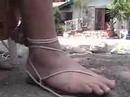
Tying Hemp-Strapped Huarache Sandals
Making Shoes
Stitching Simple Moccasins
Lasting By Hand
Found a good "Shoe & Boot Making" link? Let Us Know!
Curing & Using Hides & Skins: Even if you are not obliged to use the skins of animals for garments or footwear they may often be used to good advantage when camping out and every camper should learn how to tan hides and skins and how to make moccasins.
Excerpt from the: "Book of Camping" By A. Hyatt Verrill,
1917; Chapter Five
How to Make a Shoe: The Author of the book in hand, having passed through the various scenes through which he would accompany his readers, was prompted to make this offering to the craft and the public in order to relieve his mind of the thoughts had upon the subject of making shoes, as well as to contribute something of a literary character which, in the broad
range of possibilities, may become useful as a text-book, or family-book, for those who may feel interested in making or wearing shoes, and perhaps lead to something better. Realizing the imperfections and shortcomings of the human family, to some extent at least, no claim beyond that which you are disposed to put upon it is held, so that any communication will be gladly received and noted. This opportunity is also taken to express thanks for some valuable suggestions from the U. S. Bureau of Education, and others, concerning the publication of this little volume, and in its present shape you are invited to read and make the best use of it you can..
Small Scale Footwear The technological information contained in the
memoranda is fairly detailed as it would be difficult for the reader to
obtain missing information. Thus, clear and detailed descriptions of
processes as well as drawings of equipment which may be manufactured locally
are provided, and lists of equipment suppliers -from both developing and
developed countries - are included whenever the local manufacture of
equipment may not be easily undertaken. A methodological framework for the
evaluation of alternative technologies is provided in order to enable the
reader to identify the least-cost or most profitable technology.
Most medieval shoes were "turn shoes", sewn together inside out and
then turned right side out, to keep the stitching protected from wear. Like
almost all shoes of the period, this pattern has an upper of one main piece
with the seam on the inside of the foot; small inserts are added to close
any gaps. The toe is pointed, and there can be an embroidered stripe running
from the toe to the throat. Shoes were made with a right and left, and could
be slip-ons or fastened with a drawstring.
HOG BRISTLE NEEDLES © Jack C. Thompson: Illustrations by Carl
Furfaro - It is not uncommon to find rather large holes at the sewing
stations of medieval books. These holes are sometimes described as "V" cuts.
In my experience, the cuts are generally slits which have been enlarged by
passing a bodkin through the slit and pushing one edge inward and away from
the plane of the slit...
Shoe Making This is a pattern for a shoe of the
kind found in Jorvik, England. [PDF Link recovered
4/30/11]
A Beginner's Addendum to Making Shoes This information is intended
for the rooky period shoemaker, and is meant to supplement other
instructions available on the Internet. It provides some basic information
from the novice point of view, as I have made a few pairs of shoes, but am
still new enough at it to have trouble. I am taking the "make a somewhat
authentic pair of shoes" approach here, in order to encourage more people to
make and wear period footwear. I am inspired enough from doing this to want
to try more advanced and authentic methods, but my overall goal is wearable
shoes. Hopefully, this handout will get you started and help you avoid some
of the same troubles!
The History of Shoes: Shoe Making Cameron Kippen, Curtin
University of Technology, Perth WA. Shoes both protect feet as well as, when
incompatible in size and shape, present exciting factors in inflammatory
conditions e.g. bunion. Despite the presence of pain, people are reluctant
to change their footwear styles. The main function of modern footwear is to
provide feet with protection from hard and rough surfaces, as well as
climate and environmental exposure. To the wearer the appearance of their
footgear is often more important than its (mis)function. Consumer resistance
to change style is common. Informed decisions of shoe styles are thought to
occur when the benefits of alternative shoe styles are carefully explained
and footwear habits discussed in a culturally sensitive manner. The author,
in the interests of intellectual exchange, explores the world of shoe making
in an attempt to inform both lay person and health professional.
[PDF Link recovered 4/30/11]
A BASIC GUIDE TO FOOTWEAR IN THE VIKING AGE By Jeff Clarke (Hafgrim
Gunnarson) When I started writing this article I thought I would create the
ultimate guide to Viking footwear - No chance! I ended up with ten pages of
just notes, to my own shock and horror I found I could probably write a book
on the subject. So instead, I thought I would create a sort of `Bluffers
Guide' or more precisely a Duffers guide for Vikings.
VIKING SHOES by Danr Bjornson, 1999 (with minor updates in June
2005) Shoes are an everyday item which people have used for millenia. It is
no surprise that many archeologists found shoes in their search for
artifacts from the Viking Age. Much like the trends of fashion we see today,
the designs varied according to place and time, and sometimes shoes of
different design were found within the same location and time period...
[PDF Link recovered 4/30/11]
Medieval Shoemaking Discussion List - A group for all students of
medieval and pre-17th century shoemaking. While this group is geared toward
the Society for Creative Anachronism, not all group members are members of
the SCA, and we welcome all students of pre-17th century shoemaking.
Beginner's Luck Elven Shoes by Elerronyar - These shoes take Duct
tape, a plastic bag, glue, and a little bit of fabric!
Making the ultimate Jack Sparrow boots - This tutorial can actually
be used to make any sort of tall boot. I myself have used the same tricks to
create my Anakin Skywalker boots, Royal Guard boots, ect. I hope that this
becomes as useful to you, and it has been to me.
Footwear of the Middle Ages by Marc Carlson - This document is an
exploration of the topic of shoemaking in the so-called Middle Ages,
particularly centered on the British Isles and Western Europe. It includes
an examination of shoemaking and footwear types, techniques for working the
leather, designing the pattern and so forth. I hope the reader will find the
discussion to be at a level that would be of some use to the most practiced
professional, but without losing the tremulous tyro, as yet uninitiated into
the Mystery of Cordwaining. This is in no way meant to be the "last word" on
this topic of shoemaking, nor is it intended to be a replacement for a real,
intensive study of the topic. It is my hope, however, that no question be
left unanswered at the end of this document, with each of the steps
described, and demonstrated when necessary; from measuring and making the
pattern, to "clicking," or cutting the pattern, and the final assembly.
Making a Modern Shoe
From "Footwear of the Middle Ages"
How To Make Moccasins
This page shows you how to make a pair of
woodlands style moccasins with fur trim. A
free pattern in a woman's size 7 is also available as a PDF file. You
need the free Adobe Acrobat reader to view it.
Ghillies Pattern
These moccasin-like shoes are all based on a simple patterns which are
gathered around the foot with a drawstring lace - a "point", made of
leather, or rawhide. These are the ancestors of dance ghillies worn by
modern Highland, or Irish dancers. A pattern for ghillies is included here
and can by enlarged, or reduced using a photocopier to match the size
needed.
Tire Sandals.
Excellent article on making your own, by T.J. Elpel. Complete with photos
and a "blueprint" – makes it extremely easy for you to make your own. Thanks
Thomas! See also:
Make sandals made from old tires
HISTORY OF YOUR SHOES
There is much evidence that a foot covering was
one of the first things made by our primitive ancestors. Necessity compelled
them to invent some method of protecting their feet from the jagged rocks,
burning sands, and rugged terrain over which they ranged in pursuit of food
and shelter.
Making Medieval Shoes For some reason, the top of this page says
"Making Medieval Arrowheads" but don't let that psyche you out - the article
itself is about making shoes. How much you wanna bet there's another article
on this site about making medieval mead . . . ?
Reproducing a Late 14th Century Shoe using
Patterns Taken from Extant Examples[1]
The shoes found in the excavations in London docklands reveal a number of
variations on a standard construction method called a "turn shoe". A turn
shoe is so called because it is constructed inside out, and then turned,
leaving the seams on the inside and the finished (possibly decorated)
surface of the leather on the outside.
SHOE FROM PARLIAMENT ST. York
Great article on how to make a simple shoe. With
a good pattern.
Arapaho Moccasins
Hopefully no one will ever copy these moccasins exactly as the pattern
belongs to the original maker, but the style and color combinations are
there for you as an aid when you create your own authentic-to-the-period
moccasins or perhaps even adapt these to a pouch or other item you need.
How to make a shoelast
Short and
sweet, all text. See also:
Shoe Lasts & Metrology
[Links recovered 4/30/11]
Felt Boots
- Who
says that all the frontiers of the world have been explored? The following
is an exploration into the wilds of felt boot making. Come join me and my
faithful student on this textile safari as we tame the wild textiles,
capture the formidable felt process, stare death in the face as we full the
felt, and finally emerge victorious with an actual felt boot... oh, come on,
intrepid costumer! You've read this far... See Also:
Felt Slippers and
Making a Pattern for a Pair of Felt Boots.
Poor People's Poulaines
Easy pointy shoes out of modern leather, which will look accurate at normal
distances.
Moccasins
Moccasins, (low tailored shoes), are one type of
traditional North American footwear. Woven sandals, boots, and leggings
attached to shoes have also been produced by Native Americans. The origins
of moccasins go back to the cold, harsh climates of man's past that made it
necessary to make protective footwear. See also
Instructions for Making Center-seam Moccasins
and
The Creek/Seminole Moccasins ~ notes from a
Darry Wood demonstration
Leggings ~ by Pete Thompson and Rick
Obermeyer Includes a little
history and some sparse instructions, but followed by links:
Construction of Cloth Leggings
and
Construction of Buckskin Leggings
Pointe shoe - Making Freed Pointe Shoes
Freed classic pointe shoes are made by the ‘Turnshoe’ technique, which was
the method used for all shoes at one time. This is that the shoe is made
inside out and then turned the right way for wearing. The sequence is as
follows.
Overview of Native American Footwear -
Moccasins Native Tech:
Discussion of history and origin of Native American footwear. Includes
sketch of construction techniques of different styles and overview of
materials used in construction and decoration.
Map of North America with Native American Varieties of Moccasins
Native Tech: Map image displays type moccasins by tribal location. Link
links to view photo samples of individual moccasins by tribe/location. Fun
and informative graphic aid.
Instructions for One-Piece, Soft-Sole, Center-Seam Moccasins
Native Tech: Step-by-step instructions for making your own paper pattern
and one-piece, soft-sole, center-seam moccasins.
Arapaho Moccasins From the Museum and Research Center of
the American Mountain Men: Article from Tomahawk & Long Rifle. Detailed
sketches and description of moccasins, circa 1900.
How to Make a Pair of Moccasins - eHow.com These moccasins are
very comfortable and can be made from a variety of garment-weight leathers.
Once you have worn them a few times, a sole will be formed at the bottom of
the shoe.
Billy Bowleg Moccasins Lately, while down in the land of the
Seminole, I ran across what is, to me, an entirely new style of moccasin; a
very simple style and probably the most primitive form of moccasin used by
the American Indian. It is still in use by a few of the Seminole Indians in
the swamp and lakelands of Florida. This form of foot covering, one of which
I now have in hand, can be of little protection against thorns or snake
bites...
Sioux or Heard-sole Moccasin This was usually made of three
pieces, each a different kind of leather -the sole of the heaviest moosehide,
the ankle flaps of thin, soft buckskin, and the inset or tongue of the
finest caribou leather, elaborately decorated. Also includes Ojibway or
Pucker-top Moccasin and Moccasins Made of Sneakers
How to Make Moccasins
directions to make some cozy footwear for you. Even if you don’t have
the time or experience to make the leather yourself you can pick up some at
a local leather shop.
Homemade Moccasins
reprint from NativeTech website.
Nebraska Trailblazer #1, American Indians
Paper Moccasin Pattern Excellent
instructions on making a pattern - but nothing on making the shoe.
How to Make a Pair of Slippers - eHow.com
These slippers are very easy to make. Use scrap fabric to make your
slippers, or, next time you make a robe or pajamas, buy extra fabric and
make a pair of slippers to match. Use cotton, cotton blends, flannel, fleece
or even terry cloth.
Hand Knit Slippers boots
Please visit
The blog for the new accurate version of this pattern. Errors have
crept into this one, and I can't maintain both pages! I'm keeping this here
because it has l inks to all the steps, but something is wrong with one of
the calculations! Lucia. See also:
Antique Ballet Slippers = easy to crochet slippers and
CROCHETED SLIPPERS and
Crocheted Sneaker Slippers and
COMFY SLIPPERS and
How to Knit Slippers and
SAG'S SLIPPER PATTERN and
Charity Pattern - 2-strand Shaker Knit Slippers and
Canadian Living : Cosy crocheted slippers and
Anne's Slippers and
Bed Slippers - Craftbits.com Craft Project and
Woman's Day Magazine - Crochet Slippers and
Knitting pattern for adult slippers. and there's more out there!
Minimus Activities
Make your own Roman Sandals - All our sandal soles were made from 3mm. MDF
(hardboard would do). We also used cork tiles and leather scraps.
One Ounce Camp Sandals And Modified Socks
Mage from shoestrings and inserts. Clever.
Splaff Flopps, Sandals and flip flops. Doesn't tell how to make
them, but you can use their idea to make your own: Splaff Flopps started in
a garage with a tire, a bike tube, and a shoe knife. The vision was to make
a comfortable, long lasting, fairly priced sandal from all recycled
materials. Today Splaff products include sandals, handbags, belts, mirrors,
and a coffee table. They are all made with recycled race car tires and
bicycle Inner tubes, regupol (a cushioning material made from used tires
which have been chipped and pressed into mats), and hemp. They are
hand-crafted and are produced in a 100% waste free, earth friendly process
in which all left over materials are either re-used or recycled.
Raffia and Cattail Sandals by Amber Cook and MOTHER's staff: Fiber
sandals may be as close to a timeless, universal form of footwear as we're
ever likely to encounter. And though inexpensive ones can be easily
purchased in most areas of the country, you may find it rewarding to craft
your own with raffia or bulrushes (or a combination of both fibers).
[PDF Link recovered 4/30/11]
ROMAN SANDALS
Pics and drawings with text instructions. See also:
Make Your Own Egyptian Sandals (try reversing the cardboard pattern and
tracing on old carpet remnants.)
Make your own geta
Weird shoe. Cool site.
Turn
Shoes Research
The turn-shoes before you are not based on any one pair found in history;
instead they are a conglomerate based upon the information gathered in my
research. I created the base design around the concept of water / mud
resistant footwear. While the lower cut side (associated with the Latchet
type or category) was a common shoe of the 14th-century, I chose a design
drawn from manuscript Roy 14E, III. from the British Museum. The wearer is
described as a traveler. The shaping of the shoe appears to be divided down
the top arch of the foot. The vamp appears to remain solid on the instep and
opens on the outside to be more reminiscent of the lower cut shoes described
above. These shoes are not detailed with any decoration nor do they show a
method of closure. [PDF Link recovered 4/30/11]
A Burgundian Court Shoe
Much of the construction technique of period shoes can be inferred from
archeological and iconographic evidence. Until the advent of the so-called
Tudor shoe, whose construction is in many ways similar to modern shoes, most
shoes were constructed inside-out and then turned. They are most often
referred to as turn-shoes. Turning the shoes inside out has two advantages.
First is that the finished appearance is tidier since the seam allowances
are all neatly tucked inside. Second is that since the stitches are moved
inside the shoe the thread used to bind the sole to the uppers is not
exposed to wear while walking. [PDF Link recovered
4/30/11]
The Duck Tape Club
MAKE A DUCT TAPE FLIP FLOPS. Decent pictures and sparse instructional text.
[PDF Link recovered 4/30/11]
Making Medieval Shoes:
By Martin Austwick: Shoes in the late mediaeval period were constructed in a
somewhat different manner to their modern day equivalent. The following is a
construction guide for anyone who wishes to make a pair of authentic turnsoles.
SHOE FROM PARLIAMENT ST. YORK ~ CONSTRUCTION NOTES: This pattern is for a
type of early medieval (l0th to 13th cent.) shoe that is distributed widely in
North Western Europe, examples are known from York, England as well as Hedeby/Haithabu
in Germany and Svendborg in Sweden. The shoe (Find no.756), sole (757), and
upper (819) are described in reference [1]. A triangular internal heel stiffener
is present on some shoes of this type, but may be omitted. For much useful
information on medieval shoe construction, see reference [2].
Making Medieval "Bag" Shoes
This document covers the making of a make a pair of medieval hide shoes which is
any shoe made from a single piece of leather fitted to the foot. Specifically
Cuarans (in Celtic), Rivelins (in Teutonic or Scottish), or sometimes referred
to as bag shoes by Scadians. This is a relatively simple shoe design dating back
to at least the7th century based upon finds from a bog in Ireland. The shoes are
constructed from one piece of leather stretched and gathered about the foot with
thongs.
Pattens, Clogs and Wooden Soled Shoes
Before I get into this, I feel it's important to note that I have a certain
bias. I don't like pattens, clogs, or wooden soled shoes. I don't know why
this is, and objectively there is nothing wrong with them. They are part of
the record. I just don't care much for them. I suppose I could claim that
it's due to my scarred past, of being forced to wear platforms during the
70s, or that I nearly broke my neck the first time I tried to run in wooden
shoes, but those aren't enough to justify this sort of disregard. So while I
will try to tell you something about them, I will warn you that I may not be
doing them justice, and encourage you very strongly to take a long
look at the sources for this paper and look there as well...
Please Read The Website Disclaimer!
Copyright 1986-2012, The Survival & Self-Reliance Studies Institute (SSRsi), All
Rights Reserved
Site conceptualized, designed, created & maintained by MEG Raven
Snail Mail: SSRsi, PO Box 2572 Dillon, CO. 80435-2572
Page Updated
4/30/11