




















Found a good "Primitive Cooking & Baking Techniques" link? Let Us Know!
Improvised Grain Mill The grain mill described can efficiently pound
whole-grain wheat, corn, etc., into meal and flour thereby greatly improving
digestibility and avoiding the diarrhea and sore mouths that would result
from eating large quantities of unground grain.
Build a Wood-burning Cookstove From a Steel Barrel Many people are familiar
with wood heaters made from steel barrels. This is a description of how to make
a wood cook stove from a barrel. An effort has been made to keep it simple so
that you will not need special skills like welding or forging. The only tools
needed are a drill, a jigsaw (with hacksaw blade), tape measure, and simple hand
tools.
WOOD-BURNING OVEN by REV. BERTRAND SAUBOLLE. This oven was designed
and built for use in the Godavari School in Kathmandu, Nepal. It is built of
solid brick, with a sheet iron door. A wood fire is burned in the oven, the
ashes removed, and the bread slipped in to bake in the heat retained by the
thick brick wall. The oven for the school has a baking space of about 122cm
x 122cm (4' x 4'), but some have been built with oven floors as large as
183cm x 183cm (6' x 6'). (For larger sized baking areas, of course, the size
of the entire structure has to be adjusted.)
Camp/Primitive Cooking
In recent times the popularity of compact camping stoves has brought outdoor
cooking within the reach of many who would never have attempted it
previously. The stoves are very convenient and when on you're on the trail
and want something quick to eat or drink they are hard to beat. However,
nothing will ever taste the same as food cooked on an open fire of your own
making. Apart from purely aesthetic considerations a cooking fire is also
more practical in many situations and allows a wider variety of cooking
opportunities. As well as roasting and toasting over the flames or just
boiling something up in your billy there are many other possible cooking
methods, none of which require recourse to store bought equipment, here are
a few ideas.
Stove Technology: Terms And Concepts As early as Roman times stoves
made of clay, tile, or earthenware were in use in central and N Europe.
Early Swiss stoves of clay or brick, without chimneys, were built against
the outer house wall, with an opening to the outside through which they were
fueled and through which the smoke could escape.
Building Masonry Cookstoves Also available
HERE
Cooking Over an Open Fire
I have cooked over a fire in a fireplace for
years, here are a few things that I think are very important.
Cooking Info-Open Hearth
Open hearth cooking is the oldest way of cooking. Before cook stoves came
into existence, fireplaces were commonly used. A cook knew how to prepare
the fire for a day of planned cooking. The cook would rise early in order to
start the fire for the day's cooking. The fire was also the last thing at
night the cook tended to, banking it for the next morning's use.
Open Hearth Grilled Fish
There was only one way to roast a fish in the open hearth prior to the
reflector oven. The cook would place a seasoned, whole fish on an oak, pecan
or cedar plank. Then the plank would be placed standing upright on the side
wall of the hearth. The reflective heat from the coals cooked the fish. This
dish works equally well in the home fireplace.
The Art of Open-Hearth Cooking
"Roast meats aren't what
they used to be," says author Karen Hess. "Until just a century ago, turkeys
and squabs and hams and other meats were roasted to golden-brown perfection
in front of-not over—a blazing fire. Today, however, the art of roasting
meat in this fashion has been almost totally forgotten."
Fireplaces That Can Heat Your Home and Cook Your Meal Any
fireplace will happily cook while it heats — persuading your wood to do
double duty. You can wrap sweet corn, potatoes, fresh-caught trout, and
apples in tinfoil and bury it in the ash bank just as you would in a camp
fire. But there's no timer or automatic thermostat to regulate a live fire
for more complex recipes.
Central PA Magazine - WITF's Monthly Magazine
Although a large, roaring fire in the kitchen fireplace is how you may think
of open-hearth cooking, Martin says a small blaze was usually used in the
early 1800s. "You regulate temperature by how much fire you have," he says,
adding that embers are most common to cook on. "Embers are easier to
control; they have a more uniform heat."
HOW TO COOK WITH A WOOD COOK STOVE
When my companion and I began our 18-month
transition period of moving to and living in the woods, we also began a
period of education. We discussed and planned much. We bought books and
magazines and took classes on everything from solar collecting to gardening.
One subject evaded me: cooking on a wood-burning stove. Every time I saw a
magazine that flashed headlines on wood stoves, my hands would tremble in
anticipation as I reached for it. However, the wood stoves in question were
for heating, not for cooking.
Cooking on a wood stove
Cooking on a wood stove is an art and a science, but it's not hard to learn
with some basic guidance.
Wood Cooking & Heating Cooking with wood stoves is pretty tricky.
That was an art handed down from mother to daughter for generations! The
instruction manual for my Monarch wood/electric range has about 50 pages of
instructions. Regulating the temperature of a real, honest to goodness wood
cooking range is hard enough: regulating the cooking surface temperature of
a makeshift stove is much more difficult. Generally, the use of trivets to
elevate the cooking pots and pans above the stove surface will allow more
air circulation and lower the temperature, and that is easier to regulate
than the temperature of the stove.
Heating and Cooking with Wood We used to cook most of our meals on
an open fire but this can be a pretty inefficient way to cook so now we have
built our enclosed kitchen we use on wood burning stove build from an old
oil drum.. Much of the heat of an open fire is quickly lost into the
atmosphere and the wind cools the food. A stove or oven provides greater
control over the combustion and burns the wood more completely and is
therefore potentially more efficient. However we used to burn waste
cardboard from packaging on an open fire to quickly boil a kettle and it
takes much longer on the stove. See also:
How to make a wood burning stove
Fuel Efficient Wood Stove Research
The Aprovecho Research Center has been involved with
designing and testing fuel efficient wood stoves since 1976. Aprovecho
initially helped to create the Lorena stove in Guatemala and published a
manual teaching how to construct this high mass stove. Further testing of
stoves led to the development of other stoves that were more fuel efficient.
I Live With a Cook stove and Love It The first time I baked
biscuits I burned them to ebony. Also the second and third time. But on the
fourth try they came out golden brown. And I burned my hands and wrists
every day until I finally got it through my blockhead that EVERYTHING on or
near that stove was HOT! But surely—if somewhat slowly—I mastered the wood
range.
Backcountry Baking Stove-Top Style! Some chill, hungry day this
winter, give this trio of north-country recipes a try, and see if they don't
please your palate, warm your body, and infect your spirit with the call of
the wild!
"Cooking on a Wood Cook Stove" by Karen L. Zlattner Although my
husband and I are not off the grid, we don't want to rely on public
utilities if we don't have to. So, even though we have an all-electric
kitchen we decided to add a wood cook stove
Haybox Cooking. Haybox cooking, or retained-heat cooking, is an
age-old slow cooking method used to conserve energy, both in fuel and labor.
Working off thermodynamic principles, food is brought to a boil, simmered
for a few minutes then put into a well insulated box where it will continue
to cook slowly for hours. Since the insulated haybox cooker prevents most of
the heat in the food from escaping into the surrounding environment, no
additional energy is needed to complete the cooking process. While cooking
time takes about twice as long as stovetop cooking, haybox cooking can save
between 20% and 80% of the energy normally needed. Your pot only needs to
remain on the stove for a quarter of the time needed in conventional
cooking. Haybox cooking also prevents food from boiling over, overcooking,
sticking to the bottom or burning. Food turns out perfectly cooked every
time.
Building an Horno: the Adobe Bread Oven
by Michael Moquin - Detailed adobe instructions.
Greg's Earth Oven Good adobe oven building instructions
with illustrations.
Backyard Bakeoven Workshop with Norbert Senf
step-by-step construction photos of a 32" X 36" oven.
BlackOven Good site by a brick oven enthusiast,
including recipes and baking info.
Castable Oven step-by-step
construction photos of a refractory concrete oven.
Wood Burning Oven Website, including oven plans, pizza instructions,
and more.
Cob Oven - An Experiment in Progress
Interesting oven experiments, including a novel firing technique
Building Heather's Oven - construction sequence of an
Alan Scott style 4' X 6' oven.
1930's - 1950's Finnish Commercial - This double deck design was
presented at the
1997 MHA meeting by
Heikki Hyytiainen and is from a 1951 book from Finland.
Seven secrets of Dutch Oven cooking
Squatting heavily in dank basements, drafty attics, and dusty, cluttered
garages, these three-legged hulks from a bygone era wait impatiently to
release their treasures. Until then, they are pitted by time and tarnished
by neglect. For those who will uncover the mystery, their gaping caverns can
once again be brimming with magic.
Making and using a solar cooker Solar
cooking is a delightful alternative to conventional cooking methods. The
solar cookers available today really work and they deserve serious
evaluation by a much larger audience. For 40 years, small groups of people
have been using and refining some very good designs. But these designs have,
for the most part, gone unnoticed even by those involved with alternative
energy. With such a lack of support, you’d think they would have vanished
from view long ago. But they haven’t.
Fireplace cooking cures the winter blues Several years ago we experienced
a prolonged winter storm that left power lines down and thousands of people
without heat, hot water, and operative cookstoves. And for the better part
of the week they learned to live a little like the pioneers of old...
Cooking Over an Open Fire How to not lose your eyebrows!
Cooking With a Dutch Oven Yes, you can cook just about ANYTHING with
it..
How to Cook With a Wood Cook Stove From an experienced cook stove user.
The Solar Cooking Archive.
Info & plans for 11 different types of solar cookers. Fairly decent graphics
and text. Great selection.
Hot-Rock Cooking Party.
Excellent &
interesting article from the Smithsonian Magazine.
Building a Brick Pizza Oven. Limited details, but
interesting enough. Good photos fill in some of the blanks.
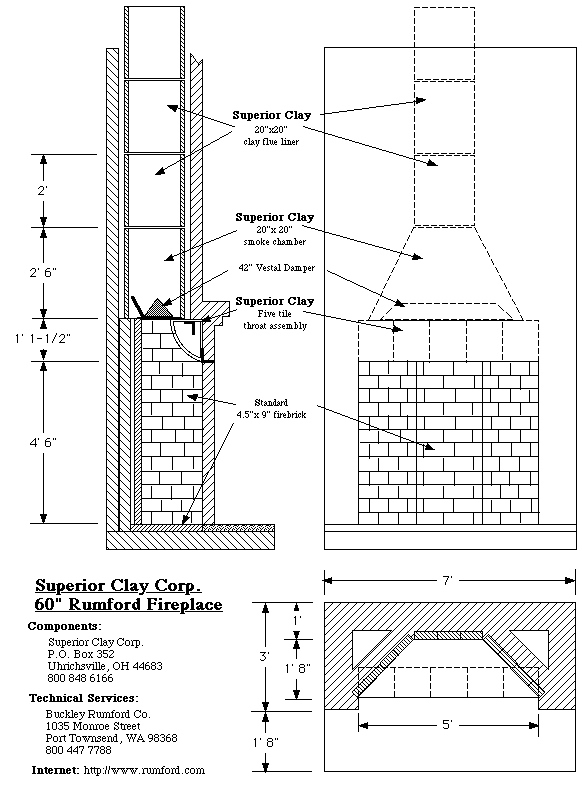
Cooking Fireplace and Bread Oven @
Rumford Fireplace
Cooking Fireplace Plan
Superior Clay Bake Ovens
Picture circa 1760 reproduction fireplace & oven
Picture of circa 1720 Bucks County, PA oven
Solar Cooking Page. Plans, pics and testimonials. Some
links to other places, too, which are probably duplicates to others on RMSG.
"Oven Building" Very interesting
article on building and using a Viking era oven. Primitive, but useable. By
Mark Beadle.
Solar Cooking Documents About 6 months worth of reading in one
handy location.
Design Principles for Wood Burning Cook Stoves [40pg PDF]
Although open fires are often used wastefully, carefully operated open fires
can be fuel efficient and clean burning when tested in the lab. In many
situations, cooks are not overly concerned with fuel use, and studies have
shown that when fuel is plentiful three-stone fires can use an excessive
amount of wood to cook a small amount of food. But in other places where
fuel is scarce, open fires can be carefully controlled so that fuel
efficiency rivals many first generation improved cook stoves.
How To Use Wood Stoves (and use them safely!) Part Two In MOTHER
NO. 48, we printed—at some length—Ole's advice on the general use (with an
emphasis on safety) of wood stoves. The following excerpts from Ole's new
book—which may be the only one ever published on the design and construction
of wood-burning stoves—will give you a further example of the thoroughness
and precision with which Ole Wik puts his ideas across. Read on and learn
... and remember: There's much more wood stove wisdom where this came from!
Cookstoves for the Developing World Half the World's population of
nearly six billion people prepare their food and heat their homes with coal
and the traditional biomass fuels of dung, crop residues, wood and charcoal.
The procurement and consumption of these fuels define the character of
everyday life in many developing countries.
The Art of the Wood Cookstove These old-fashioned stoves still
attract a loyal following, and it’s easy to understand why. Cookstoves
combine stove-top cooking, baking, water heating and home heating, all in a
single appliance that is steeped in tradition and powered by a readily
available, renewable fuel. As with so many combination devices, cookstoves
perform each function with varying degrees of competence, but if the
following owners and users of antique and new wood cookstoves are any guide,
the problems that do arise are easily overlooked. These folks are smitten.
NASD: Cooking When the Power Goes Off after a Disaster After a
storm has knocked out electricity or gas lines, cooking meals can be a
problem and can be hazardous if a few basic rules are not followed. See
also:
SURVIVAL ESSENTIALS - COOKING METHODS
Haybox how to and description | Lost Valley Haybox cooking (also
called retained-heat cooking) is an age-old method that can be used to
conserve energy not only during times of crisis, but anytime. Depending on
the food item and amount cooked, the use of a haybox or insulated cooker
saves between 20% and 80% of the energy normally needed to cook a food. The
longer an item usually takes on a stovetop, the more fuel is saved. For
example, with a haybox, five pots of long-cooking dry beans will use the
same amount of fuel to cook to completion as just one pot cooked without a
haybox.
An Improved Stove Can Change Your Life / Radio Scripts / DCFRN a
couple of articles on 3rd world cooking.
Hayboxes: Haybox cooking
(also called retained-heat cooking) is an age-old method that can be used to
conserve energy not only during times of crisis, but anytime. Depending on the
food item and amount cooked, the use of a haybox or insulated cooker saves
between 20% and 80% of the energy normally needed to cook a food. The longer an
item usually takes on a stovetop, the more fuel is saved. For example, with a
haybox, five pots of long-cooking dry beans will use the same amount of fuel to
cook to completion as just one pot cooked without a haybox.
How to start and maintain a wood fire The knowledge and skills
needed to operate a wood burning system effectively need to be learned and
practiced to get them right. Although it is not brain surgery or rocket
science, it is not as simple as it might first appear. So, when you can
light a fire with a single match and get a hot, bright fire burning in just
a few minutes, you've accomplished something worth knowing and we salute the
time and care you've taken. Reach around and pat yourself on the back.
Settler's pickle for hams, cheeks, and shoulders This page has a
bunch of old time Canadian Settler's Guide (written in 1855) recipes for
various items.
Stoves Archive for January 2002 This is an archive of messages
from a discussion group.
Solar Cookers &
Solar Cookers &
Solar Cookers II &
Solar Cooker III - a series of FAO pamphlets & manuals. See
also:
Cook Stove &
Fuel-saving Stoves &
Fuel-saving Cook stoves &
Biomass Stoves &
Wood Stoves &
Wood Stove Testing &
Cookers &
Improved Stoves &
Stove Portable &
Sawdust Stove
Build a wood-burning cookstove from a steel barrel. Author:
Countryside Publications Ltd.; Buy New: $5.95
The joys of the wood cookstove. Author: Countryside
Publications Ltd.; Buy New: $5.95
Space heating, water heating and cooking: Of course, we've always heated this house with wood, but I wanted to extend the use of wood to the heating of water and cooking of food in order to cut our household use of fossil fuels even further. Unfortunately there are no clean burning (EPA certified), full-sized wood stoves that have a bake oven and water heating option. The EPA exempted cook stoves back in the 1980s when they designed their wood smoke regulation. The result of that decision is obvious today: want a clean cook stove that will also heat your house and water? Sorry, you're out of luck. Space heating, water heating and cooking: Of course, we've always heated this house with wood, but I wanted to extend the use of wood to the heating of water and cooking of food in order to cut our household use of fossil fuels even further. Unfortunately there are no clean burning (EPA certified), full-sized wood stoves that have a bake oven and water heating option. The EPA exempted cook stoves back in the 1980s when they designed their wood smoke regulation. The result of that decision is obvious today: want a clean cook stove that will also heat your house and water? Sorry, you're out of luck.
Please Read The Website Disclaimer!
Copyright 1986-2012, The Survival & Self-Reliance Studies Institute (SSRsi), All
Rights Reserved
Site conceptualized, designed, created & maintained by MEG Raven
Snail Mail: SSRsi, PO Box 2572 Dillon, CO. 80435-2572