




















Found a good "Satellite Communications" link? Let Us Know!
Satellite Communications Tutorial
Information and Activities for
students grades 7 - 12 [Link recovered, reformatted &
archived on site 5/8/11]
SATELLITE COMMUNICATIONS SYSTEMS AND TECHNOLOGY (1993 study) The
primary mission of the panel was to review the field of satellite
communications technology and systems on a global basis with a primary focus
on Europe, Japan, Russia, and the United States. It was not an explicit
mission of the panel to review the current and projected future markets for
satellite communications on a global basis. However, such an important area
could not be simply ignored. This section attempts to place the results of
the panel's global review of satellite communications into a perspective of
emerging global markets over the next decade. In this regard one extremely
vital conclusion is very clear. This is that while technology is indeed of
great importance, the development and commercial exploitation of new
applications is even more vital. In this respect Europe and especially Japan
seem to be more adept at developing new applications. Today this can be seen
in direct broadcast satellite services, and it is becoming apparent in
mobile satellite services as well.
Mobile Satellite Users Association (MSUA) The primary goals of the
Mobile Satellite Users Association (MSUA) are to convey users' views on
mobile satellite issues to appropriate authorities, to monitor the mobile
satellite market and to ensure that members have access to the latest
information and analysis of their industry. In addition to these goals, the
MSUA WWW page will be undergoing constant change that will make it the
definitive resource for mobile satellite communications on the Internet.
Members will have access to a full site search, private mobile satellite
communications related online discussion groups, online access to MSUA
newsletters and other documents and resources. I would highly recommend
joining the MSUA.
Military Communications Satellites As soon as the possibility of
placing a man-made satellite into an Earth orbit was recognized, speculation
began as to the feasibility of using a radio repeater (transponder) for
intercontinental communications. The use of geostationary satellites for
this purpose was suggested by Arthur C. Clarke in an article in "Wireless
World", 1946. The advantages of the geostationary orbit for general
communications and for broadcasting was apparent, although there was much
speculation about the acceptability of satellite links for telephone
channels in view of the long echo delay of some 540 milliseconds. A public
offering of satellite voice channels was not made until sixteen years later
at which time they were found to be acceptable as had indeed been predicted
by simulated tests.
Adcock Antenna for HF RDF
Learn about the Adcock antenna usable on the HF bands. Some information on
building one.
[Link recovered 5/5/11]
Antennas Online tutorials
Attenuator, indestructible. Here is an attenuator good up to at
least 5 GHz, lots of attenuation, and it can't be damaged by transmitting.
[Link recovered 5/5/11]
Attenuator, pot. Quick and easy RF attenuator, from the
junk-box. [Link recovered 5/5/11]
Remote S Meter. Its nice to have a large S meter sitting on the
dashboard. [Link recovered 5/5/11]
RF Sniffer with Tone Output. No need to look at it. Just listen
to it. No tripping over stuff! [Link recovered
5/5/11]
Balloon Tracking and Recovery*
[PDF link recovered 5/5/11]
Buildings, Hunting Inside of. OK, we found the building, but
where inside is the transmitter? [PDF link recovered
5/5/11]
Comparing SuperDF* with other RDF systems. (Text & a chart).
[PDF link recovered 5/5/11]
Discussion of Propagation, Multipath, and Antennas as Related to Radio
Direction Finding Yes, its a long title, but so is the discussion! But
don't worry, its broken down into digestible pieces. [PDF
link recovered 5/5/11]
Hunting AM Signals with SuperDF*
&
Hunting an ELT on the ground
&
Setting up an ELT Hunting Team.
[PDF links recovered 5/5/11]
UK Satellite Communication Resources - From space to
satellite to modem. This website has been developed for the scientists and engineers of the
United Kingdom Satellite Communications industry interested in space,
satellite communications and modems. "We are not a
company, we are an impartial non-profit organization. This website is
intended to be a useful resource for both novices and experts alike wishing
to know more about satellite communication. This subject is huge, but we are
trying to cover it all. We monitor what our visitors are looking for and
endeavor to provide it."
The Satellite Communications Glossary
Not exactly exhaustive, but a good starting point.
The HAM Radio Operator's Antenna Handbook on the Internet
PacketRadio Networks Page. Clear drawings/photos
with explanations and instructions.
antenneX Home Page
antenneX Online, a magazine all about antennas and
amateur radio! Most of the info is subscriber - only, but they have a bunch
of good stuff for free as well.
Amateur Radio Antenna Projects
Gathered by AC6V from the internet
Antenna signal galvanic isolation
Antenna isolator circuits for preventing ground
loop problems. Build your own antenna isolation transformer.
Antenna Tips for vintage (tube)
radios.
Emergency Antennas.
American Survival Guide May, 1996. Increasing
the effectiveness of Your Comm System by Joseph J. Carr. [PDF
link recovered 5/5/11]
MCRP 6-22D
field antenna handbook the 192 page USMC manual.
FM 24-18
Tactical Single-Channel Radio Communications Techniques
APPNDX M NEAR-VERTICAL SKY-WAVE CONCEPT
The standard communications techniques used in the
past will not support the widely deployed and the fast-moving formations we
intend to use to counter the modern threat. Coupling this with the problems
that can be expected in deploying multichannel LOS systems with relays to
keep up with present and future operation, high frequency (HF) radio and the
near-vertical incidence sky-wave (NVIS) mode take on new importance. High
frequency radio is quickly deployable, securable, and capable of data
transmission. It will be the first, and frequently the only, means of
communicating with fast-moving or widely separated units. It may also
provide the first long-range system to recover from a nuclear attack. With
this reliance on HF radio, communications planners, commanders, and
operators must be familiar with NVIS techniques and their applications and
shortcomings in order to provide more reliable communications.
The AN/PRC-90 Legacy
will explain to some degree the story
of the AN/PRC-68, the first synthesized U.S. military handheld radio, and
the similar but improved products that followed, all of which came out of
Magnavox in Fort Wayne, Indiana starting sometime in 1976.
AMSAT-NA.
Official site for The Radio Amateur Satellite
Corporation. (-RtB)
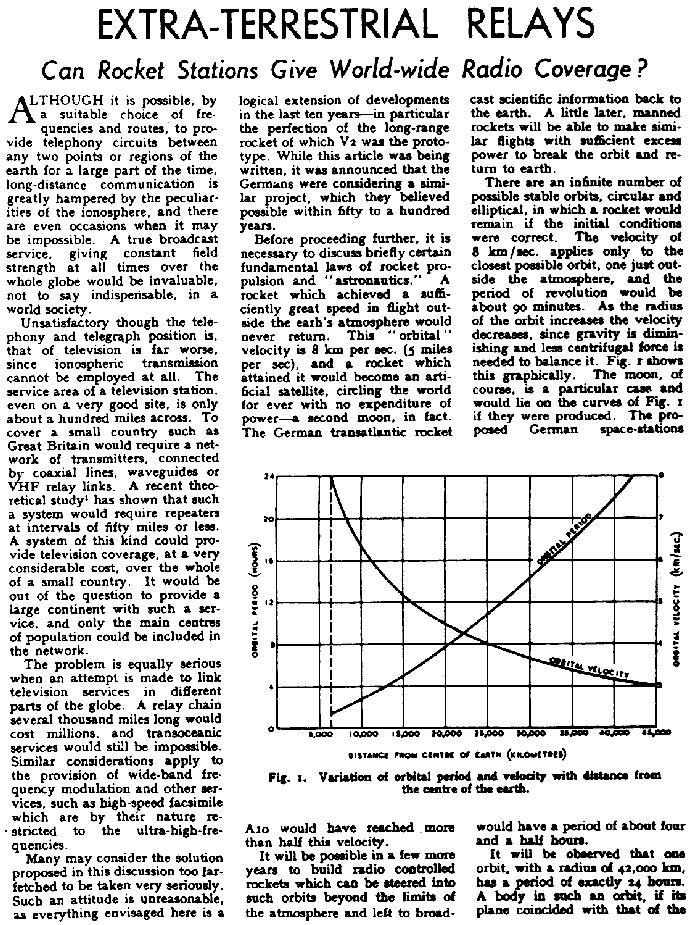
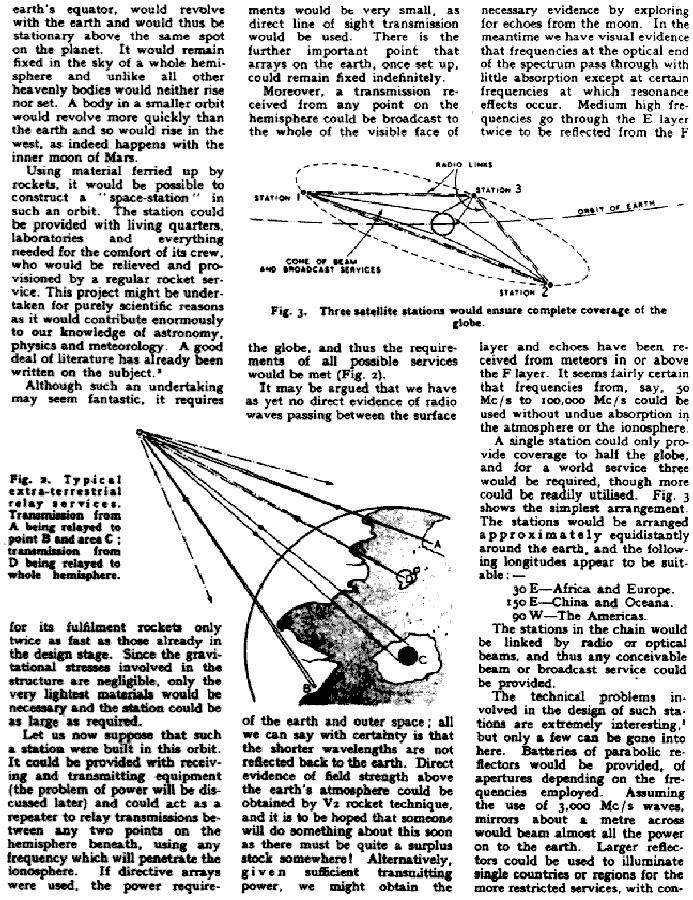
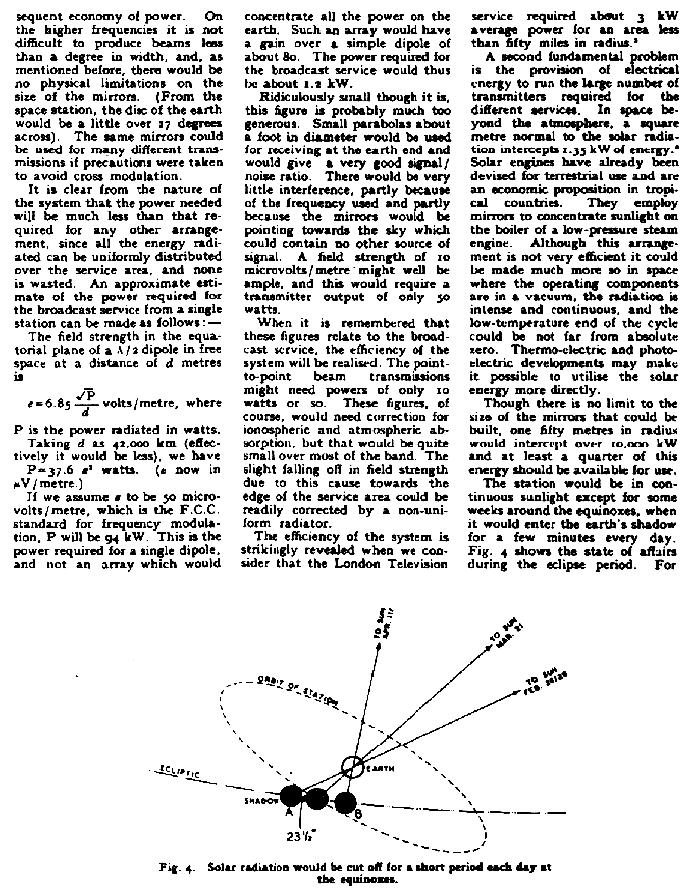
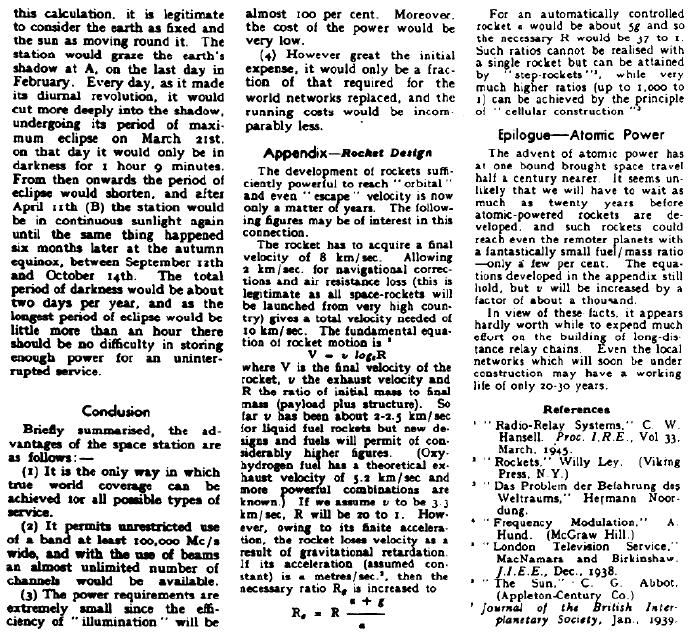
"Extraterrestrial Relays: Can Rocket Stations
Give Worldwide Radio Coverage?" Wireless World, October 1945, p.
305,
306,
307,
308.
FM 24-11 TACTICAL SATELLITE COMMUNICATIONS, 20 September 1990
FM 24-24 SIGNAL DATA REFERENCES: SIGNAL EQUIPMENT Section V.
Multichannel Satellite Communications Terminals. Satellite communications (SATCOM)
systems have been used since 1967 to provide vital communications service to
United States forces throughout the world. SATCOM has advantages which are
not found in other systems...
CHAPTER 7 - Space Systems SECTION 2 - Satellite Communications (SATCOM)
ARMY SPACE REFERENCE TEXT
U.S. Army Information Systems Engineering
Command
Automated Information Systems (AIS) Design Guidance
Satellite Communications for the Warfighter - MILSATCOM
Handbook Volume 1 - Air Force Space Command. This handbook, the first of
a two-volume series, grew out of a tasking to develop education materials
for satellite communications (SATCOM) users. Space-based communications
systems provide vital capabilities to successfully execute the National
Military Strategy and implement the Command, Control, Communications,
Computers, and Intelligence (C4I) for the Warrior concept.
NTP 2 SECTION 1 (D) NAVY SUPER HIGH FREQUENCY
SATELLITE COMMUNICATIONS The
purpose of this section of Naval Telecommunications Procedures 2 (NTP 2) is
to promulgate information concerning direction, management, and control of
super high frequency (SHF) satellite communications (SATCOM) systems
operating in the X-band which are employed to support naval operations.
Recent Department of Defense (DOD) studies project a threefold to fivefold
increase in warfighter information transfer requirements that must be
satisfied by SATCOM systems in the next decade. This surge in required data
transfer capabilities is due largely to the need to perform information
exchanges to accomplish distributed collaborative planning, video
teleconferencing (VTC), video telemedicine, primary imagery distribution,
video teletraining, and remote maintenance/ technical assistance.
Space Communications Architecture 29 August 1996. The purpose of
this document is to present the results of the Department of Defense (DoD)
Space Architect's space communications architecture development effort
completed on 29 August 1996. The full description of the process to develop
architecture alternatives and the analysis leading to the final architecture
is provided in the Space Communications Architecture Development Final
Report by the Department of Defense Space Architect.
Please Read The Website Disclaimer!
Copyright 1986-2012, The Survival & Self-Reliance Studies Institute (SSRsi), All
Rights Reserved
Site conceptualized, designed, created & maintained by MEG Raven
Snail Mail: SSRsi, PO Box 2572 Dillon, CO. 80435-2572
Page Updated
5/8/11