





















Fresh caught fish provide a
completely balanced diet when sufficiently fat & not overcooked. The main
difficulty with subsisting exclusively on fish arises from the fact that (in
calories) they are often far less nourishing than one might expect. It is
reasonable to generalize that a man in survival needs at least at least
5,000 calories daily. Any calories not supplied directly by food will be
taken from the body's carbohydrates, fats & proteins.
METHODS TO PRESERVE FISH:
SMOKING:
If you have the time & want to keep fish for considerable periods; clean
the fish, cut off the head & then split each into 2 filets joined by the
tail so that they will hang over a smoldering fire day & night with some
green wood such as Alder. The fish MUST be as protected as possible from
dampness for the several days until they are dehydrated & covered with
salt.
SUN DRIED:
Fish can be dried by the sun if you suspend it to branches high enough
to AVOID flies, or spread over hot rocks, or raft sides.
When the meat becomes dry, throw some salt water on it to make it salty.
INDIAN FISH COOKING:
On a board or cut off log which was squared off, the fish are fixed
tight with wire at 2 or 3 places, then place by fire.
Fish can be pegged on preheated hardwood slabs &
leaned before a bank of glowing coals. If after they are opened & cleaned
there is any difficulty in making them lie flat with their skin against the
wood, the backbone may be removed. Turning the slab a time or 2 will give
the flesh a better chance to become flaky throughout.
SALTED FISH COOKING:
If you want to eat salted fish you MUST first parboil it using fresh
water, then throw this first water out and re-boil it into new fresh water
till fully cooked. Otherwise it will be too salty.
FISHING BARE HANDS:
Fish such as Salmon & Herring go up streams in such a numbers at certain
times of the year (spring & fall) that one can catch them & throw them on shore by large
numbers with bare hands. Also Smelt when schools come up on beaches to spawn
in the surf - usually January thru March.
When and
Where to Catch Salmon
SHARKS BUT NOT BARRACUDA:
Sharks ARE EDIBLE, although some may object to their taste. This can be
much improved if the meat is sectioned & then soaked in salted water for 24
hours. Barracuda are sometimes poisonous.
FROZEN RAW FISH
Up in Arctic the natives, catch their fish, leave them on the ice to be
frozen then eat them raw. Surprisingly Good once you have tried it.
WARNING!: You should REMEMBER that, because of pollution, fish can be a
dangerous even deadly depending where they are caught. Ex: Near
towns/villages. Fish can carry deadly radiation or mercury, and chemical
poison.
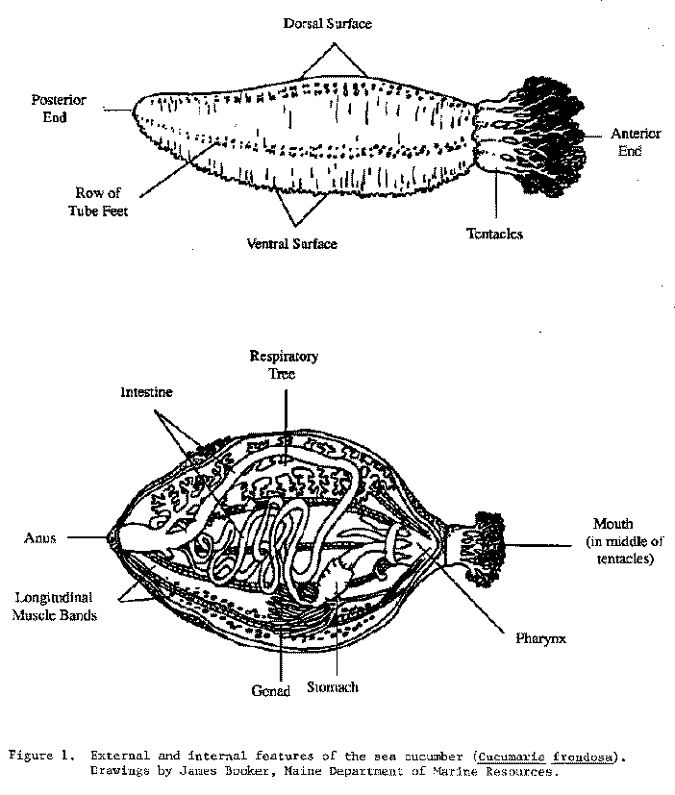
SEA CUCUMBERS:
Sea Cucumbers ARE EDIBLE Raw, boiled, stewed, or fried. This easily
recognizable organism so common along sea shore has a rough & flexible body
about 6" to 8" long when contracted & about twice that length when expanded.
The 5 long white muscles which are left after the insides have been
discarded & the slimy outer skin scraped away are what is used. Tastes like
clams.
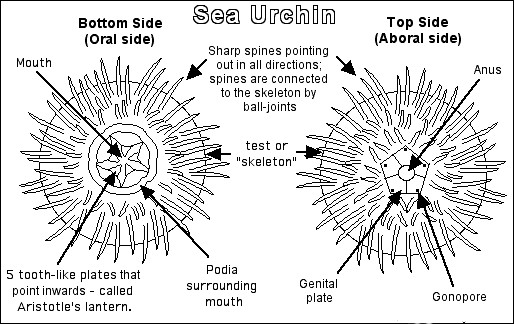
SEA URCHIN:
The Sea Urchin a marine animal related to Starfish is a main source of
food for many localities. Safe when found in the Temperate & Arctic waters
of this continent gathered at low tide. They are shaped like slightly
flattened balls & have a thin fragile shell that bristles with mobile spines. The lengths of eggs inside the top shell ARE
EDIBLE both Raw & Cooked.
WARNING: Unfortunately many EDIBLE Seaweeds and sea animals or fishes are now poisonous due to pollution & can not be eaten Raw! Yet survival is the key! The practice of sea dumping and lakes used as open sewers makes your future survival a harder survival, you therefore best to concentrate upon EDIBLE plants as well when possible.
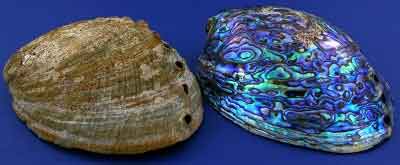
ABALONE:
It's a large rock-clinging Mollusk well known along the Pacific Coast of
N. America where hundreds at a time are found at low tides attached to
boulders & ledges. Occasionally found floating free in seaweed. Their
flattened shells which vary from black & green to red are fantastically
lined with Mother of Pearl. By abruptly inserting a long thin instrument
such as a sheath knife or nail or stick between the Abalone & the rock &
prying quickly! The Shell-fish can be detached usually with little trouble
before it has a chance to adhere more tightly. The operation otherwise
requires a heavier tool and considerable pressure. The Abalone can then be
levered from the shell which not infrequently has a diameter of 10" or so &
therefore considerable utility as a bowl. Or the shell can be cracked with a
rock & picked out. The hard white meat is what is retained. This may be
sliced in thin steaks & tenderized by pounding with the flat edge of a stone
then fried, broiled over open coals or diced & simmered into chowder.
OTHER FREE LUNCHES:
Any times you look for food, there will be in general the best promising
area are near water (far off cities). Piles of shells besides a creek may be
the clue for Clams that often can be seen in clear water or felt beneath the
bare feet. Salt water Clams although not so easily dug can be secured at low
tide. One indication of the bivalves presence being their elongated siphons
or the marks left by the withdrawals thereof. But along PACIFIC SHORES BELOW
THE ALEUTIANS; ALL dark portions of clams MUST be discarded for the 6 months
beginning with May & ending with October because of possible dangerous
concentrations of Toxic alkaloids in it, the white meat alone to be eaten.
SNAILS ETC.:
Snails, Scallops, Shrimps, Oysters, Eels, Lobsters are all EDIBLE.
Mussels can be safe to eat with one exception, if care is taken to
AVOID any
that don't close tightly when touched.
WARNING: The small bluish black Mussel found attached usually in clusters to seashore rocks becomes poisonous at certain time of the year on the Pacific Coast below the Aleutians. The poison being alkaloid CAN NOT be destroyed by heat. It is a result of a diet which includes venomous organism that drifts shore-ward from about the end of April through October. If there is any doubt whatsoever about when in any particular area these mussels are fit for food, they should be AVOIDED entirely. Lately we have seen many cases of poisonous Mussels from the East to West Coast of N. America due to pollution.
CRABS:
They are all good. They can usually be immobilized with a stick for a
long enough period for one either to crush them or reach behind and pick
them up. They will attach themselves readily to flesh lowered on a line.
Although salt water varieties may be eaten Raw, land crabs are often
infected with parasites & MUST be dropped into boiling water for at least 20
min.
TURTLES:
Turtles fat gives a clear savory oil, which is so nutritious that this
reptile is AN UNUSUALLY VALUABLE FOOD SOURCE. Blood & juices are often used
to relieve thirst. Its sometimes possible to back track a female to a fresh
nest of eggs, generally buried in sand or mud close to water. Those eggs are
very nourishing. Turtle can be killed by concussion (hitting) or
decapitation. Care MUST be taken even after it is dead to AVOID both jaws &
claws. If possible the Turtle can be scalded for several minutes by being
dropped into
boiling water. The under shell may then be quartered & the entrails removed
whereupon the meat can readily be simmered free of the upper shell.
Common Snapping Turtles:
Catching, Cleaning, Eating or save it to your hard drive as a
PDF file
How to Clean a Snapping Turtle

CLEANING FISH:
Fish can be slit from vent to throat & the viscera removed easily &
cleanly. Many like to scrape away the blood vessels & kidneys which form
dark lines next to the back bone.If the fish has scales, it can be held by
the tail using a stick or a nail to hold it in place, for it is very
slippery, then you scrape it off using the back of a knife of something
similar. You may not want to bother with the head, tail & fins of small fish
except to eat around them, for bones will then hold together better & less
of a nuisance. Furthermore a few choice titbits will thus be saved otherwise
wasted. If you ever have a number of heads, you may care to find out by
essaying a chowder with them, for they are regarded by many as the most delicious part
of the fish. To skin off fish; start from tail upward.
MAKESHIFT FISHING:
Just because you don't happen to have a hook & a line it doesn't mean
that you can't catch fish. Unravel a bit of sweater for example then tie on
a small strip of bright cloth ex; the corner of a shirt will do. When the
fish closes his mouth over the cloth, give the line a tug. There are good
chances that you will flip the fish on the bank or in the boat or raft. It
does not ALWAYS work of course but fish don't take regular bait either. As
matter of fact; Fishermen on East coast use pieces of bright (Skipping rope)
which they slide onto their hooks to attract fishes, it works real good.
HOOKS MADE ON THE SPOT:
You can invent any number of different types of hooks. A bent pin really
works as many youngsters have learned. The only trick is to maintain
pressure so that the fish wont slip off. An open safety pin is a bigger
model. Bent nails have been used with considerable
success. Therefore the hooks can be made out of any workable material of
sufficient rigidity. You can also cut hooks from wood preferably hard &
tough. Whittle out the shank first. Lash one or more sharp slivers so that
they slant upward from the lower end. You can even add a barb by lashing
another sliver even more acutely downward from the top. Thorns if available
can be used. Fish bones too can be used as points and barbs.
PRIMITIVE FISHING DEVICES:
One of the most primitive fishing devices still used successfully if not
sportingly; is made by tying the line to the middle of a small fish & use it
as a bait.
SALTWATER FISH:
Provided the fish have the usual appearance of fish and have scales &
the conventional shape of fish you can say that it is safe to eat & has no
poison in the flesh. If the creature does not have the usual "fish shape"
and does not have scales then regard it as poisonous unless certain it is
safe. Ex: The Shark which has no scales. The flesh of Shark is safe to eat
but Beware of the innards. Shark liver has a high concentration of vitamin
D, fried liver may be fatal.
EEL & RAYS:
Flesh of Eels is also good to eat. So are Rays good eating. Yet under no
circumstances should you eat the innards.
CAUTION DO NOT EAT:
The Puffer or Toady, the Box Fish, the Pig fish and Leather Jacket are
ALL POISONOUS. The Color of the flesh is NO indication of the presence of
poison in the flesh, ex: Parrot-Fish or Mackerel have green color yet GOOD
TO EAT.
SHELLFISH:
All bivalves are free from toxic poisons except for the reputed poison
in the saltwater Mussels at certain period of the year and the flesh of all
is safe to eat unless taken from contaminated waters. This is unfortunately
more and more frequent. This also applies to freshwater Shellfish which host
many parasites harmful to man. Actually NO freshwater Shellfish should be
eaten unless you are way out in the bushes near a lake or river of which you
know there is no town near by. Then those shellfish should be well cooked to
destroy any possible parasites and their eggs. We repeat NO freshwater shell
fish ARE EDIBLE when close to cities, towns, due to sewage etc.
BIVALVES:
When unpolluted are found all along coastal sea beaches and make an
excellent meal. 12-18 bivalves make a good feed for one person. To cook put
the bivalves into a billy and pour boiling water over them. The bivalve will
open and the fish itself can be easily removed from the 2 shells. The fish
MUST be washed many times in fresh water to remove all sand and then boiled
in fresh water. You can add milk and thickening after boiling for 10 min.
(Use also dried milk.) Before cooking the flesh can be cut into small
pieces. After 10 minutes boiling add thickening and salt to taste.
OYSTERS:
They are eaten Raw of course or maybe cooked & served as soup. Oysters
ARE EDIBLE & safe all year round.
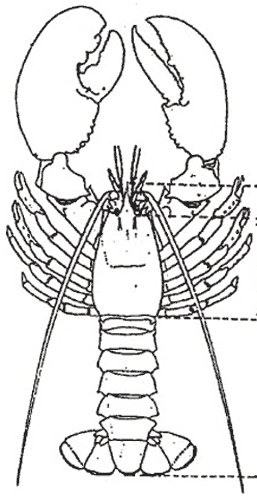
CRUSTACEANS:
All crustaceans are safe to eat and free from toxic poisons. But
freshwater Crayfish and #Yabbies# are subjected to parasite infestations
harmful to man. Their flesh MUST be EXTREMELY well cooked as a safety
measure. (None from nearby town ARE EDIBLE.) When we say fit to eat we ALWAYS refer to those away from
civilization. Crustaceans are usually boiled but it is also practical to
simply kill the creature and wrap the Shellfish in either an old wet
newspaper, a ball of clay or large green leaves such as banana or palm
leaves. The wrapped shellfish is then placed deep IN the hot ashes of a
fire. Be sure you place it IN the ashes and not ON the surface coals. Cover
the bundle completely and leave for 6 to 12 hours. The food will not have
dried nor burn but cooked great.
OCTOPUS AND GASTROPODS:
The flesh on the tentacles of all the Octopus & Gastropods (Octopus,
Cuttlefish etc.) IS EDIBLE but many are EXTREMELY tough and rubbery. Octopus
flesh taste like Lobsters. To cook, beat the Octopus tentacles and boil in
very hot oil 10-15 minutes. CAUTION: One small species of Ringed Octopus 4" to 6" long has been known to give
Fatal stings.
CRABS CAPTURED AT NIGHT:
The nights frequently proved more productive than the days. Many
terrestrials and aquatic creatures move around only after dark. So it is for
the giant coconut crab and spiny lobsters, if you want them then be ready
for the night shift fishing.
CLAY FISH COOKING:
Coating the fish with clay and grass and lay them on coals. Diners;
break off the hard shell 1/2 hour later and find that the fish has lost none
of its natural juice.
GIANT CLAMS OF THE PACIFIC:
#Hypopus clams# are found on reef, you remove the content, the large
abductor muscle which has a plant like taste and make it boil in their own
shells which you use as a shell for plate.
FISHING TIP:
Place your gill net at the bottle neck of lake or stream, creeks for
better fishing. Also you can do the chilly art of stirring the mud of beaver
ponds with your feet and with bare hand, catch trout as they are blinded by
the muddy water.
SMOKING TROUT INDIAN STYLE 1930:
They would use a big flower barrel, covered by a makeshift strainer
or by a bag and a series of stick. The trout were hanged by the tail well
cleaned off, and maintained open using fine little sticks stuck in the skin
inside the abdomen. The head was kept on. They would choose trout about 6 to
8" as the best. (15-20cm). First they would soak them in a light brine for
one night. They would use rotten wood stump (Birch) for the smoke. They
would install a stove pipe of 7"(18cm) wide in the moss and 4 to 6m long
(15-20') along a slope up trench to the barrel. They would light the fire at
the bottom entry of the pipe. The draft was sufficient to drive the
smoke upward, they say that it is important for them that the smoke be cool
when reaching the smoking barrel. A good Northwest wind was the best to dry
the fish and smoke them faster. They would need 2 days to do the job but 6
days would give a better result. These trout would keep up to a month after which they loose their taste.
FROZEN FISH & FROZEN MEAT:
As soon as you have caught the fish, then gut them out and, let them
freeze on the ice so that it keeps its freshness. Now you have food for a
long time and the best way to eat it is Raw and frozen, it tastes Delicious!
With the frozen fish that you eat you will not notice the warmth right away
as if you had eaten hot rice but after 20 minutes then you will feel its
warmth and it will last for several hours. As for the frozen and Raw meat
beside having its top in vitamin values you also can eat enormous quantities
when frozen.
As for the meat that has spoiled this taste is acquired with time this
wouldn't apply in hot climate as in the arctic regions.
DRYING FISH:
Preserve fish as biltong. Cut off heads and tails and gut. Split open.
Remove back bone and lay on hot sun-baked rocks. Score inner flesh to speed
up drying. Small fish under 7.5cm (3in) long need not to be gutted. Fish can
also be smoked. They should be opened out, but it will be easier to hang if
cleaned and gutted without removing the backbone, head or tail. Suspend by
one side of the head.
DRIED FISH:
Fish can sun-dry as meat yet it's ESSENTIAL to dry them quickly and if
the day is not hot and dry then smoke them thoroughly over the fire. If you
can. If the flesh is flaky & can not be cut into strips, heat flat smooth
stones and lay the slices of flesh on these and place in the sun to dry out
completely. Turn the slices frequently. Fish meat is easily powered into
Fish Pemmican and can be cooked either by making into fish cakes or by
soaking if in strips and then fried in batter.
SMOKING FISH:
By keeping the fish strips in the smoke continuously until they are
completely dry you have smoke fish and Very Good too. The best smoke for
this is a thin blue smoke & definitely not a heavy white smoke. Same
warnings about NEVER use green leaves or evergreen.
TURTLES:
Boil turtles and tortoises until the shell come off. Cut up the meat &
cook until tender. Alternatively, you can toss them directly on the fire and
roast until the shell becomes brittle.
SHARK MEAT:
Has a bad taste unless correctly cooked. Cut into small cubes and soak
overnight in fresh water. Boil in several changes of water to get rid of the
ammonia flavor.
SHELLFISH:
Crabs, lobsters, & shrimps, crayfish, prawns & so forth are safer boiled
since they may contain harmful organisms. ALL SEAFOOD SPOILS QUICKLY & MUST
BE COOKED AS SOON AS POSSIBLE, ESPECIALLY IN HOT CLIMATES. Drop into boiling
salted water for 10 minutes. If you are sure the food is fresh, a clambake
is delicious way to prepare mussels, clams and similar creatures. Dig a hole
in the sand and light a fire along side with stones on top. When the stones
are hot place them in the hole, put shells on top and cover with wet seaweed
or grass, then a 10cm (4in) layer of sand. The hole will develop a lot of
steam which cooks the mollusk.
STEAMING: IT DOES NOT OVERCOOK
SO IT PRESERVES ALL NUTRITIONAL VALUES. (ESSENTIAL in Survival) It is an
excellent way of cooking fish and green vegetables.
Please Read The Website
Disclaimer!
Copyright 1986-2012, The Survival & Self-Reliance Studies Institute (SSRsi), All
Rights Reserved
Site conceptualized, designed, created & maintained by MEG Raven
Snail Mail: SSRsi, PO Box 2572 Dillon, CO. 80435-2572