




















Found a good "North American History 1950-2000 AD" link? Let Us Know!
1950s Germanium is used to make semiconductors in transistors. Late in the 1950s, silicon begins
to replace germanium as a semiconductor material.
1950s Rectangular cathode-ray tube perfected.
(Radio and Television)
1950s
Walter Sohne develops the theoretical basis for soil traction mechanics,
important in the design of tractors and tillage implements
(Agricultural Mechanization)
1950s
Police began using traffic radar. (Imaging)
1950s
Charles Huntnagel pioneers prosthetic heart valves.
(Health Technologies)
1950-55 Koppers-Totzek
gasifier introduced. (Petroleum and
Petrochemical Technologies)
1951: UNIVAC 1The Eckert and
Mauchly Computer Co. of Philadelphia sells the first commercial computer, the
UNIVAC 1, to the U.S. Census Bureau. The memory called up data by transmitting
sonic pulses through tubes of mercury. An additional 45 UNIVAC 1 machines would
eventually be sold.
1951
- Defense of Greenland: Agreement Between the United States and the Kingdom of
Denmark, April 27
1951
- Defense of Iceland: Agreement Between the United States and the Republic of
Iceland, May 5
1951
- Mutual Defense Treaty Between the United States and the Republic of the
Philippines; August 30
1951
- Security Treaty Between the United States, Australia, and New Zealand (ANZUS);
September 1
1951
- Military Facilities in the Azores: Agreement Between Portugal and the United
States, September 6
1951
- Security Treaty Between the United States and Japan; September
1951
- Military Assistance Agreement Between the United States and Yugoslavia,
November 14
1951 Experimental
Breeder Reactor 1 (EBR-I) produces the world's first usable amount of
electricity from nuclear energy. (Nuclear
Technologies)
1952
- Richard M. Nixon, Television Address. 23 September 1952 [The
"Checkers" speech]
1952 The
first database is implemented on RCA's Bizmac computer. (Computers)
1952 Admiral
Grace Hopper develops the first computer compiler, leading to the creation of
user-friendly languages and opening the door to a larger universe of computer
applications and users. (Computers)
1952 Federal-Aid
Highway Act authorizes the first funding specifically for system construction
(Highways)
1952 Basic
oxygen process refines steel making.
(High-performance Materials)
1953: Heart-lung Machine Dr.
John H. Gibbon performs the first successful open heart surgery in which the
blood is artificially circulated and oxygenated by a heart-lung machine. This
new technology, which allows the surgeon to operate on a dry and motionless
heart, greatly increases surgical treatment options for heart defects and
disease.
1953
- Military Facilities in Spain: Agreement Between the United States and Spain,
September 26
1953
- Mutual Defense Treaty Between the United States and the Republic of Korea;
October 1
1953 Karl
Zeigler invents new process for producing polyethylene.
(High-performance Materials)
1953 Dacron,
plasticized PVC, and silicones manufactured by Dow Corning.
(High-performance Materials)
1953
Corvette becomes the first car whose body is made of fiberglass-reinforced
plastic. (Automobile)
1953 Image
intensification, Coltman. (Imaging)
1953-55 Three
Boiling Reactor Experiment (BORAX) reactors are built at the Idaho National
Engineering and Environmental Laboratory.
(Nuclear Technologies)
Brown
v. Board of Education 1954
1954
- Dwight D. Eisenhower, "State of the Union"
1954
- Brown vs. Board of Education- [ended "Separate But Equal
Doctrine"]
1954
- Agreement on the Cessation of Hostilities in Viet-Nam, July 20
1954
- Southeast Asia Collective Defense Treaty (Manila Pact); September 8
1954
- Protocol to the Manila Pact, September 8
1954
- Pacific Charter, September 8
1954
- Joint United States-Chinese Statement; December 1
1954
- Mutual Defense Treaty Between the United States and the Republic of China;
December 2
1954
- Exchange of Notes Between the Secretary of State and the Chinese Minister of
Foreign Affairs, December 10
1954 United
States launches the U.S.S. Nautilus, the world's first nuclear-powered
submarine. (Nuclear Technologies)
1954 The second Atomic Energy Act is passed by the U.S. legislature.
(Nuclear Technologies)
1954 Arco, Idaho, population 1200, becomes the world's first community to have all
electrical power provided by nuclear energy.
(Nuclear Technologies)
1954 First human kidney transplant, Edward Donnal Thomas.
(Health Technologies)
1954 James S. Robbins built first tunnel-boring machine.
(Water Supply and Distribution)
1954 The transistor radio is introduced and becomes the largest selling item of the
time (Electronics)
1954 Regular broadcasts of color television. (Radio and
Television)
1954 Gene Amdahl develops the first computer operating system for the IBM 704.
(Computers)
1954 Submersible mobile drilling unit operates in Gulf of Mexico for shallow water installations.
(Petroleum and Petrochemical Technologies)
1955: Nuclear Submarine The Nautilus, the
first nuclear submarine, revolutionizes naval warfare. Conventional submarines
need two engines: a diesel engine to travel on the surface and an electric
engine to travel submerged, where oxygen for a diesel engine is not available.
The Nautilus, the first nuclear sub, can travel many thousands of miles below
the surface with a single fuel charge.
1955
- Dwight D. Eisenhower, "State of the Union"
1955 First
jack-up oil drilling rig designed.
(Petroleum and Petrochemical Technologies)
1955 Reynold
Johnson develops the first disk drive. (Computers)
1955
French Citroen introduces revolutionary gas suspension system. Its brakes,
transmission, and steering are all power-assisted.
(Automobile)
1955 Modem
first described by Ken Krechmer, A. W. Morten, and H. E. Vaughn. (Telephone)
1955 Domestic
deep freezer. (Household Appliances)
1955 Polypropylene
(petroleum-based). (High-performance
Materials)
1956
= Dwight D. Eisenhower, "State of the Union"
1956 Construction
of the interstate highway system is launched
(Highways)
1956 Highway
Revenue Act creates the Highway Trust Fund as a dedicated source for the
interstate system. (Highways)
1956 Plastic
contact lenses developed by Norman Bier.
(Health Technologies)
1957: Polio Vaccine Dr. Albert Sabin
develops a polio vaccine using strains of polio too weak to cause infection but
strong enough to activate the human immune system. His invention will put an end
to the polio epidemics that have crippled thousands of children worldwide.
1957
- Dwight D. Eisenhower, Second Inaugural
1957
- Dwight D. Eisenhower, "State of the Union"
1957 First
externally worn, battery-powered pacemaker developed by Earl Bakken Robert
Jarvik, and C. Walton Lillehie. (Health
Technologies)
1957 Blood-heat
exchanger developed by Duke University, GM, and SUNY Buffalo.
(Health Technologies)
1957 FORTRAN
becomes commercially available. (Computers)
1957 Sputnik
I is launched by liquid-fueled rocket built by Sergei Korolev.
(Spacecraft)
1957 Scintillation
camera, Anger. (Imaging)
1957 Spin
clothes dryer. (Household Appliances)
1957 Charles
Townes, James Gordon, and Herbert Zeiger develop first maser.
(Laser and Fiber Optics)
1957 The
International Atomic Energy Agency is formed with 18 member countries to promote
peaceful uses of nuclear energy. Today it has 130 members.
(Nuclear Technologies)
1957 First
U.S. large-scale nuclear power plant begins operation in Shippingport, Penn.
(Nuclear Technologies)
1958: Explorer I Three months after the
Soviet Union began the Space Age by launching Sputnik, the U.S. responds by
sending the Explorer I satellite into orbit. Explorer I's mission is to detect
radiation; it discovers one of the Van Allen radiation belts.
International
Relations. 1958-60, Volume X, Part 1, Eastern Europe Region; Soviet Union;
Cyprus
1958
- President Eisenhower's Address on Little Rock
1958
- Dwight D. Eisenhower, "State of the Union"
1958 Arthur
Schawlow develops working principles of laser.
(Laser and Fiber Optics)
1958 Schawlow
and Townes publish paper on laser. (Laser
and Fiber Optics)
1958
Jack Kilby of Texas Instruments invents the integrated circuit (IC).
(Electronics)
1958 Jack
Kilby of Texas Instruments and Robert Noyce of Fairchild Semiconductor
independently develop the integrated circuit (IC). (Computers)
1958
Robert Noyce develops an integrated circuit that can be miniaturized and
reliably manufactured (Electronics)
1958
Seymour Cray at Control Data Corp. develops a transistorized computer
(Electronics)
1958 ALGOL
computer language, a high-level language designed specifically for programming
scientific computations, comes into use.
(Computers)
1958 AT&T
introduces datasets (modems) for direct connection. (Telephone)
1958 Texas
Instruments introduces the silicon-based transistor.
(Telephone)
1958 The
U.S. launches Explorer 1, signaling the beginning of the space program. (Spacecraft)
1958 President
Dwight D. Eisenhower saw need for the Advanced Research Projects Agency (ARPA)
to keep the U.S. at the forefront of technology. (Internet)
1958 Ultrasound.
(Imaging)
1959
- Dwight D. Eisenhower, "State of the Union"
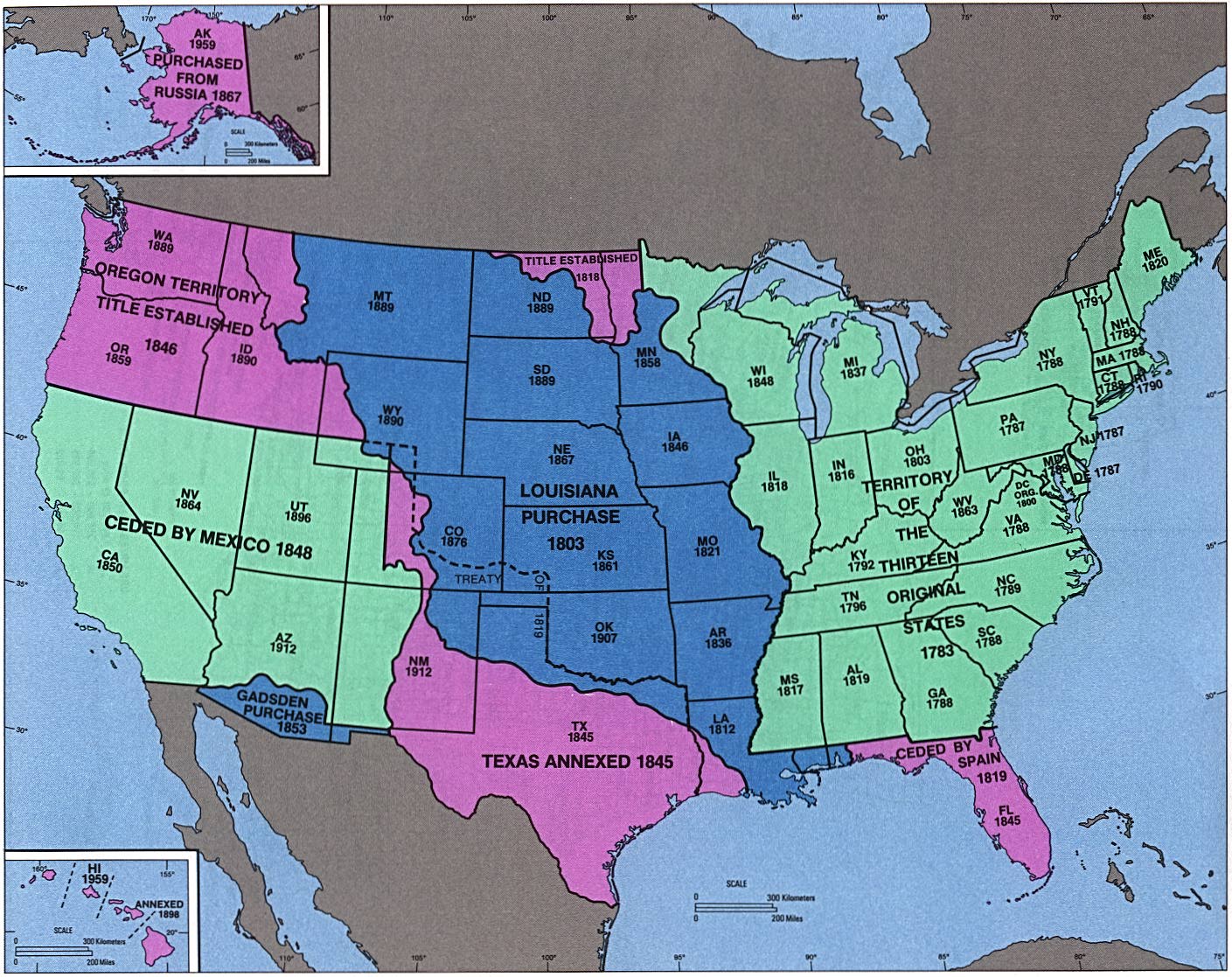
Growth
of the United States to 1959 - Map
1959 COBOL
computer language is created. (Computers)
1959 AT&T
introduces the TH-1 1860-channel microwave system
(Telephone)
1959 Russian
lands a Luna probe on the moon and takes the first pictures of its far side.
(Spacecraft)
1950-60s
Eugene McKibben conducts theoretical and applied research in the soil dynamics
of plows and other tillage equipment, and directs the USDA research programs in
mechanization (Agricultural
Mechanization)
1960: Laser Working
at Hughes Research Laboratories, physicist Theodore H. Maiman creates the first
laser. The core of his laser consists of a man-made ruby -- a material that had
been judged unsuitable by other scientists, who rejected crystal cores in favor
of various gases.
1960
- Dwight D. Eisenhower, "State of the Union"
1960 OPEC
founded. (Petroleum and Petrochemical
Technologies)
1960
Private car ownership reaches 1 car for every 31 people in the world; 1 for
every 22 in Europe, and 1 for every 3 in the United States, where 15% of
families have more than one car.
(Automobile)
1960 AT&T
installs first electronic switching system
(Telephone)
1960 Radionuclide
generator, Richards. (Imaging)
1960 First
totally implanted pacemaker. (Health
Technologies)
1960s
Solid
state imaging devices first demonstrated. (Radio and Television)
1960s
Use
of radar in air traffic control. (Imaging)
1960s
Doppler
radar. (Imaging)
1960s
Charles
K. Kao is the first to publicly propose the possibility of a practical
application for fiber-optic telecommunication. (Laser and Fiber Optics)
1961
- John F. Kennedy, Inaugural Speech (text)
1961
- John F. Kennedy, Inaugural Speech, 20 January [Audio - RealPlayer]
1961
- Dwight D. Eisenhower, Farewell Address
1961
- Cuban Missile Crisis October
[The Avalon Collection of documents on the Cuban Missile Crisis numbers 275,
dated from October 1 1961 to January 26 1963. The first few of these follow:]
More Documents on the Cuban Missile Crisis
John F. Kennedy
Letter
from President Kennedy to President Diem, December 14, 1961
1961 Bell
Telephone Labs releases design information for touch-tone dial to Western
Electric (Telephone)
1961
Silicon chips first appear (Electronics)
(Computers)
1961 Russian
Yuri Gagarin orbits Earth one time.
(Spacecraft)
1961 Alan
Shepard is launched 115 miles into space, lands 15 minutes later in Atlantic
Ocean. (Spacecraft)
1961 Smaller
freezers with front doors introduced, more suitable for home kitchens.
(Household Appliances)
1961 First
semiconductor laser, Robert Hall. (Laser
and Fiber Optics)
1961 Superpolymers
(heat resistant). (High-performance
Materials)
Marilyn
Monroe (1962)
1962
Mechanical raise-borer enabled engineers to significantly decrease the amount of
time to bore through 200 feet of earth. (Water
Supply and Distribution)
1962 AT&T
introduces T-1 multiplex service in Skokie, Illinois
(Telephone)
1962 First
minicomputer comes into use. (Computers)
1962 Telephone
cables start to use plastic insulation
(Telephone)
1962 Paul
Baron introduces idea of distributed packet-switching networks
(Telephone)
1962 John
Glenn orbits Earth three times in a Mercury capsule, Friendship 7.
(Spacecraft)
1962 Mariner
2 flies past Venus, the first probe to fly beyond another planet. (Spacecraft)
1962 Leonard
Kleinrock invents packet-switching technology. (Internet)
1962 First
nuclear-powered surface ship, N.S. Savannah, put to sea.
(Nuclear Technologies)
1962 First
advanced gas-cooled reactor is built in England.
(Nuclear Technologies)
1963
- Martin Luther King, I Have a Dream, August 28
1963
- Robert C. Weaver, "The Negro as American"
1963
- Gideon v. Wainwright [Supreme Court Decision establishing the defendant's
right to counsel]
Martin
Luther King's "I have a dream" speech - August 28, 1963
1963 Steam-or-dry
electric iron. (Household Appliances)
1963 Douglas
Englebart, SRI, patents the idea of the computer mouse.
(Computers)
1963 RL-10
rocket engine, the world's first high-energy liquid hydrogen engine.
(Spacecraft)
1963 Valentina
Tereshkova, Soviet cosmonaut, becomes the first woman in space.
(Spacecraft)
1963 The
first communications satellite to reach synchronous orbit, Syncom II, is
launched. (Spacecraft)
1963 J.C.R.
Licklider, head of computer research at ARPA, articulates vision of worldwide
network. (Internet)
1964: Operating System IBM rolls out the
OS/360, the first mass-produced computer operating system. Using the OS/360, all
computers in the IBM 360 family could run any software program. Already IBM is a
giant in the computer industry, controlling 70% of the market worldwide.
Lyndon
B. Johnson
Foreign Relations Documents Of the Johnson Administration
1964
- The Tonkin Gulf Incident: President Johnson's Message to Congress, August 5
Tonkin
Gulf Resolution
Speech
by George C. Wallace, The Civil Rights Movement: fraud, sham and hoax,
1964
1964
- George C. Wallace, "The Civil Rights Movement"
1964
- Civil Rights Act; July 2
Barry
Goldwater's Acceptance of the 1964 Republican Presidential Nomination
Ronald
Reagan, Address on Behalf of Senator Barry Goldwater. "Rendezvous with
Destiny", October 27, 1964
1964 John
Kemeny and Thomas Kurtz develop the BASIC computer language. Intel Chairman
Gordon Moore suggests that integrated circuits would double in complexity every
18 months. This later becomes known as Moore’s Law and is applied to
microprocessor speed. (Computers)
1964 First
space walk, U.S. Gemini program.
(Spacecraft)
1964 Acrylic
paint. (High-performance Materials)
1964 Carbon
fiber (used to reinforce materials in high temperature environment).
(High-performance Materials)
1964 Beryllium
(hard metal) developed for heat shields in spacecraft, animal surgery, aircraft
parts, etc. (High-performance Materials)
1965: Minicomputer Digital
Equipment introduces the PDP-8, the world's first computer to use integrated
circuit technology. Because of its relatively small size and its low $18,000
price tag, Digital sells several hundred units.
President
Johnson on the Watts Riots
1965
- Lyndon B Johnson: We Shall Overcome, 15 March
1965 Digital
Equipment Corp. (DEC) introduces PDP-8 minicomputer. (Computers)
1965 Early
Bird is launched for use by communications services.
(Spacecraft)
1965 Gemini
spacecraft makes first rendezvous in space between two spacecraft.
(Spacecraft)
1965-69 U.S.
gas shortage threatened due to lack of financial incentives for exploration.
(Petroleum and Petrochemical Technologies)
1966
Electronic fuel injection system is developed in Britain.
(Automobile)
1966 The
Advanced Testing Reactor at the Idaho National Engineering and Environmental
Laboratory begins operation for materials testing and isotope generation.
(Nuclear Technologies)
1967
Pontiac develops safer car bumpers that absorb some of the energy of an impact
or collision. (Automobile)
1967
First handheld calculator using an integrated circuit is made by Texas
Instruments.
1967 Larry
Roberts publishes a paper proposing the ARPAnet network. (Internet)
1967 Pilot
plant built for extraction-hydrogenation process to produce synthetic oil.
(Petroleum and Petrochemical Technologies)
1968
- Agreement on the Rescue of Astronauts, the Return of Astronauts and the Return
of Objects Launched into Outer Space, April 2
Agreement
on the Rescue of Astronauts, the Return of Astronauts and the Return of Objects
Launched into Outer Space, April 22
1968
- Treaty on the Non-Proliferation of Nuclear Weapons
1968
Robert Noyce co-founds Intel.
(Electronics)
1968 200
million televisions worldwide. (Radio and
Television)
1968 DOD
initiates the ARPAnet development. (Internet)
1969: Moon Landing Millions
watch worldwide as the landing module of NASA's Apollo 11 spacecraft touches
down on the moon's surface and Neil Armstrong becomes the first human to set
foot on the moon. President John F. Kennedy, who vowed to the world that the
United States would put a human on the moon before 1970, has not lived to
witness the moment.
Richard
M. Nixon
1969 PASCAL computer language. (Computers)
1969 ARPAnet
unveiled at UCLA. (Internet)
1969 The
Zero Power Physics Reactor goes operational at Argonne National Laboratory-West
in Idaho. (Nuclear Technologies)
1970: Optical Fiber Corning
Glass announces it has created a glass fiber so clear that it can communicate
pulses of light. GTE and AT&T will soon begin experiments to transmit sound
and image data using fiber optics, which will transform the communications
industry. Robert Maurer leads a team at Corning.
1970
The bar code system is created.
(Electronics)
1970 AT&T
introduces its ESS#2 electronic switch. (Telephone)
1970 Bell
Labs releases design information to Western Electric for modular telephone cords
and jacks (Telephone)
1970 Emission
tomography, Kuhl. (Imaging)
1970 Sialon
(ceramic material for high-speed cutting tools in metal machining).
(High-performance Materials)
1970s
Realtime, gray-scale ultrasound, Kossoff. (Imaging)
1970s
Earth-observing satellites begin to use radar to measure Earth's topography. (Imaging)
1971
- New York Times vs. The United States [The "Pentagon
Papers" trial]
1971
- Vietnam Veterans Against the War Statement by John
Kerry to the Senate Committee of Foreign Relations April 23
1971Intel introduces its popular 4004 4-bit microprocessor, starting the evolution
of Intel’s famous line of 386, 486, and Pentium processors (Electronics)
1971First video game and video disc introduced.
(Electronics)
1971 Intel introduces its popular 4004 4-bit microprocessor, starting the evolution of
Intel’s famous line of 386, 486, and Pentium processors.
(Computers)
1971 Earth-orbiting space station, USSR. (Spacecraft)
1972: Video Game Pong, one of the first
mass-produced video games, has become the rage. Noland Bushnell, the 28 year-old
inventor of Pong, will go on to found Atari.
1972
Richard M. Nixon and H. R. Haldeman. Conversation at the White House, 23 June
(text) [The "Smoking Gun" tape]
1972
Richard M. Nixon and H. R. Haldeman. Conversation at the White House, 23 June
[Audio - RealPlayer: The "Smoking Gun" tape]
1972 E-mail
introduced by Ray Tomlinson. (Internet)
1972 X-ray
computed tomography, Hounsfield. (Imaging)
Roe
v. Wade (1973) [Majority opinion in landmark
decision on abortion]
1973
Richard M. Nixon, Second Inaugural Speech
1973 Richard M. Nixon, Peace With Honor, 23 January
1973
War Powers Act, November 7
1973
- Richard M. Nixon. First Watergate Speech
1973
- Watergate tapes: President Richard M. Nixon Watergate tapes President counsels
Dean on possible testimony. March 17 [Audio - Real Player
1973
- Watergate tapes: President Richard M. Nixon Watergate tapes. Haldeman tries to
convince the President he will survive this crisis, March 20 [Audio - Real
Player
1973
- Watergate tapes: President Richard M. Nixon Watergate tapes. Dean advises the
President about Hunt's involvement; attempt to shield the President from any
wrong-doing, March 21 [Audio - Real Player
The
United States v. Nixon [limitation of "executive privilege"]
1973
- ROE V. WADE, 410 U.S. 113 [decriminalized abortion]
Richard
M. Nixon, Second Watergate Speech, August 15, 1973
1973 Oil
embargo created by cut in OPEC oil supplies.
(Petroleum and Petrochemical Technologies)
1973 Xerox
develops first Ethernet Local Area Network (LAN) technology. (Computers)
1973 Skylab
is placed in orbit. (Spacecraft)
1973 Computerized
tomography (CAT scan). (Health
Technologies)
1974: Barcode The
first shipments of bar-coded products arrive in American stores. Scanners at
checkout stations read the codes using laser technology. The hand-punched
keyboard cash register takes one step closer to obsolescence.
Articles
of Impeachment. House of Representatives Committee on the Judiciary. July 27
1974
Richard
M. Nixon, Resignation Speech, August 8 1974
Gerald
R. Ford's Remarks on Taking the Oath of Office as President, August 9, 1974
Richard
M. Nixon, Farewell Address to his Staff, August 10, 1974
1974
- President Gerald R. Ford's Remarks on Signing a Proclamation Granting Pardon
to Richard Nixon, September 8
President
Gerald R. Ford's Proclamation 4311, Granting a Pardon to Richard Nixon,
September 8, 1974
1974 John
MacChesney and colleagues at Bell Labs develop the modified chemical vapor
deposition process. (Laser and Fiber
Optics)
1974 Alberta
tar sands synthetic fuel project starts.
(Petroleum and Petrochemical Technologies)
1974 John
MacChesney introduces an alternative synthesis process leading to low
contamination and precise index of refraction profiles.
(Laser and Fiber Optics)
1974 Atomic
Energy Commission splits into the Energy Research and Development Administration
and the Nuclear Regulatory Commission.
(Nuclear Technologies)
1974-1977
National Security Study Memoranda and Decision Memoranda
1975: Microsoft Old
high school friends Bill Gates and Paul Allen form a partnership known as
Microsoft to write computer software. They sell their first software to Ed
Roberts at MIT, which has produced the Altair 8800, the first
microprocessor-based computer. Gates soon drops out of Harvard.
Gerald
Ford
1975 First
non-experimental fiber-optic link installed in Dorset (UK) police
communication system. (Laser and Fiber
Optics)
1975 First
semiconductor laser operating continuously at room temperature.
(Laser and Fiber Optics)
1975-79 U.S.
natural gas deregulated and gas prices rise. (Petroleum and Petrochemical
Technologies)
1975 Last
manual telco switchboard in Maine is retired
(Telephone)
1975 Fiber
optics trials begin in U.S. and Europe
(Telephone)
1976: Super Computer Cray Research, Inc.
introduces its first supercomputer, the Cray-1, which can perform operations at
a rate of 240,000,000 calculations per second. Supercomputers designed by
Seymour Cray will continue to dominate the market; the Cray 2, marketed in 1985,
will be capable of 1,200,000,000 calculations per second.
1976 Mars
space probes, NASA's Viking I and Viking II, launched.
(Spacecraft)
1976 Rotary
and tine separator combines. (Agricultural
Mechanization)
1976 Steve
Jobs and Steve Wozniak form the Apple Computer Company. (Computers)
1976 Alan
Shugart, IBM, invents the 5.25-inch floppy.
(Computers)
1976 Singer
electronic sewing machine that dials up to 25 preset stitches, self-winding
bobbin. (Household Appliances)
1976 Bell
Labs field tests multimode fiber-optic system at its Norcross, Georgia plant.
(Laser and Fiber Optics)
Jimmy Carter
1977 General
Telephone and Electronics begins first trial of 6Mbit/s fiber-optic link
carrying live telephone traffic in Long Beach, California
(Laser and Fiber Optics)
1977 Bell
system starts testing 45 Mbit/s fiber link in downtown Chicago phone system.
(Laser and Fiber Optics)
1977 Chicago
has the first commercial fiber-optic communications system.
(Laser and Fiber Optics)
1977 U.S.
Space Shuttle program begins.
(Spacecraft)
1978
1979: Human-Powered Flight Cyclist
Byron Allen crosses the English Channel in a pedal-powered aircraft called the
Gossamer Albatross. The flight takes 2 hours, 49 minutes, and wins a
[sterling]100,000 prize for its crew, headed by designer Dr. Paul MacCready.
Constructed of Mylar, polystyrene, and carbon-fiber rods, the Albatross has a
wingspan of 93 feet 10 inches and weighs about 70 pounds.
1979
Direct-Injected Stratified Charge (DISC) engine is developed.
(Automobile)
1979
Mattel Toy Company receives 1 millionth chip for electronic games
(Electronics)
1979 Dan
Bricklin introduces the Visicalc spreadsheet. (Computers)
1979 Three
Mile Island accident. (Nuclear
Technologies)
1980
Voice prompts are first used in the Datsun 810.
(Automobile)
1980 Philip
Estridge, IBM, develops the first hard drive for PCs. It holds 10MB.
(Computers)
1980 AT&T
introduces the DataSpeed 40, forerunner of "smart terminals" with data
processing capability
(Telephone)
1980 Magnetic
resonance imaging, Lauterbur. (Imaging)
1980s
Miniaturized televisions. (Radio and
Television)
1980s
Integrated circuits applied to computers
(Electronics)
1980s
Microprocessors revolutionize household appliances.
(Household Appliances)
1981: Space Shuttle For
the first time, NASA successfully launches and lands its reusable spacecraft,
the Space Shuttle. The shuttle can be used for a number of applications,
including launch, retrieval, and repair of satellites and as a laboratory for
physical experiments. While extremely successful, the shuttle program will
suffer a disaster in 1986 when the shuttle Challenger explodes after takeoff,
killing all on board.
Ronald
Reagan
1981 32-bit
silicon chips developed (Electronics)
1981 IBM
introduces the PC. (Computers)
1981 Bell
Labs designs network-embedded database of Personal Identification Numbers (PINs)
for calling card customers to be accessed by public telephones.
(Telephone)
1981 Columbia
Space Shuttle, the first reusable winged spaceship, is launched.
(Spacecraft)
1982: Artificial Heart Dr. Robert Jarvik
implants a permanent artificial heart, the Jarvik 7, into Dr. Barney Clark. The
heart, powered by an external compressor, keeps Clark alive for 112 days.
1982 Tallest
giant oil platform for North Sea exploration built in Inverness, Scotland.
(Petroleum and Petrochemical Technologies)
1982 Caller
ID patent filed by Carolyn Doughty, Bell Labs
(Telephone)
1982 First
IBM-compatible PC clone is introduced by Columbia Data Systems. (Computers)
1982 William
C. DeVries surgically implants a permanent artificial heart designed by Robert
Jarvik. (Health Technologies)
1983: PC In
January "Time" names its 1982 "man" of the year -- the
personal computer. PC's have taken the world by storm, dramatically changing the
way people communicate. IBM dominates the personal computer market, benefiting
both from the production of its own machines as well as "clones"
produced by other companies.
1983 Apple
Computer introduces the Macintosh computer. Microsoft releases Microsoft Windows
1.0. (Computers)
1983 Soft
bifocal contact lens. (High-performance
Materials)
1984
Compact disc (CD) player introduced.
(Electronics)
1984
CD-ROM (compact-disc read-only memory) is available
(Electronics)
1985: Genetic Engineering The
USDA gives the go-ahead for the sale of the first genetically altered organism.
The rapidly growing biotech industry will seek numerous patents, including one
for a tomato that can be shipped when ripe.
1985 Soft
bifocal contact developed by Sofsite Contact Lens Laboratory.
(Health Technologies)
1985 Michele
Mirowski develops ventricular defibrillator.
(Health Technologies)
1986 In
France, Professor Benabid uses electrical stimulation to treat Parkinson's
patients. (Health Technologies)
1986 Chernobyl
accident. (Nuclear Technologies)
1986 Synthetic
skin. (High-performance Materials)
1987 Bellcore
introduces Asymmetric Digital Subscriber Line (ADSL) concept which has potential
of multimedia transmission over nation’s copper loops. (Telephone)
1987 Introduction
of erbium-doped fiber amplifiers. (Laser
and Fiber Optics)
1988: Graphic User Interface Apple
files a suit charging that Microsoft has pirated Apple's user-friendly graphical
interface. The suit will fail, and Microsoft's star will continue to rise. By
the mid 1990's, Apple will be experiencing a painful and public financial
shakeout.
1988 TAT-8
fiber-optic cable for telephone service laid.
(Laser and Fiber Optics)
1988 Albert
Gore, then a Tennessee senator, proposes the National Research and Education
Network, which would provide top computing facilities to research communities
and schools. (Internet)
George Bush
1990: Hubble Telescope The space shuttle
Discovery deploys the Hubble Space telescope 350 miles above the Earth. Although
initial flaws limit its capabilities, the Hubble will be responsible for
numerous discoveries and advances in the understanding of space.
1990
- Americans with Disabilities Act; July 26
Nelson
Mandela's speech upon release, 11 February 1990
1990s
Liquid crystal display panels (LCD), high definition television (HDTV).
(Radio and Television)
1990s
A network of over 130 Doppler radar stations is in place in the U.S. (Imaging)
1990s
The Magellan spacecraft maps most of the surface of the planet Venus. The
Cassini spacecraft carries radar instruments to study the surface of Saturn's
moon Titan. (Imaging)
1990s
The U.S. Naval Nuclear Propulsion Program pioneers new materials, including
uranium-dioxide fuels systems, the use of zirconium and its alloys, boron, and
hafnium, and develops material fabrication, radiological control, and quality
control standards. (Nuclear Technologies)
1990s
New composites and lightweight steel.
(High-performance Materials)
Civil
Rights Act of 1991
1991 Gopher
document retrieval system introduced at University of Minnesota. (Internet)
1992 The
World Wide Web is born, introduced by Tim Berners-Lee. The first audio and video
multicasts are broadcast over the Internet. (Internet)
Constitution
of the State of Maine [Codification of 1993]
Bill
Clinton
1993 The
Internet browser MOSAIC is introduced at the University of Illinois by Marc
Andreeson. (Internet)
1993 Telecom
Relay Service available for the disabled
(Telephone)
1994 Real Audio introduced to Internet which allows one to hear audio in near real time. Radio HK, first 24-hour Internet-only radio station, starts broadcasting. (Internet)
1995 Nationwide Caller ID implemented (Telephone)
1996 Telecommunications Act of 1996 deregulates data network transmission. (Internet)
1997 The
robotic explorer, Sojourner, lands on Mars.
(Spacecraft)
1997 Pioneer
10 spacecraft exits the solar system for interstellar space, and is still
functioning. (Spacecraft)
1997 Discovery
Shuttle mission with John Glenn aboard at age 77.
(Spacecraft)
Independent
Counsel's Report to the United States House of Representatives 1998
Monica Lewinsky Scandal
1998-1999 Impeachment and Trial of
President William J. Clinton II
1999 150
million users on the Internet. Over 800 million web pages accessible. (High-performance
Materials)
2000
George
W. Bush Inaugural Speech 2001
2001
- George Bush - Address to the Nation, September 11
George
W. Bush: Speech to Congress, September 20, 2001 [On
the evnts of September 11]
Full
Text of HR 3162 "The PATRIOT Act" 24 October 2001 [403 Kb]
George W. Bush. State of the Union 2002
George
W. Bush. State of the Union 2003 [Declaration of U.S. intentions toward
Iraq]
George
W. Bush. Address Announcing the End of Major Combat Operations in Iraq. 1 May
2003
Please Read The Website Disclaimer!
Copyright 1986-2012, The Survival & Self-Reliance Studies Institute (SSRsi), All
Rights Reserved
Site conceptualized, designed, created & maintained by MEG Raven
Snail Mail: SSRsi, PO Box 2572 Dillon, CO. 80435-2572